

Commercial property in Navi Mumbai, in 60 seconds
- Commercial pays more rent than residential. Where a flat yields roughly 2–3.5% a year, a well-let office, showroom or warehouse in Navi Mumbai can yield 6–9% — the single biggest reason investors move from residential to commercial once their portfolio matures.
- The location is structurally strong. A planned city, the MIDC industrial spine through Turbhe and Mahape, the Belapur CBD, the Airoli–Ghansoli IT belt and now the Navi Mumbai International Airport together make this one of the deepest commercial demand pools in the metropolitan region.
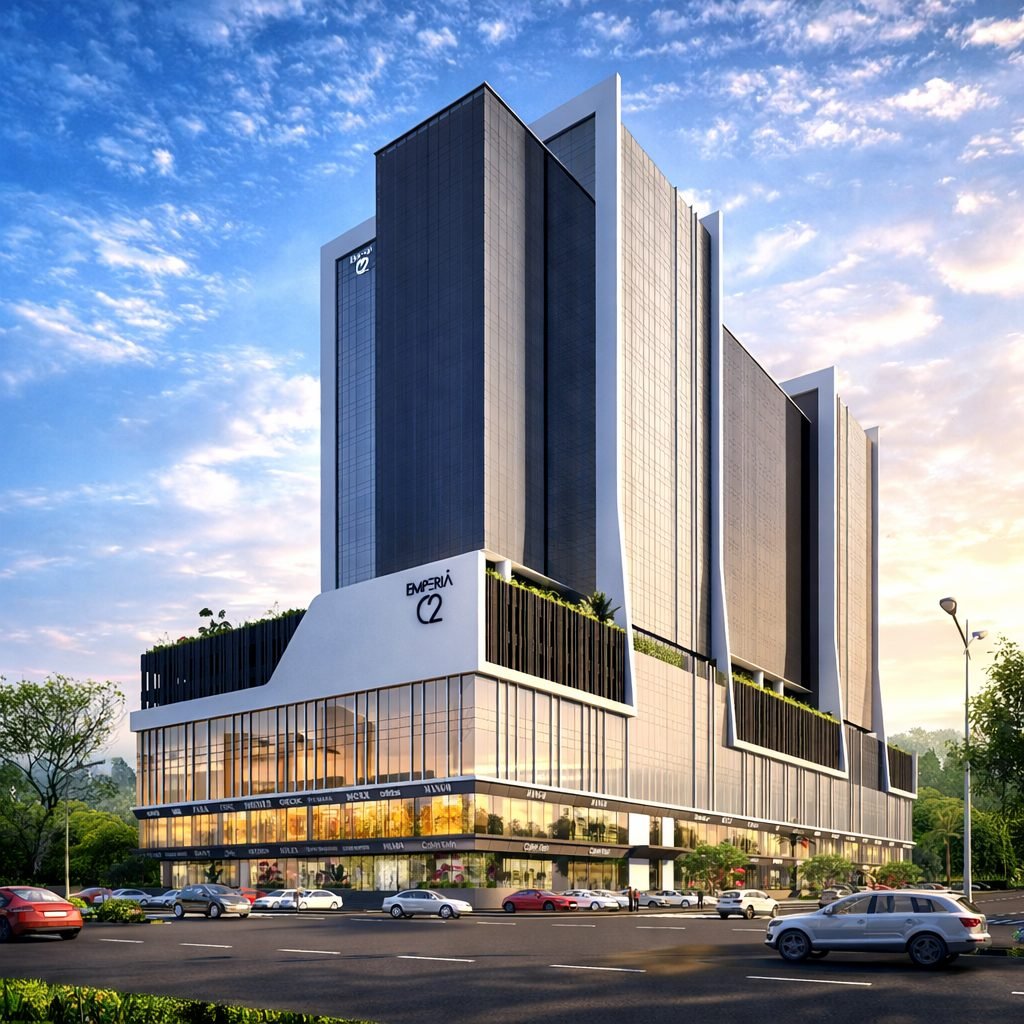
- Turbhe and MIDC are the office spine. Close to the harbour line, the highways and the airport corridor, this stretch is where new Grade A office and showroom supply concentrates — see Emperia C2 in Turbhe.
- Commercial is a different discipline. Tenant quality, lease structure, vacancy risk and GST all matter far more than they do for a home. The upside is real; so is the homework.
- Buy a leasable asset in a connected node, RERA-clean, at launch. That is where the yield and the appreciation both concentrate. Our live commercial picks sit on exactly that map.
What this guide covers
- Why commercial property in Navi Mumbai now
- Commercial vs residential: the investor’s trade-off
- The types of commercial property
- The commercial yield & EMI calculator
- The Navi Mumbai commercial map
- Turbhe & MIDC: the office spine
- Vashi: the established retail-office core
- Belapur CBD: the banking & government hub
- Airoli, Ghansoli & Mahape: the IT belt
- The airport effect on commercial demand
- Rental yields: what commercial actually pays
- Lease structures: lock-in, escalation, deposit, CAM
- Grade A vs Grade B offices
- Pre-leased vs vacant commercial
- GST & taxation on commercial property
- Stamp duty & registration on commercial
- Financing a commercial purchase
- RERA & legal due diligence
- The real risks & how to manage them
- How to evaluate a project at launch
- Tenant profile & vacancy risk
- Five worked investor scenarios
- Exit & resale of commercial
- Your commercial buying checklist
- Commercial questions investors ask
- Glossary: the commercial terms
1. Why commercial property in Navi Mumbai now
Direct answer: Navi Mumbai is one of the few places in the metropolitan region where the case for commercial property rests on fundamentals rather than hope — it is a planned city with an existing industrial and office base, deep and improving connectivity, a large and growing workforce, and now a live international airport that adds a structural new layer of business demand. For an investor who wants income today and appreciation over a cycle, that combination is rare, and 2026 sits at an unusually favourable point in it.
Start with what already exists. Navi Mumbai was not built around a single industry that can leave; it was planned node by node with industrial estates, office districts, a banking and government hub and retail cores designed in from the start. The MIDC belt through Turbhe and Mahape has decades of manufacturing, logistics and back-office tenancy behind it. The Belapur CBD houses banks, government offices and corporate headquarters. The Airoli–Ghansoli stretch has grown into a genuine IT and back-office belt. This is not a speculative business district waiting to be invented; it is a working one with established rent rolls, which is exactly what gives a commercial buyer confidence that a unit can actually be let.
Then layer on what is arriving. The Navi Mumbai International Airport is the single biggest commercial-demand trigger the region has seen in a generation, because an airport does not just move passengers — it pulls hotels, offices, cargo and logistics businesses, exhibition and convention space, and the whole aerocity economy toward itself. The Atal Setu sea-link collapses the distance to South Mumbai, the metro stitches the inner nodes together, and the NAINA plan opens a large new business region around the terminal. Each of these turns Navi Mumbai from a satellite of Mumbai into a destination in its own right, and destinations are where commercial rents compound.
The investor’s timing argument is simple. Much of this infrastructure is now live or near-live rather than promised, which removes a large slice of the old execution risk, yet a meaningful part of the commercial repricing has not yet happened because the airport’s full demand effect builds over years, not months. That gap — de-risked infrastructure but not-yet-realised demand — is the window a commercial buyer is looking for. The rest of this guide is about locating the specific nodes, asset types and lease structures where that window is widest, and avoiding the ones where the story is louder than the substance.
2. Commercial vs residential: the investor’s trade-off
Direct answer: Commercial property and residential property are different instruments, not different sizes of the same thing — commercial pays far higher rental yield and is valued largely on its tenant and lease, while residential pays low yield but is easier to finance, easier to sell and far simpler to own. The right choice depends on whether you want income or simplicity, and most investors move toward commercial only once they have the capital, the holding power and the appetite for the extra homework it demands.
The headline difference is yield. A residential flat in the region typically returns somewhere around 2–3.5% gross rent a year against its price, because home prices are driven by owner-occupier demand rather than rental maths. A well-located, well-let commercial unit — an office, a showroom, a warehouse — commonly returns 6–9% gross, because businesses pay rent out of revenue and value a good location enough to pay for it. Over a long hold, that yield gap compounds into a very large difference in cash returned, which is the core reason serious investors graduate into commercial.
The trade-offs are equally real and run the other way. Commercial loans carry lower loan-to-value ratios, higher interest rates and shorter tenures than home loans, so you bring more of your own capital. Vacancy hurts more, because a single tenant leaving an office can mean months of zero income, where a flat re-lets quickly into a deep residential pool. The legal and tax layer is heavier — GST applies to commercial rent and often to purchase, leases are complex contracts with lock-ins and escalations, and the diligence on a tenant and a title is more involved. And commercial is less liquid: the buyer pool is smaller and more discerning, so exits take longer and depend more on the asset’s lease at the time of sale.
The practical way to decide is to be honest about your stage and temperament. If you want a simple store of value with a clean exit and modest income, residential is the lower-effort instrument. If you want to maximise income and are willing to underwrite tenants, structure leases, manage vacancy and carry the heavier tax and financing load, commercial is the higher-return one. Many investors hold both — residential for stability and a clean exit, commercial for yield — and use the airport-belt growth in Navi Mumbai to anchor the commercial side of that barbell.
3. The types of commercial property
Direct answer: “Commercial property” covers several quite different assets — offices, retail and showroom space, warehousing and logistics, co-working and managed space, and specialised formats such as clinics or restaurants — and each has its own tenant pool, yield band, risk profile and ideal location. Choosing the type is the first real decision, because it determines almost everything else about how the asset behaves.
Offices are the largest and most familiar category. They range from small strata-sold cabins to whole Grade A floors, and their tenants are corporates, IT and back-office firms, professional services and start-ups. Offices reward connectivity to transit and a credible address, and in Navi Mumbai they cluster on the Turbhe–MIDC spine, in Belapur CBD and across the Airoli–Ghansoli IT belt. Yields are solid and tenants on good leases are sticky, but vacancy between tenants can be long, so the lease and the tenant covenant matter enormously.
Retail and showroom space is the high-street category — ground-floor shops, showrooms on arterial roads, and units in or near malls and high-footfall pockets. Its value is made by visibility and footfall, so a showroom on a busy main road in Vashi or near a station commands a premium that an identical unit on a quiet internal lane never will. Retail can yield very well with the right tenant — a bank branch, a brand showroom, a clinic — but it is the most location-sensitive category, and a poorly placed shop can sit vacant for a long time.
Warehousing and logistics is the category the airport and the highways most directly feed. Cargo, e-commerce fulfilment, cold storage and distribution all want large, well-connected sheds near the airport, the port and the expressways, and the Taloja, Mahape and outer-MIDC stretches are the natural home for them. Warehousing typically trades on long leases with strong industrial tenants, which makes income predictable, though entry tickets are larger and the asset is specialised. Alongside these sit newer formats — co-working and managed offices, which convert a vacant floor into a flexible income stream, and specialised units for clinics, restaurants and services — each of which can lift yield but adds operational or fit-out complexity. The investor’s job is to match the type to their capital, their risk appetite and the node’s actual demand, which the map in the next chapters lays out.
4. The commercial yield & EMI calculator
Direct answer: Before you fall in love with a unit, run the money on it as an income asset. A commercial purchase is judged on two numbers at once — the monthly EMI you pay the bank, and the monthly rent the unit earns — and a good deal is one where the rent comfortably services the loan and leaves a real net yield on your own capital. Set the value, tenure and rate below to see the EMI, then read the yield guide that follows to translate it into a return on the cash you actually put in.
Commercial property EMI calculator
Move the sliders. Indicative only — your sanctioned rate, LTV and amount decide the final number.
The way to read the output is in two steps. First, the EMI is what your financing costs each month — and notice that commercial loans usually carry a higher rate and a shorter tenure than a home loan, so the same ticket costs more per month than a residential one would. Second, set the EMI against the rent the unit can earn. If a unit costs one crore and lets for, say, sixty to seventy thousand a month, that is roughly a 7–8.5% gross yield, and whether it makes sense depends on how much of the price you borrowed and at what rate. The asset is genuinely working for you when the net rent, after maintenance, taxes and vacancy allowance, covers the EMI and still returns a healthy figure on your own equity.
Two cautions the calculator cannot show. Commercial rent attracts GST and your income is taxed, so the headline gross yield overstates what reaches you — always model the net. And vacancy is the silent killer of commercial returns: a unit that is empty for four months of a year has lost a third of its annual income, so a slightly lower rent from a strong, long-locked tenant often beats a higher rent from a shaky one. Use the EMI figure as the floor your rent must clear with room to spare, never as a number the rent merely matches. For the deeper mechanics, see our EMI and affordability guide.
5. The Navi Mumbai commercial map
Direct answer: Navi Mumbai’s commercial demand is not spread evenly — it concentrates along a clear spine of nodes, each with its own tenant type and yield character, and knowing the map is what separates a placed, leasable asset from a vacant one. The core stretches are the Turbhe–MIDC office and industrial spine, the Vashi retail-and-office core, the Belapur CBD banking hub, the Airoli–Ghansoli–Mahape IT belt, and the airport-facing logistics belt around Taloja and Dronagiri.
Think of the map as a few overlapping demand pools. The first is the office pool, which runs from Turbhe and the MIDC stretch up through Mahape, Ghansoli and Airoli into the IT belt, and anchors itself on Belapur CBD at the southern end. These nodes draw corporates, IT and back-office firms and professional services, and their value is made by transit access — proximity to the harbour line stations and the highways — and by the credibility of the address. The second is the retail pool, concentrated in the established cores of Vashi and Belapur and along the arterial roads, where footfall and visibility drive value. The third is the logistics pool, which has shifted outward toward Taloja, Mahape’s industrial edge and the airport-and-port-facing belt, where land is larger and cheaper and the tenants are cargo, e-commerce and distribution.
The connectivity overlay is what is changing the map right now. The harbour railway line has long defined where offices want to be, but the new layer — the airport, the Atal Setu sea-link, the metro and the upgraded road grid — is pulling demand toward the nodes that sit on the new connectivity rather than only the old. Turbhe is a clear beneficiary, because it sits where the established MIDC office spine meets the new airport corridor and the highways, giving it both an existing tenant base and a fresh growth driver. That dual position is exactly why the Turbhe stretch is worth a close look for a new commercial buyer, and why the next chapter goes deeper on it.
The investor’s discipline with the map is to buy where a node’s demand pool and its connectivity both point the same way. A unit is leasable when it sits in a node whose tenant type is established, on connectivity that is finished or near-finished, in a format that node actually absorbs. A unit struggles when it is the wrong type for its node — a high-street showroom on an internal industrial lane, or a large office in a node with no office tenants — however attractive the price. Read the map first, then the project.
6. Turbhe & MIDC: the office spine
Direct answer: The Turbhe and MIDC stretch is the practical heart of Navi Mumbai’s commercial office and showroom market, because it combines an established industrial and office tenant base with exactly the new connectivity — the highways, the harbour line and the airport corridor — that is driving the next wave of demand. For a commercial buyer it offers something rare: a node where the tenants already exist and the growth driver is still arriving.
Turbhe’s position on the map is its single biggest asset. It sits on the harbour railway line, close to the Thane–Belapur road and the Sion–Panvel artery, and within the airport-corridor catchment, which means a business located here can reach the rest of Navi Mumbai, the highways, the airport and the wider region with unusual ease. The surrounding MIDC industrial estate has decades of manufacturing, logistics, warehousing and back-office tenancy, so the area is not waiting to attract its first occupiers — it already has a deep, working base of businesses that need office, showroom and commercial space nearby.
What makes Turbhe interesting now rather than just stable is the new supply of organised, Grade A commercial space arriving to meet that demand. As older industrial plots redevelop and modern commercial projects come up, the stretch is shifting from purely industrial to a mixed office-and-showroom character, which is precisely the transition that lifts commercial values — better buildings command better tenants and better rents. A project such as Emperia C2 in Turbhe sits in exactly this position: organised commercial space on an established spine, with the airport corridor as a growth tailwind. For a buyer it is the kind of node where a leasable asset can be acquired at a stage where the tenant base is real but the airport repricing is not yet fully in the price.
The diligence on Turbhe is the diligence on any office node, sharpened to the spot. Confirm the exact walking distance to the nearest harbour-line station and the road access, because office tenants pay for transit. Check the building’s grade, floor plates, parking and power backup, since corporate and back-office tenants screen hard on these. Verify the project’s RERA status and the developer’s delivery record. And read the local tenant demand honestly — what kinds of businesses are actually leasing nearby, at what rents, and how quickly — so you buy the format the node absorbs. Turbhe rewards the buyer who treats it as a working office market with an airport tailwind, not as a speculative bet on the airport alone.
7. Vashi: the established retail-office core
Direct answer: Vashi is Navi Mumbai’s most mature and complete commercial core — the closest the city has to a finished high street and office district in one — which makes it the lowest-risk, highest-liquidity place to buy commercial, at the cost of the lower upside that comes with growth already in the price. For an investor who values certainty and an easy exit over raw appreciation, Vashi is the belt’s safest commercial address.
Vashi’s strength is its completeness. It has the established retail high streets, the malls and the footfall, a deep office base, excellent harbour-line connectivity and a settled, affluent residential catchment around it. That maturity means a well-placed showroom or office in Vashi rarely sits vacant for long — there is a real, standing pool of tenants and buyers — and that liquidity is itself valuable, because it makes both letting and exiting easier than almost anywhere else in Navi Mumbai. A bank branch, a brand showroom, a clinic or a corporate office in the right Vashi location is about as close to a blue-chip commercial holding as the city offers.
The trade-off is exactly what you would expect from a finished market: the yield and the appreciation are more modest, because the growth that a frontier node still promises has already been delivered and priced. You are paying for certainty and liquidity rather than for a growth story, which is the right deal for some investors and the wrong one for others. Vashi also rewards precision within the node — a unit on a busy retail street or near a station behaves completely differently from one on a quiet internal road — so the micro-location matters as much as the node.
For the new commercial buyer, Vashi is best understood as the anchor end of a portfolio rather than the growth end. It is where you put capital you want to keep safe and liquid, earning a steady, reliable yield, while you take your growth exposure in a connected, still-repricing node such as Turbhe. Used that way — Vashi for stability, the airport-corridor nodes for upside — the two ends of the Navi Mumbai commercial market complement each other rather than compete.
8. Belapur CBD: the banking & government hub
Direct answer: Belapur’s central business district is Navi Mumbai’s institutional core — the planned hub of banks, government offices, corporate headquarters and large organised office space — which gives it a distinctive tenant profile of stable, creditworthy, long-staying occupiers that many investors prize above all others. It is the node to consider when you want institutional-grade tenants and are buying office rather than retail.
The CBD was designed from the start as Navi Mumbai’s command centre, and that planning shows. It carries wide roads, large planned plots, a concentration of banking and government institutions, and the kind of organised Grade A office stock that big tenants require. Those tenants — banks, public-sector bodies, established corporates — are exactly the covenant a commercial landlord wants: they sign long leases, they pay reliably, and they rarely leave on short notice, which converts an office holding here into a predictable income stream rather than a vacancy gamble. Belapur also enjoys strong connectivity, sitting on the harbour line with good road links and metro access, which keeps it accessible to the workforce that fills those offices.
The flip side of institutional strength is that Belapur is a mature, large-format market that does not always suit a smaller individual buyer. Much of the prime stock is large floor plates aimed at big tenants, entry tickets can be high, and the growth, like Vashi’s, is substantially in the price already. A retail investor may find fewer right-sized, affordable units here than in a node like Turbhe, and the appreciation runway is gentler than on the airport-corridor frontier. Belapur is about quality and stability of income, not about a rapid repricing story.
For an investor, the way to use Belapur is as the institutional-quality slice of a commercial portfolio — the place to hold a well-let office with a strong tenant covenant for steady, low-drama income, if and when a right-sized unit is available at a sensible entry. Pair that stability with the growth of the Turbhe–MIDC spine and the upside of the airport corridor, and you have a commercial position that spans the full risk spectrum from blue-chip income to growth. As always, verify the specific building’s grade, tenant and lease before treating the node’s reputation as the unit’s guarantee.
9. Airoli, Ghansoli & Mahape: the IT belt
Direct answer: The northern stretch of Airoli, Ghansoli and Mahape is Navi Mumbai’s IT and back-office belt — a band of business parks, technology campuses and organised office space that draws software, IT-enabled-services and corporate back-office tenants — and it offers a commercial buyer exposure to the city’s most modern, fastest-growing white-collar demand pool. It is the node to consider when you want to ride the IT and corporate-services story specifically.
This belt grew up around the demand for large, modern, well-serviced office space that the IT and back-office industries need, and it shows in the building stock: organised business parks, bigger floor plates, better power and connectivity infrastructure, and a tenant base of technology and services firms rather than traditional industry. Airoli’s proximity to Thane and the Eastern Express Highway corridor, Ghansoli’s position on the harbour line, and Mahape’s established IT-park base together make this one of the most active office-demand pools in the city, with tenants who value modern space and good transit and are willing to pay for both.
For the connectivity story, this belt benefits from its links toward Thane and the central suburbs as well as the harbour line, and it stands to gain further as the wider Navi Mumbai transit and road grid deepens. The IT and back-office tenant pool is also relatively resilient and growing, which supports both occupancy and rent over a cycle, though it is more exposed than, say, government tenancy to swings in the technology sector’s hiring and space appetite. That cyclicality is the main risk to weigh: the belt does best when the IT and services economy is expanding, and softens when those firms pull back on space.
An investor looking at this belt should buy modern, well-specified office space in an organised project with genuine transit access, and should underwrite the tenant pool’s health rather than assume it. Check what kinds of firms are leasing nearby and on what terms, confirm the building’s grade and infrastructure since IT tenants screen hard on power, connectivity and floor plates, and verify the project’s RERA and delivery credentials. Used well, the Airoli–Ghansoli–Mahape belt adds modern, growth-oriented office exposure to a Navi Mumbai commercial portfolio, complementing the airport-corridor and CBD slices.
10. The airport effect on commercial demand
Direct answer: A major airport is one of the most powerful commercial-demand generators that exists, because it pulls an entire ecosystem of businesses toward itself — hotels, offices, cargo and logistics, exhibition and convention space, retail and services — and the Navi Mumbai International Airport is now beginning to exert exactly that pull on the commercial market around it. For a commercial investor, the airport is not a residential story borrowed for offices; it is a direct, structural new source of business tenancy.
The mechanism is well understood from airports the world over. Around a major terminal, a predictable cluster of commercial activity forms — an aerocity of hotels for travellers and crew, offices for the airlines, freight forwarders, customs and logistics firms that the airport’s operations require, large warehousing and cold-storage facilities for cargo, convention and exhibition space that proximity to an airport makes valuable, and the retail and services that all of this generates. This cluster is not speculative; it is the natural commercial footprint of a working airport, and it grows steadily as the terminal ramps up flights and freight.
For Navi Mumbai, this means the airport adds a new, distinct demand pool on top of the existing office, retail and IT pools — an airport-and-logistics pool concentrated in the nodes that face the terminal and sit on the cargo-and-highway corridors. The Turbhe spine, with its established office base and its position on the airport corridor and highways, is well placed to capture the office and showroom side of this demand, while the Taloja, Mahape-edge and airport-facing belts are positioned for the warehousing and logistics side. The sea-link, metro and road grid that serve the airport also lift the broader commercial accessibility of the whole region, deepening every demand pool at once.
The investor’s discipline here mirrors the residential one: buy the connectivity and the demand pool, not the airport headline. The commercial nodes that benefit are the ones genuinely on the airport’s business corridor with finished access, in formats the airport economy actually absorbs — offices and showrooms on the connected spine, warehousing on the logistics belt. A unit far from the corridor, or in a format the airport economy does not need, gains little from the terminal however close it looks on a map. Read the airport effect as a real but located force, concentrate where it lands, and verify the specific node’s access and tenant demand before paying an airport premium.
11. Rental yields: what commercial actually pays
Direct answer: The reason investors buy commercial is yield — a well-located, well-let commercial unit in Navi Mumbai commonly returns a gross 6–9% a year against its price, against roughly 2–3.5% for residential — but the number that matters is the net yield after maintenance, taxes, GST and a realistic vacancy allowance, which is always lower than the headline. Underwriting the net, not the gross, is the single most important habit in commercial investing.
Gross yield is simply the annual rent divided by the price, and it varies by asset type and node. Warehousing and logistics on long industrial leases can sit at the higher end of the band because the assets are cheaper per square foot and the leases are long; Grade A offices in strong nodes sit in the middle with solid, stable tenants; prime retail can spike high with the right footfall-driven tenant or disappoint badly with the wrong one. A realistic working range for a sensibly bought, well-let Navi Mumbai commercial unit is a gross yield somewhere in the 6–9% region, but treat any specific quote as a claim to verify against comparable lettings nearby, not as a promise.
Net yield is where the real return lives, and it is meaningfully below gross. From the rent you subtract maintenance and common-area charges you bear, property tax, the cost of any vacancy between tenants, brokerage on re-letting, and the tax on your rental income — and you account for GST, which applies to commercial rent and changes the cash flows. A unit advertised at an 8% gross yield might net closer to 6% once these are honestly modelled, and that net figure, measured against the equity you actually put in after the loan, is the true return on your capital. An investor who underwrites only the gross is consistently disappointed; one who models the net is rarely surprised.
The yield discipline also guides what to buy. A slightly lower gross yield from a strong, long-locked tenant in a connected node usually produces a higher and steadier net yield than a higher gross from a weak tenant in a thin location, because the second carries vacancy and re-letting risk the first does not. Yield is not just a number to maximise on day one; it is an income stream to protect over a hold, and protecting it means buying tenant quality and location as much as headline rent. Build your case on a conservative net yield that survives a vacancy or two, and the commercial maths works in your favour over a cycle.
12. Lease structures: lock-in, escalation, deposit, CAM
Direct answer: In commercial property the lease is the asset, and its structure — the lock-in period, the rent-escalation clause, the security deposit and the common-area-maintenance arrangement — determines how much income you actually capture and how protected it is. Reading and negotiating these terms is the core skill of commercial investing, far more than choosing a pretty building.
The lock-in period is the tenant’s commitment. A commercial lease typically runs for a set term — often structured in blocks such as a longer overall term with a shorter lock-in — during which the tenant cannot leave without penalty. A longer lock-in with a creditworthy tenant is gold for a landlord, because it guarantees income and makes the asset far easier to finance and to sell; a short or weak lock-in leaves you exposed to early vacancy. When you evaluate a pre-leased unit, the strength and remaining length of the lock-in is one of the first things to check, because it is much of what you are paying for.
The escalation clause is how the rent grows. Commercial leases usually build in periodic rent increases — a fixed percentage every few years — so that your income rises over the hold rather than staying flat while costs and prices climb. A healthy escalation clause is what keeps a commercial yield from eroding in real terms over a long lease, and its absence or weakness is a quiet drag on returns. Alongside it, the security deposit — often several months of rent held against default and damage — protects your downside, and a thin deposit from a weak tenant is a warning sign.
Common-area maintenance, or CAM, is the often-overlooked detail that decides who bears the cost of running the building — lobbies, lifts, security, common power and upkeep. Whether CAM is the tenant’s responsibility or the landlord’s materially changes your net yield, and an investor who reads only the rent and ignores the CAM arrangement can be surprised by how much of the income the building’s running costs consume. The discipline across all of these is the same: the headline rent is only the start; the lock-in protects it, the escalation grows it, the deposit secures it and the CAM arrangement determines how much of it you keep. Read the whole lease, not just the number on the first page, and where you can, buy assets whose leases are structured in the landlord’s favour with strong tenants.
13. Grade A vs Grade B offices
Direct answer: Office space is informally graded by quality — Grade A means modern, well-built, well-managed buildings with good floor plates, power backup, parking and amenities, while Grade B means older or less-specified stock — and the grade drives the tenant pool, the rent, the vacancy risk and the resale liquidity. For most investors, a well-located Grade A unit is the safer long-term hold even at a higher entry price.
Grade A buildings attract the strongest tenants — corporates, established IT firms, professional-services companies — because these occupiers screen hard on building quality, infrastructure and address, and will not house their operations in sub-standard space. That tenant quality flows straight into the investment: stronger covenants, longer leases, more reliable rent, lower vacancy risk and a deeper pool of future buyers when you exit. The premium you pay for Grade A is, in effect, the price of a better and more durable income stream, and over a long hold it usually justifies itself through lower vacancy and stronger appreciation.
Grade B space can still be a reasonable investment in the right hands, but it carries more risk and demands more management. Its tenants are smaller, less established firms with weaker covenants and shorter leases, vacancy between tenants tends to be longer, and the resale pool is thinner. The case for Grade B is price — a higher headline yield on a lower entry — but that yield has to be discounted for the higher vacancy and re-letting risk, and the asset is harder to finance and to sell. Grade B suits an experienced, hands-on investor who can actively manage tenancy, not a first-time commercial buyer looking for a passive income asset.
The practical guidance for a new commercial buyer in Navi Mumbai is to favour well-located Grade A or near-Grade-A space in a connected node, even at a higher price, because it minimises the two things that hurt commercial returns most — vacancy and illiquidity. The modern organised projects coming up on the Turbhe–MIDC spine and across the IT belt are largely in this category, which is part of what makes them suitable entry points. Verify the specifics — floor plates, power backup, parking, lift and amenity provision, building management — rather than taking a marketing “Grade A” label at face value, because the grade is defined by the building’s actual specification and management, not by the brochure.
14. Pre-leased vs vacant commercial
Direct answer: A commercial unit can be bought either pre-leased — already let to a tenant on a running lease — or vacant, and the two are almost different investments. Pre-leased gives you immediate, known income and lower risk at a higher price and lower headline yield; vacant gives you a cheaper entry and higher potential yield in exchange for the risk and effort of finding a tenant. The right choice depends on your appetite for risk and your ability to let space.
Pre-leased commercial is the lower-risk path and the one most passive investors prefer. You buy an asset that is already producing rent from a known tenant on a known lease, so your income starts on day one and your underwriting is concrete — you can read the actual tenant covenant, lock-in, escalation and deposit rather than estimating them. The price reflects this certainty: pre-leased units trade at a premium and therefore a lower headline yield than equivalent vacant ones, because you are buying away the leasing risk. The key diligence shifts entirely to the lease and the tenant — how strong is the covenant, how long is the remaining lock-in, how market-aligned is the rent, and what happens at lease end — because those terms are most of what you are paying for.
Vacant commercial is the higher-risk, higher-effort path with more upside for the capable investor. You buy at a lower price, with no income until you let the unit, and you carry the full risk that letting takes longer or happens at a lower rent than you hoped. The reward is that you capture the full yield yourself rather than paying a previous landlord a premium for the lease they secured, and you control the tenant selection and lease terms. Vacant suits an investor who understands the local leasing market, has the holding power to carry an empty unit for a while, and can either find tenants directly or work effective brokers — in the right connected node with real demand, the leasing risk is manageable and the extra yield is genuine.
For a first-time commercial buyer in Navi Mumbai, the safer default is pre-leased in a strong node if a well-let unit at a sensible price is available, because immediate income and concrete underwriting reduce the learning-curve risk. A buyer with more experience, more risk appetite or a strong read on a specific node’s leasing demand — such as the office demand on the Turbhe spine — can do well buying vacant at launch and capturing the full yield by letting it themselves. Either way, the discipline is the same: with pre-leased, scrutinise the lease; with vacant, scrutinise the leasing market. The asset’s value lives in the tenancy either way.
15. GST & taxation on commercial property
Direct answer: Commercial property carries a heavier tax layer than residential — GST applies to the purchase of under-construction commercial units and to commercial rent, and your rental income and any capital gain are taxable — and ignoring this layer is one of the most common ways investors overstate their returns. Model commercial returns after tax, not before, and take professional advice on your specific position.
On purchase, GST applies to under-construction commercial property at the applicable rate, which is different from the concessional residential rates — so the tax on buying a commercial unit under construction is a real, sizeable addition to the price that must be built into your cost base from the start. A ready, completed commercial unit with its occupancy certificate is generally outside GST on the sale in the way a completed residential resale is, but the under-construction position is materially different, and you should confirm the exact treatment for your specific transaction. Our GST guide covers the residential side and the principles that carry over.
On rent, commercial leasing attracts GST in a way residential letting does not — renting commercial space is a taxable supply, which affects both your cash flows and your tenant’s costs, and changes how you must invoice and account for the rent. This is a key reason the gross yield overstates the net: the GST and compliance layer on commercial rent is a real cost of doing business that residential landlords simply do not face. Whether and how you can offset input tax credits depends on your specific structure, which is exactly the kind of thing to confirm with a tax professional before you buy rather than after.
On income and exit, your rental income is taxable as income, and any gain when you sell is subject to capital-gains tax, with the rate and any indexation or reinvestment relief depending on how long you held and the specifics of the law at the time. The practical investor’s habit is to model the whole tax journey — GST on purchase if under-construction, GST and income tax on rent through the hold, and capital-gains tax on exit — into the return from the outset, so the net figure you underwrite is the one you actually keep. Commercial property can still return very well after all of this, but only if the after-tax maths is done honestly upfront. Treat tax as a core part of the deal, not an afterthought, and take specific professional advice for your situation.
16. Stamp duty & registration on commercial
Direct answer: Buying commercial property in Maharashtra carries stamp duty and registration charges just as residential does, and these are a meaningful percentage of the price that must be in your cost base from the start — on a commercial purchase you should budget for stamp duty plus registration on top of the price, GST if under-construction, and the legal and transaction costs of a more complex deal. The headline price is never the whole cost.
Stamp duty is a state levy charged as a percentage of the property’s value, and it applies to the conveyance of commercial property in the same broad framework as residential, though you should confirm the exact applicable rate and any commercial-specific nuances for your transaction at the time of purchase. Registration charges are a further, smaller percentage to register the document with the sub-registrar, which is what gives your ownership its legal standing. Together these are not trivial — on a commercial ticket they translate into a substantial cash amount that you pay at completion and never recover, so they belong in your acquisition cost and your return calculation from day one. Our stamp duty and registration guide sets out the framework in detail.
Commercial transactions also tend to carry heavier surrounding costs than residential ones, because the diligence and documentation are more involved. You are more likely to need professional legal review of the title and the lease, a more careful examination of the developer’s commercial approvals, and more complex agreements — particularly if you are buying pre-leased and inheriting an existing tenancy. These professional and transaction costs are real and should be budgeted; trying to save on diligence in a commercial deal is a false economy, because the downside of a title or lease problem on a commercial asset is large.
The disciplined way to handle all of this is to build a complete acquisition cost before you commit — price, stamp duty, registration, GST if applicable, legal and diligence fees, and any brokerage — and to underwrite your yield and return against that full number rather than the sticker price. An investor who measures returns against the headline price alone consistently overstates them; one who measures against the all-in cost knows the real figure. Get a precise, current quote for stamp duty and registration on your specific transaction from a professional, because rates and concessions change, and confirm the exact treatment rather than relying on a general figure.
17. Financing a commercial purchase
Direct answer: Commercial property is financed differently from a home — lenders offer lower loan-to-value ratios, charge higher interest rates and grant shorter tenures than on home loans — so a commercial purchase demands more of your own capital and produces a higher monthly EMI per rupee borrowed than a residential one. Plan the financing as carefully as the asset, because the loan terms materially change the return on your equity.
The first difference is the loan-to-value ratio. Where a home loan might fund a large share of the property’s value, a commercial loan typically funds a smaller share, meaning you must bring more equity to the table. That higher equity requirement is the main reason commercial is a later-stage investment — it ties up more of your own capital per deal — and it is also why the return on equity, not just the yield on price, is the number that matters: a strong yield on a heavily self-funded purchase can still be a modest return on the cash you put in. Model the deal on the equity you actually deploy.
The second and third differences are rate and tenure. Commercial loans carry higher interest rates than home loans, reflecting the lender’s view that commercial assets are higher-risk, and they are usually granted over shorter tenures, which raises the monthly EMI for a given amount. The calculator earlier in this guide reflects this with a higher default rate and shorter tenure than a residential one would use. The practical effect is that the rent must clear a higher EMI hurdle to make the deal work, which reinforces the earlier discipline: buy assets whose net rent covers the EMI with real headroom, not ones where the rent merely matches it.
Lenders also underwrite commercial deals more rigorously, scrutinising the asset, the location, the developer, and — for a pre-leased unit — the tenant and lease, because a strong lease to a creditworthy tenant materially de-risks the loan. This means a well-let asset in a strong node is not only a better investment but also easier and cheaper to finance, while a vacant unit in a thin location is harder to fund. Approach financing as part of the diligence: get a clear read on the LTV, rate and tenure you will actually be offered before you commit, build the resulting EMI into your net-yield underwriting, and ensure your equity and holding power are sufficient to carry the asset through a vacancy. For the underlying EMI mechanics, see our EMI and affordability guide.
18. RERA & legal due diligence
Direct answer: Commercial property demands the same RERA and title diligence as residential plus an extra layer for the tenancy and the commercial approvals, and skipping it is far more dangerous on a commercial asset because the tickets are larger and the problems harder to unwind. Verify the project’s RERA registration, the clean title, the developer’s track record and — for pre-leased units — the lease and tenant, before you part with money.
Start with RERA. Commercial real-estate projects, like residential ones, are required to be registered with MahaRERA, whose portal carries the project’s registration, approvals, timelines and the developer’s other projects and any complaints against them. Confirming the registration and reading the filings tells you whether the project is legitimate, whether its approvals are in order, and whether the developer has a history of delivering on time or of disputes — all of which matter as much for a commercial buyer as a residential one. Our RERA verification guide walks through how to read the portal.
Next, the title and approvals. A clean, marketable title verified by a competent property lawyer is non-negotiable, and on commercial property you should also confirm that the project has the specific approvals and permitted use for commercial occupation — that the building and the unit are legally usable for the commercial purpose you intend, with the right zoning, occupancy and any trade-specific permissions. A unit that cannot be legally used as you intend, or whose title is clouded, is a far costlier mistake on a large commercial ticket than on a flat. Invest in proper legal review; it is cheap insurance against an expensive problem.
Finally, for pre-leased units, diligence the tenancy as carefully as the title. Read the actual lease — the tenant’s identity and creditworthiness, the lock-in, the escalation, the deposit, the CAM arrangement, the remaining term and what happens at its end — and verify that the rent is being paid and the lease is genuine and enforceable, not a paper arrangement to flatter the sale. For a vacant unit, the diligence is on the leasing market and the developer instead. Across all of this, the principle is that a commercial purchase rewards thorough, professional diligence more than almost any other property decision, because the downside of a legal, title or lease problem on a large, illiquid commercial asset is severe. Do the homework, use professionals, and verify before you commit.
19. The real risks & how to manage them
Direct answer: The genuine risks in commercial investing are vacancy, tenant default, oversupply, illiquidity, the cyclicality of business demand, and execution risk on under-construction projects — and each is manageable with the right asset selection and discipline rather than a reason to avoid commercial altogether. Knowing the risks and buying to mitigate them is what separates a sound commercial investor from a burned one.
Vacancy is the largest risk and the one that most often turns a good-looking yield into a poor return. A commercial unit between tenants earns nothing while still costing maintenance, tax and EMI, and commercial vacancy can run for months because the tenant pool is narrower than residential. You manage it by buying in connected nodes with real, deep demand for the asset type, favouring pre-leased units with long lock-ins or, for vacant units, only buying where you have a confident read on letting. Tenant default is the related risk — a tenant who stops paying or fails — managed by underwriting tenant creditworthiness, holding a solid security deposit, and preferring strong covenants over slightly higher rent from a weak one.
Oversupply and cyclicality are market-level risks. If a node sees a glut of new commercial supply, rents and occupancy soften for everyone, so it pays to read how much competing space is coming up before you buy. And commercial demand follows the business cycle — office and IT demand in particular rise and fall with corporate hiring and the economy — so an asset bought at the top of a cycle into a frothy market carries more risk than one bought into a recovering one with an infrastructure tailwind. The Navi Mumbai airport story is a genuine structural tailwind that partly offsets cyclicality, but it does not suspend the cycle, and you should not assume it does.
Illiquidity and execution risk round out the list. Commercial sells more slowly and to a narrower pool than residential, so plan a longer exit horizon and keep the asset’s lease strong, because a well-let asset sells far faster than a vacant one. On under-construction projects, execution risk — delay or developer failure — is managed by buying from credible, RERA-registered developers with delivery track records and by staging payments to construction. None of these risks is a reason to stay out of commercial; together they are a specification for how to buy it well — connected nodes, strong tenants, sound leases, credible developers, realistic horizons and honest underwriting. Manage the risks deliberately and the higher commercial return is available; ignore them and the higher yield is illusory.
20. How to evaluate a project at launch
Direct answer: Evaluating a commercial project at launch comes down to a disciplined checklist — the node and its demand pool, the developer’s credibility, the building’s grade and specification, the RERA and legal position, the realistic rent and yield, and the price against comparable space — run in order, with the deal-breakers checked first. Launch can offer the best entry price, but only if the project passes the homework.
Begin with the node and the demand, because no amount of building quality rescues the wrong location. Confirm that the project sits in a node whose tenant type is established and whose connectivity is finished or near-finished, in a format that node actually absorbs — an office on a connected office spine, a showroom on a high-footfall road, warehousing on a logistics belt. For Navi Mumbai, that means reading the commercial map from earlier in this guide honestly against the specific site: a well-located office launch on the Turbhe–MIDC spine, for example, sits in a node with real office demand and an airport tailwind, which is the kind of fundamental that supports a launch entry.
Then assess the developer and the building. Check the developer’s track record, financial strength and delivery history through their RERA filings and past projects, because at launch you are buying a promise and the developer’s credibility is your main protection against delay or failure. Examine the building’s grade and specification — floor plates, power backup, parking, lifts, amenities, management — against what the node’s tenants require, since the grade drives the tenant pool and therefore the rent and vacancy risk. A modern, well-specified building from a credible developer in the right node is the combination launch buyers are looking for.
Finally, run the money and the legal position together. Verify the RERA registration and have a lawyer confirm the title and the commercial approvals and permitted use. Establish a realistic rent by checking what comparable space actually lets for nearby, translate it into a conservative net yield after all costs and a vacancy allowance, and measure that against the all-in acquisition cost including stamp duty, GST and fees. Then judge the launch price against comparable space and against the upside the node’s growth story offers. A project that clears the node, the developer, the building, the legal and the yield tests at a launch price below comparable ready space is the kind of opportunity launch is meant to provide — and one that fails any of the deal-breaker tests is not rescued by a low price. Evaluate in that order, and use professionals for the legal and tax pieces.
21. Tenant profile & vacancy risk
Direct answer: In commercial property the tenant is much of the asset, so the tenant profile a unit can attract — and how reliably it can be kept occupied — is central to its value. The best commercial holdings draw strong, creditworthy, sticky tenants on long leases in formats and nodes with deep demand; the riskiest depend on a thin pool of weak tenants in locations where vacancy runs long.
Tenant quality is a spectrum, and where your unit sits on it shapes your whole experience as a landlord. At the strong end are institutional and corporate tenants — banks, established corporates, large IT and services firms — with solid covenants, long leases and a low propensity to leave, the kind concentrated in Belapur CBD and the better Grade A office stock. At the weaker end are small, young or under-capitalised firms with thin covenants and short horizons, more common in lower-grade space and thinner nodes. The stronger the tenant your unit can attract, the more reliable your income, the longer your leases, the lower your vacancy risk and the easier your eventual exit — which is why the quality of the achievable tenant pool, not just the headline rent, should drive your purchase.
Vacancy risk is the direct consequence of tenant pool depth, and it is the metric that most distinguishes a good commercial location from a bad one. A unit in a connected node with a deep, active demand for its asset type re-lets quickly when a tenant leaves, limiting the income gap; a unit in a thin or wrong-format location can sit empty for many months, devastating its effective yield. This is why the location and format discipline from the map chapters matters so much: you are buying the depth of the tenant pool as much as the building. Before you buy, ask honestly — if my tenant left tomorrow, how quickly and at what rent could I re-let this exact unit in this exact node? — and let the answer weigh heavily.
Managing tenant and vacancy risk is an active discipline through the hold, not just a purchase decision. Favour assets that attract strong tenants on long, well-structured leases with solid deposits; keep the building well-maintained and competitively positioned so it retains and attracts good tenants; stay aware of the local leasing market and competing supply so you can re-let promptly and price realistically; and build a vacancy allowance into your underwriting so a gap between tenants does not break your numbers. The airport-driven growth and the established demand pools in Navi Mumbai’s connected nodes give a careful investor access to good tenant pools, but the unit still has to be the right format in the right node with the right specification to capture them. Buy the tenant pool, protect the occupancy, and the income follows.
22. Five worked investor scenarios
Direct answer: The right commercial buy depends entirely on the investor’s capital, goal and risk appetite, so the clearest way to make this guide concrete is to walk through five distinct investor profiles and the Navi Mumbai commercial approach that fits each. Find the one closest to your situation and use it as a starting frame, not a prescription — then run the specific numbers and diligence the guide sets out.
The first-time commercial investor moving up from residential wants income without taking on too much risk while learning the asset class. The fitting approach is a smaller, pre-leased Grade A or near-Grade-A unit in a strong, connected node — an office on the Turbhe–MIDC spine with a sound tenant and a long lock-in, or a well-let unit in Vashi for maximum liquidity. Immediate income, concrete underwriting and an easy exit reduce the learning-curve risk, and the buyer pays a premium for that certainty knowingly. The yield-focused investor with more capital and experience wants to maximise net return and can underwrite tenants and structure leases. They might buy vacant at launch on the Turbhe spine and capture the full yield by letting it themselves, or take on warehousing on the logistics belt with a long industrial lease, accepting the higher effort and risk for the higher return.
The growth investor is buying the airport story for appreciation as much as income, and is comfortable holding through the middle of the cycle. Their approach is a well-located unit in a connected, still-repricing node on the airport corridor — an office or showroom on the Turbhe stretch where the tenant base is real but the airport premium is not yet fully in the price — held for the multi-year repricing as the terminal ramps up. The stability investor, by contrast, wants blue-chip income with minimal drama and is content with a gentler return. They look to Belapur CBD or prime Vashi for an institutional-quality tenant on a long lease, treating the holding as a bond-like income stream rather than a growth bet.
The portfolio investor with substantial capital wants to span the risk spectrum rather than concentrate in one bet. Their approach is a barbell: an anchor of stable, liquid income in Vashi or Belapur, a growth slice on the Turbhe–MIDC airport-corridor spine, and perhaps a higher-yield logistics holding on the outer belt — diversifying across node, asset type and risk so that no single tenant, node or cycle dominates the outcome. Across all five profiles the disciplines are constant: buy the connectivity and demand pool, underwrite the net yield and the tenant, structure or scrutinise the lease, account for the full tax and acquisition cost, and use credible developers and professional diligence. The profile sets the strategy; the discipline makes it work.
23. Exit & resale of commercial
Direct answer: A commercial asset is sold on its lease as much as its bricks, so the exit you can expect depends heavily on the tenancy at the time of sale — a well-let unit with a strong tenant and a long remaining lease sells faster and at a better price than an equivalent vacant one — and commercial is less liquid than residential, so plan a longer exit horizon and keep the asset sale-ready throughout the hold. Buy with the exit in mind.
The single biggest driver of a commercial exit is the lease. A buyer of commercial property is buying an income stream, so a unit that comes with a strong, creditworthy tenant on a long remaining lock-in with sound escalations is far more attractive — and commands a far better price and a quicker sale — than the same unit standing vacant, which forces the buyer to take on the full leasing risk. This is why keeping your asset well-let, with the lease in good order, is not just an income strategy through the hold but an exit strategy: the best time to sell is often when the asset carries a strong, long lease that the next investor will pay a premium for.
Liquidity is the constraint to plan around. The commercial buyer pool is narrower and more discerning than the residential one, so even a good asset can take longer to sell, and the achievable price is more sensitive to the asset’s lease, the node’s standing and the point in the business cycle. The practical implication is to hold commercial with a longer and more flexible exit horizon than residential, to avoid being a forced seller into a weak market, and to keep enough financial cushion that you can choose your moment rather than having it chosen for you. An investor who needs a quick, certain exit is better suited to residential or to the most liquid commercial nodes like Vashi.
Plan the exit mechanics from the start. Keep the title, the lease, the payment and tax records and the building documentation in clean order, because a fully papered, well-let asset transacts faster and at a better price than one with gaps a buyer’s lawyer must chase. Understand the capital-gains position on a commercial sale and factor brokerage and transaction costs into your expected net. And time the sale with both the asset’s lease and the cycle in mind — selling a strongly-let asset into a confident market, ideally as the airport-driven repricing matures, is how the structural gain actually lands in your pocket. The investors who treat the purchase as the whole transaction are surprised at exit; the ones who plan the round trip keep the return.
24. Your commercial buying checklist
Direct answer: A disciplined commercial purchase follows a clear sequence — fix your strategy and capital, choose the asset type and node, run the yield and financing maths, diligence the project, lease and legal position, and only then commit — with the deal-breakers checked before the nice-to-haves. Use this checklist as the spine of any Navi Mumbai commercial buy.
First, fix your strategy and your money. Decide which investor profile you are — income, growth, stability or a portfolio mix — and how much equity you can deploy given that commercial loans need more of your own capital. Get a realistic read on the loan-to-value, rate and tenure you will be offered so you know your true buying power and EMI. Then choose the asset type and node deliberately: match office, retail, warehousing or specialised space to a node whose demand pool and connectivity support it, using the map in this guide — for office and showroom exposure with an airport tailwind, the Turbhe–MIDC spine and projects like Emperia C2 are a natural starting point.
Second, run the numbers and the diligence in order. Establish a realistic, comparable-checked rent and translate it into a conservative net yield after maintenance, taxes, GST and a vacancy allowance, measured against your all-in acquisition cost including stamp duty, registration, GST and fees. Verify the project’s RERA registration, have a lawyer confirm a clean title and the commercial approvals and permitted use, and for a pre-leased unit, scrutinise the lease and the tenant covenant in detail. Check the developer’s track record and the building’s grade and specification against the node’s tenant requirements. Each of these is a potential deal-breaker; check them before falling in love with the unit.
Third, structure and commit with the exit already in view. Negotiate or scrutinise the lease for a strong lock-in, sound escalation, solid deposit and a clear CAM arrangement; ensure your financing and holding power can carry the asset through a vacancy; and keep every document in order from day one so the asset stays sale-ready. Buy the unit the next investor will also want — a well-located, well-specified, well-let asset in a connected node — and plan a realistic, flexible exit horizon. Run through this checklist on every deal, lean on professionals for the legal and tax pieces, and the higher returns that commercial offers become achievable with the risks deliberately managed rather than discovered the hard way.
25. Warehousing and logistics: the airport’s quiet winner
Direct answer: Warehousing and logistics is the commercial sub-sector most directly fed by the Navi Mumbai airport and the JNPT-to-highway cargo corridor, offering some of the highest gross yields in the market — commonly at the top of the 6–9% band — in exchange for larger ticket sizes, location specificity and tenants whose fortunes track trade and e-commerce volumes. For the investor with the capital and the right node, it is the cleanest way to own the airport story.
The logic is structural. A major airport does not only pull offices and hotels toward it; it pulls cargo, and cargo needs space — sorting hubs, cold storage, fulfilment centres, last-mile depots and bonded warehousing. Navi Mumbai already sits on the country’s busiest container-port corridor through JNPT, and layering an international cargo airport on top concentrates an enormous logistics demand pool on the connected belts: the Mahape and Taloja industrial estates, the Panvel and JNPT-facing corridors, and the highway-fed nodes that can move a truck to the terminal in minutes. The tenant here is not a software firm choosing a campus; it is a third-party logistics operator, an e-commerce platform or a manufacturer who needs throughput and will sign a long lease for the right shed in the right place.
What makes warehousing attractive to an investor is the combination of high yield and long, sticky leases. A well-located warehouse let to a serious logistics tenant can return a gross yield at the top of the commercial range, with lock-ins and escalations that a strong covenant will honour because relocating a fitted-out fulfilment centre is expensive and disruptive. The trade-offs are real and must be respected: ticket sizes are larger, the asset is more location-specific than an office (a warehouse in the wrong place is far harder to re-let than a Grade A office floor), and demand is tied to trade and consumption cycles that can soften. But for the investor who buys connectivity — genuine highway and corridor access, not a shed that merely sits near the airport on a map — warehousing is arguably the purest play on the demand the airport actually creates, and it deserves a place on any serious commercial shortlist alongside the office and retail options covered earlier in this guide.
26. REITs and fractional ownership: commercial without the whole ticket
Direct answer: If the equity, diligence and management load of owning a whole commercial unit is more than you want to take on, REITs and fractional-ownership platforms let you hold a slice of institutional-grade commercial property with a far smaller cheque, professional management and easier liquidity — at the cost of giving up control, capturing a diluted yield and accepting platform or market risk. They are a legitimate complement to direct ownership, not always a replacement for it.
A Real Estate Investment Trust pools investor money to own and operate income-producing commercial property, distributing most of its rental income as dividends and trading on the exchange like a share. For a Navi Mumbai investor this means you can take commercial-property exposure — including the office and logistics assets that the region’s growth is built on — with a modest, liquid investment, no leasing or maintenance to manage, and a diversified pool of tenants rather than a single covenant whose default empties your asset. The price is that you own a financial instrument, not a deed: you cannot choose the building, you capture a yield net of the trust’s costs and management fee, and the unit price moves with markets as well as with rents.
Fractional-ownership platforms sit between the REIT and direct purchase. They let a group of investors co-own a specific, identified commercial property — you can see the building, the tenant and the lease — with each holder taking a proportionate share of the rent and the eventual sale. The yield is closer to the asset’s true net yield than a REIT’s, and you retain a tangible link to a real building, but liquidity depends on the platform and a secondary market that is still maturing, and you take on platform and structuring risk that a listed REIT does not carry. The disciplined way to use both is as part of a portfolio: direct ownership of a unit like one on the Turbhe–MIDC spine for control and the full yield, a REIT or fractional holding alongside it for diversification and liquidity, sized to the capital and the involvement each investor actually wants.
27. Building a commercial portfolio over time
Direct answer: The investor who does best in commercial property treats it as a portfolio built deliberately over years — diversifying across asset type, node and tenant, staggering lease expiries, recycling capital from matured assets into new ones, and keeping enough liquidity and holding power to ride out a vacancy — rather than betting everything on a single unit. Navi Mumbai’s breadth of nodes and sub-sectors makes it a good place to build exactly that.
The first principle is diversification of risk, not just of assets. A portfolio of three commercial units let to three tenants in three different sub-sectors and nodes — say an office on the Turbhe spine, a showroom on a retail high street and a warehouse on the logistics belt — is far more resilient than three identical office floors in one building, because a downturn or oversupply in one sub-sector or one node does not empty the whole portfolio at once. Staggering lease expiries matters just as much: if every lease ends in the same year, you face all your vacancy and re-leasing risk simultaneously, whereas spread expiries keep income flowing while you re-let one asset at a time. The same airport-and-corridor thesis that anchors this guide can be expressed across several nodes rather than concentrated in one, which is itself a form of safety.
The second principle is capital recycling and discipline over time. A commercial portfolio is built in stages: acquire a well-let asset in a connected node, let the income and the area’s growth mature it, then either hold it for the compounding rent or sell into strength and redeploy the equity, plus the gain, into a larger or better-located asset. Each cycle should leave you with stronger covenants, longer leases and better-connected nodes than the last. Throughout, the non-negotiables stay the same as for a single purchase — underwrite the net yield, scrutinise the lease, verify RERA and title, keep documents sale-ready, and never deploy so much that a vacancy in one asset threatens the whole. Build the portfolio this way and commercial property delivers what it promises: a high, growing, diversified income stream that residential cannot match, with the risks spread deliberately across the map rather than concentrated in one unit and one tenant.
Investing in Navi Mumbai commercial? Start on the right spine.
We place investors in leasable, RERA-checked commercial inventory across Navi Mumbai — offices and showrooms on the Turbhe–MIDC spine, Vashi and the wider map — at the launch price, with the lease and the location read together. See Emperia C2 in Turbhe or talk to a specialist.
Commercial questions investors ask
It depends on your goal. Commercial pays far higher rental yield — commonly 6–9% gross against 2–3.5% for residential — which is why income-focused investors prefer it. But it needs more equity, carries higher vacancy and tax complexity, and is less liquid. Residential is simpler, easier to finance and exit. Many investors hold both: residential for stability, commercial for yield. Commercial suits investors with the capital, holding power and appetite for the extra homework.
A well-located, well-let commercial unit commonly returns a gross 6–9% a year against its price, varying by asset type and node — warehousing and value nodes at the higher end, prime offices in the middle, retail spread wide depending on footfall. But the number that matters is the net yield after maintenance, property tax, GST, a vacancy allowance and income tax, which is meaningfully lower. Always underwrite the net, not the headline gross, and verify any quoted rent against comparable lettings nearby.
Turbhe combines an established MIDC office and industrial tenant base with new connectivity — the harbour line, the highways and the airport corridor — so it offers something rare: a node where the tenants already exist and the growth driver is still arriving. Organised Grade A commercial space is now coming up there to meet that demand, which is the transition that lifts values. It lets a buyer acquire a leasable asset at a stage where the tenant base is real but the airport repricing is not yet fully in the price.
Pre-leased gives immediate, known income and lower risk at a higher price and lower headline yield — you buy away the leasing risk and diligence the lease and tenant instead. Vacant gives a cheaper entry and higher potential yield in exchange for the risk and effort of finding a tenant. For a first-time commercial buyer, pre-leased in a strong node is the safer default; an experienced investor with a strong read on a node’s leasing demand can do well buying vacant and capturing the full yield themselves.
Commercial loans carry lower loan-to-value ratios than home loans, so you bring more of your own capital, and they charge higher interest rates over shorter tenures, so the EMI per rupee borrowed is higher. This is why commercial is usually a later-stage investment and why return on equity, not just yield on price, is the number to track. Get a clear read on the LTV, rate and tenure you will actually be offered before you commit, and ensure your equity and holding power can carry the asset through a vacancy.
Yes, more than to residential. GST applies to the purchase of under-construction commercial units at the applicable rate, and commercial rent is a taxable supply, unlike residential letting. A completed unit with its occupancy certificate is generally treated differently on sale. This heavier tax layer is a key reason gross yield overstates net — model returns after GST and income tax, not before, and take professional advice on your specific structure and any input-credit position.
Vacancy. A commercial unit between tenants earns nothing while still costing maintenance, tax and EMI, and commercial vacancy can run for months because the tenant pool is narrower than residential. You manage it by buying in connected nodes with deep demand for the asset type, favouring pre-leased units with long lock-ins or only buying vacant where you can confidently let. Tenant default, oversupply, cyclicality and illiquidity are the other risks — all manageable with the right asset selection and honest underwriting.
A major airport pulls an entire ecosystem of business demand toward it — hotels, airline and logistics offices, cargo warehousing, convention space, retail and services — adding a structural new demand pool on top of the existing office, retail and IT pools. For Navi Mumbai this concentrates on the connected nodes facing the terminal and the cargo-and-highway corridors: offices and showrooms on the Turbhe spine, warehousing on the logistics belt. Buy the connectivity and the demand pool, not the airport headline.
The terms that make or break your income: the lock-in period (how long the tenant is committed), the escalation clause (how the rent grows over the lease), the security deposit (your protection against default), and the common-area-maintenance arrangement (who bears the building’s running costs). The headline rent is only the start — the lock-in protects it, the escalation grows it, the deposit secures it and the CAM determines how much you keep. Read the whole lease, and prefer assets whose leases favour the landlord with strong tenants.
Fix your investor profile and the equity you can deploy, get a read on your commercial loan terms, and choose an asset type and node whose demand and connectivity support it — for office and showroom exposure with an airport tailwind, the Turbhe–MIDC spine is a natural start. Then run a conservative net yield against the all-in cost, verify RERA, title and commercial approvals, scrutinise the lease or the leasing market, and use professionals for the legal and tax pieces before you commit.
For investors with the capital and the right node, yes. Warehousing and logistics is the sub-sector most directly fed by the airport and the JNPT-to-highway cargo corridor, and it offers some of the highest gross yields in the market with long, sticky leases to serious logistics tenants. The trade-offs are larger ticket sizes, greater location specificity — a warehouse in the wrong place is hard to re-let — and demand tied to trade and consumption cycles. Buy genuine corridor and highway connectivity, not a shed that merely sits near the airport on a map, and it is arguably the purest play on the demand the airport actually creates.
Yes. REITs let you hold a liquid, exchange-traded slice of institutional commercial property with a small cheque, professional management and tenant diversification, at the cost of control and a yield diluted by the trust’s costs. Fractional-ownership platforms let a group co-own a specific identified building, giving you a yield closer to the asset’s true net and a tangible link to a real property and lease, but with platform risk and liquidity that depends on a still-maturing secondary market. Both are legitimate complements to direct ownership, sized to the capital and involvement you want.
Deliberately and over years. Diversify across asset type, node and tenant rather than buying three identical floors in one building; stagger lease expiries so you are never re-leasing everything at once; recycle capital by maturing a well-let asset and redeploying the equity plus any gain into a larger or better-located one; and always keep enough liquidity and holding power to ride out a vacancy in any single asset. Navi Mumbai’s breadth of nodes and sub-sectors — office, retail, logistics — makes it a good place to express the same airport-and-corridor thesis across several assets rather than concentrating it in one.
Glossary: the commercial terms
The annual rent a commercial unit earns divided by its price, before costs — the headline return figure, commonly 6–9% for well-let Navi Mumbai commercial. It overstates what reaches you; always work to the net yield after costs and tax.
The return after subtracting maintenance, property tax, GST, vacancy allowance and income tax from the rent, measured against your equity. This is the true return on capital and the number a disciplined investor underwrites, not the gross.
A commercial unit sold already let to a tenant on a running lease, giving immediate known income and lower risk at a higher price and lower headline yield. The opposite is a vacant unit, bought cheaper with the leasing risk and reward retained by the buyer.
The minimum term during which a tenant cannot leave a commercial lease without penalty. A long lock-in with a creditworthy tenant guarantees income and makes the asset easier to finance and sell; a short or weak lock-in leaves the landlord exposed to early vacancy.
The lease term that raises the rent periodically — typically a fixed percentage every few years — so income grows over a long lease rather than eroding in real terms. Its strength is a quiet but important driver of total return.
The cost of running a building’s shared spaces — lobbies, lifts, security, common power and upkeep. Whether the tenant or the landlord bears CAM materially changes the landlord’s net yield, so it must be read alongside the rent.
The informal quality grading of office space. Grade A means modern, well-built, well-managed buildings with good floor plates, power, parking and amenities that attract strong tenants; Grade B is older or less-specified stock with weaker tenants and higher vacancy risk.
The strength and creditworthiness of a tenant — how reliably they will pay rent and honour the lease. A strong covenant (a bank, an established corporate) is one of the most valuable things a commercial asset can carry; a weak one is a vacancy risk in waiting.
The Maharashtra Industrial Development Corporation — the agency behind the industrial estates that anchor commercial nodes such as Turbhe and Mahape, providing the established manufacturing, logistics and back-office tenant base that underpins commercial demand there.
Central Business District — in Navi Mumbai, the Belapur CBD, the planned institutional core of banks, government offices and large organised office space, prized for its stable, creditworthy, long-staying tenant profile.
The risk that a commercial unit stands empty between tenants, earning nothing while still costing maintenance, tax and EMI. The largest risk in commercial investing, managed by buying connected nodes with deep demand and strong, long-locked tenants.
The Real Estate (Regulation and Development) Act and its Maharashtra authority. Commercial projects must be registered with MahaRERA, whose portal carries the registration, approvals, timelines and the developer’s record — the first stop in any diligence.
A company that runs warehousing, fulfilment and distribution on behalf of other businesses. 3PL operators are the anchor tenants of the warehousing sub-sector, signing long leases on well-connected sheds because relocating a fitted-out fulfilment centre is costly — making a strong 3PL covenant one of the most valuable things a logistics asset can carry.
A listed vehicle that pools investor money to own income-producing commercial property and distributes most of its rent as dividends, traded like a share. It gives small, liquid, diversified commercial exposure with professional management, in exchange for control and a yield net of the trust’s costs.
A structure in which several investors co-own a specific identified commercial property, each taking a proportionate share of the rent and eventual sale. It sits between a REIT and direct purchase — a tangible link to a real building and a near-true net yield, but with platform risk and liquidity that depends on a maturing secondary market.
The practice of maturing a well-let commercial asset, then selling into strength and redeploying the equity plus the gain into a larger or better-located property. Done in cycles, it is how a disciplined investor builds a portfolio with progressively stronger covenants, longer leases and better-connected nodes.
The municipal certificate confirming a commercial building is complete, compliant with approved plans and fit for use. A unit with its OC is treated differently for GST and is safer to buy and let; its absence is a red flag in diligence, signalling an incomplete or non-compliant building that can complicate financing, leasing and resale.
Carpet area is the usable floor space inside a commercial unit; super built-up adds a share of common areas and loading. Rent and price are often quoted on different bases, so always confirm which area a yield is calculated on — comparing a rent on carpet against a price on super built-up quietly distorts the true return.
Leave a Reply