~₹20,750-22,716/sqftAiroli average rate, 2026 (99acres)
~₹20,700/sqftSector 6 average rate, 2026 (99acres)
₹67L-95Ltypical 1 BHK price band, node-wide
~₹16,400/sqftSector 9 average rate, 2026 (99acres)
1. Airoli 1 BHK flat price in 2026: the direct answer
Direct answer: A 1 BHK flat in Airoli, Navi Mumbai costs roughly ₹67 lakh to ₹95 lakh in 2026, with the node’s average rate estimated at ₹20,750-22,716 per square foot depending on data source and month (99acres, 2026); sector-level rates range from ~₹16,400 per square foot in Sector 9 to ~₹20,700 per square foot in Sector 6, with Sector 8 close behind at ~₹19,700 per square foot. Airoli is Thane Belt’s most established IT/BPO-driven node, anchored by the Airoli MIDC and Reliance Corporate Park employment base, with already-delivered connectivity via a Trans-Harbour Line station and the Airoli-Mulund Bridge to Mumbai.
The two commonly cited average-rate figures, ~₹20,750 and ~₹22,716 per square foot, reflect different data snapshots rather than a contradiction; treat the lower figure as a broader synthesis and the higher one as a more recent, narrower dataset, and always confirm the specific sector’s live rate before comparing listings.
Metric
Airoli 1 BHK, 2026
Typical price band
₹67 lakh – ₹95 lakh
Average rate per sq ft (synthesis)
~₹20,750
Average rate per sq ft (recent dataset)
~₹22,716
Sector 6 average rate
~₹20,700/sq ft
Sector 8 average rate
~₹19,700/sq ft
Sector 9 average rate
~₹16,400/sq ft
Sources: 99acres property rates and price trends, Airoli, Navi Mumbai (2026); 99acres 1 BHK flats in Airoli listings. Verify against live listings before transacting, given the sector-to-sector variance shown above.
2. Why Airoli commands a premium over most Navi Mumbai nodes
Direct answer: Airoli’s premium over nodes like Panvel or Taloja rests on an already-mature IT/BPO employment base anchored by the Airoli MIDC and Reliance Corporate Park, combined with genuinely delivered connectivity: a Trans-Harbour Line suburban rail station and the Airoli-Mulund Bridge linking directly into Mumbai’s eastern suburbs. This is a settled, income-backed demand story rather than a speculative or infrastructure-anticipation one, which is why Airoli’s rates sit closer to premium Thane Belt nodes than to newer, still-developing Navi Mumbai pockets.
A planned Metro Line 8 Gold Line would add further connectivity, but it remains at approval stage and should not be treated as already priced in; buyers should value Airoli today on its existing, delivered infrastructure and employment base, with the metro extension as genuine but unconfirmed future upside.
3. Sector variance: Sector 6 vs Sector 8 vs Sector 9
Direct answer: The roughly ₹4,300 per square foot spread between Sector 6 (~₹20,700/sq ft) and Sector 9 (~₹16,400/sq ft) is one of the widest sector-to-sector gaps in Navi Mumbai’s 1 BHK market, driven by differences in proximity to the Airoli MIDC office clusters, the Trans-Harbour Line station and the Airoli-Mulund Bridge approach roads. Sector 8, at ~₹19,700 per square foot, sits close to Sector 6 and benefits from similar proximity advantages.
Buyers prioritizing the lowest entry price should look closely at Sector 9 and comparable interior pockets, while those prioritizing walk-to-station convenience and faster resale liquidity should expect to pay closer to the Sector 6/Sector 8 range; the gap is wide enough that comparing a Sector 9 listing directly against a Sector 6 listing without adjusting for location is a common buyer mistake.
4. Resale vs new-launch 1 BHK pricing in Airoli
Direct answer: Airoli is a mature node with a substantial resale market, reflecting its long development history relative to newer Navi Mumbai pockets; resale 1 BHK stock offers immediate possession, an inspectable rental history and no GST. New-launch and under-construction supply exists but is thinner than resale, concentrated in whatever redevelopment or infill plots remain available; this stock carries 5 percent GST on the agreement value plus the standard RERA-registration and builder-track-record checks.
For most 1 BHK buyers in Airoli, resale is the more realistic route given the node’s built-out character; where new-launch stock is available, verify RERA registration and construction timeline closely, since infill development in an established node can face tighter site constraints than greenfield projects elsewhere.
5. Rental yield on an Airoli 1 BHK
Direct answer: Rental demand in Airoli is strongly grounded in its IT/BPO and corporate-park employment base, giving the node one of Navi Mumbai’s more liquid and reliable rental markets; this white-collar, salaried tenant pool supports steadier occupancy than nodes dependent on industrial or purely residential demand. Yields are moderate given Airoli’s already-elevated capital values, but the depth and reliability of the tenant pool is a genuine advantage over cheaper, less employment-dense nodes.
Run the specific rent-to-price math for any listing rather than assuming a fixed yield; units within easy walking distance of the Trans-Harbour Line station or close to the Airoli MIDC office clusters typically command both higher rents and faster let times than interior sectors like Sector 9.
6. Airoli 1 BHK: outlook and comparison to nearby nodes
Direct answer: Airoli’s outlook is best read as a mature, income-backed node with steady rather than explosive appreciation: node-wide trends show roughly +13.4 percent over 3 years, +23.5 percent over 5 years and +38.3 percent over 10 years, with Sector 8 specifically showing +8.5 percent, +15.9 percent and +24.3 percent over the same periods; more recent year-on-year figures vary by source between roughly +1.24 percent and +5.1 percent, reflecting a node that has already captured much of its easy appreciation. The unconfirmed Metro Line 8 Gold Line, still at approval stage, represents further genuine upside that is not yet priced into current rates.
Compared with Ghansoli and Kopar Khairane, its immediate neighbours, Airoli commands a premium reflecting its more established employment base and delivered connectivity; compared with newer, cheaper nodes like Taloja or Panvel, Airoli trades the lower entry price for a more mature, lower-risk rental and resale market.
7. Affordability: EMI on a typical Airoli 1 BHK
Direct answer: On a representative Airoli 1 BHK priced around ₹80 lakh (mid-band purchase), a typical home loan of 80 percent loan-to-value, roughly ₹64 lakh, at a home loan rate near 8.5 percent over 20 years works out to an EMI in the region of ₹55,500-56,000 per month; use the calculator below to model your own price, down payment and tenure. Budget separately for Maharashtra stamp duty and registration on top of the purchase price, and for GST only if buying new-launch or under-construction stock.
Lenders will assess eligibility against your income and existing obligations independently of this indicative figure, so treat it as a planning estimate, not a loan pre-approval.
Airoli 1 BHK price FAQ
The questions buyers ask most about 1 BHK pricing in Airoli, answered directly with cited 2026 figures. Verify every rate against live listings before you transact.
What is the average price of a 1 BHK flat in Airoli in 2026?
Roughly ₹67 lakh to ₹95 lakh, with an average rate estimated between ₹20,750 and ₹22,716 per square foot depending on data source (99acres, 2026); Sector 6 runs highest at ~₹20,700/sq ft, Sector 9 lowest at ~₹16,400/sq ft.
Why is Airoli more expensive than most other Navi Mumbai nodes?
Airoli’s premium reflects its mature IT/BPO employment base anchored by the Airoli MIDC and Reliance Corporate Park, plus already-delivered connectivity via the Trans-Harbour Line and Airoli-Mulund Bridge, rather than speculative infrastructure anticipation.
Is resale or new-launch better for an Airoli 1 BHK?
Resale dominates given Airoli’s mature, built-out character and offers immediate possession with an inspectable rental history. New-launch supply is thinner and concentrated in infill plots; verify RERA registration and construction timeline closely.
What is Airoli’s outlook given the planned Metro Line 8 Gold Line?
A mature, steady-appreciation node with a 10-year trend of roughly +38.3% node-wide; the Metro Line 8 Gold Line remains at approval stage and is genuine but unconfirmed future upside, not yet priced into current rates.
Glossary
Key terms used in this Airoli 1 BHK price guide, defined plainly.
1. Ghansoli 1 BHK flat price in 2026: the direct answer
Direct answer: A 1 BHK flat in Ghansoli, Navi Mumbai costs roughly ₹31 lakh to ₹1.1 crore in 2026, with the node’s average rate around ₹25,750-26,450 per square foot (99acres, 2026) and an average transaction rate for flats closer to ₹23,350 per square foot; sector-level rates range widely, from ~₹19,500 per square foot in more industrial-adjacent pockets to ~₹28,750 per square foot in premium Sector 11. Ghansoli’s identity is built around the Reliance Corporate Park corporate campus and the TTC MIDC industrial estate, with two Harbour Line suburban rail stations, Ghansoli and Rabale, serving the locality.
The roughly ₹9,250 per square foot spread between the cheapest and priciest sectors is one of the widest in Navi Mumbai’s 1 BHK market, so treating Ghansoli’s node-wide average as a single number is a common buyer mistake; always confirm the specific sector’s live rate before comparing listings.
Metric
Ghansoli 1 BHK, 2026
Typical price band
₹31 lakh – ₹1.1 crore
Average rate per sq ft (apartments)
~₹25,750-26,450
Average transaction rate (flats)
~₹23,350/sq ft
Sector 11, Ghansoli (premium)
~₹28,750/sq ft
Industrial-adjacent pockets (lower end)
~₹19,500/sq ft
Sources: 99acres property rates and price trends, Ghansoli, Navi Mumbai (2026); 99acres 1 BHK flats in Ghansoli listings. Verify against live listings before transacting, given the sector-to-sector variance shown above.
2. Why Ghansoli’s sector spread is so wide
Direct answer: Ghansoli’s roughly ₹19,500-28,750 per square foot spread stems from its dual character: one part of the node caters to Reliance Corporate Park’s white-collar workforce, commanding a premium closer to Sector 11’s ~₹28,750 per square foot, while another part sits adjacent to the TTC MIDC industrial estate, keeping rates closer to ~₹19,500 per square foot. Both segments are genuinely active, so the “right” price for a 1 BHK depends heavily on which tenant profile and pocket you are targeting.
Two Harbour Line stations, Ghansoli and Rabale, give the node real transit access without needing further connectivity upgrades priced in; proximity to either station is a meaningful driver of the premium end of the range.
3. Resale vs new-launch 1 BHK pricing in Ghansoli
Direct answer: Ghansoli carries established resale stock across its sectors, reflecting the node’s longer development history relative to newer Navi Mumbai pockets; resale offers immediate possession, no GST and an inspectable rental history. Newer launches exist alongside this resale base and carry 5 percent GST on the agreement value plus the standard RERA-registration and builder-track-record checks.
Given the wide sector spread, comparing a resale listing in an industrial-adjacent pocket against a new launch in Sector 11 is not a fair comparison; match the property type and sector before deciding which route offers better value for your specific budget.
4. Rental yield on a Ghansoli 1 BHK
Direct answer: Rental demand in Ghansoli draws on two distinct pools, Reliance Corporate Park’s white-collar workforce and the TTC MIDC industrial-employment base, giving the node a genuinely diversified tenant profile compared with single-anchor nodes elsewhere in Navi Mumbai. This diversification supports steadier occupancy, though yields still depend heavily on matching the specific unit’s location to the right tenant type.
Run the specific rent-to-price math for any listing rather than assuming a fixed yield; units closer to Ghansoli or Rabale station and Reliance Corporate Park typically let faster and at firmer rents than interior, industrial-adjacent pockets.
5. Ghansoli 1 BHK: outlook and comparison to nearby nodes
Direct answer: Ghansoli’s outlook shows steady, multi-year appreciation: flat rates have moved roughly +6.6 to +9.5 percent in the last year (source-dependent), +19.5 percent over 3 years, +32.7 percent over 5 years and +69.4 percent over 10 years, reflecting a node that has genuinely repriced upward over time rather than one waiting on unconfirmed infrastructure. This trend looks likely to continue given the node’s dual employment anchors and existing Harbour Line access.
Compared with Airoli, its more premium neighbour, Ghansoli offers a lower entry point at the cheaper end of its sector spread while still carrying meaningfully higher pricing than newer nodes like Taloja or Panvel; buyers should treat Ghansoli’s wide range as an opportunity to find value within a fundamentally sound, dual-anchor node rather than a reason for caution.
6. Affordability: EMI on a typical Ghansoli 1 BHK
Direct answer: On a representative Ghansoli 1 BHK priced around ₹65 lakh (mid-band purchase), a typical home loan of 80 percent loan-to-value, roughly ₹52 lakh, at a home loan rate near 8.5 percent over 20 years works out to an EMI in the region of ₹45,000-45,500 per month; use the calculator below to model your own price, down payment and tenure. Budget separately for Maharashtra stamp duty and registration on top of the purchase price, and for GST only if buying new-launch or under-construction stock.
Lenders will assess eligibility against your income and existing obligations independently of this indicative figure, so treat it as a planning estimate, not a loan pre-approval. Given Ghansoli’s wide sector spread, decide your target monthly payment first, then let that number guide which specific pocket you shortlist.
Ghansoli 1 BHK price FAQ
The questions buyers ask most about 1 BHK pricing in Ghansoli, answered directly with cited 2026 figures. Verify every rate against live listings before you transact.
What is the average price of a 1 BHK flat in Ghansoli in 2026?
Roughly ₹31 lakh to ₹1.1 crore, with an average rate around ₹25,750-26,450 per square foot (99acres, 2026) and an average transaction rate closer to ₹23,350 per square foot; sector rates range from ~₹19,500/sq ft in industrial-adjacent pockets to ~₹28,750/sq ft in premium Sector 11.
Why is Ghansoli’s price range so wide?
Ghansoli has a dual character: pockets near Reliance Corporate Park command a premium closer to Sector 11’s ~₹28,750/sq ft, while areas adjacent to the TTC MIDC industrial estate stay closer to ~₹19,500/sq ft, creating one of Navi Mumbai’s widest sector spreads.
Is resale or new-launch better for a Ghansoli 1 BHK?
Ghansoli has established resale stock offering immediate possession and no GST. New launches exist alongside it and carry 5% GST. Match the property type and sector before comparing, given the wide sector-to-sector price spread.
What is Ghansoli’s outlook for 1 BHK buyers?
Steady, multi-year appreciation: roughly +19.5% over 3 years, +32.7% over 5 years and +69.4% over 10 years, supported by the node’s dual employment anchors (Reliance Corporate Park and TTC MIDC) and existing Harbour Line access via Ghansoli and Rabale stations.
Glossary
Key terms used in this Ghansoli 1 BHK price guide, defined plainly.
Reliance Corporate Park. A major corporate campus in Ghansoli anchoring the node’s white-collar rental and price premium.
TTC MIDC. Maharashtra Industrial Development Corporation estate adjacent to Ghansoli, anchoring its industrial-employment base and lower-priced pockets.
Ghansoli / Rabale stations. The two Harbour Line suburban rail stations serving Ghansoli, giving the node established transit access.
Carpet area. The usable floor area within a flat’s walls; RERA requires sale on this basis.
Looking for a 1 BHK in Ghansoli?
Talk to Being Real Estate for verified Ghansoli 1 BHK listings and an honest read on which sectors match your budget and tenant profile.
₹28,550-31,200/sqftVashi node average rate, 2026 (99acres)
₹26L-1.27Crtypical 1 BHK price band, 2026
400-650 sq fttypical 1 BHK carpet area
+10.1% YoYprice appreciation (99acres, 2026)
1. Vashi 1 BHK flat price in 2026: the direct answer
Direct answer: A 1 BHK flat in Vashi, Navi Mumbai costs roughly ₹26 lakh to ₹1.27 crore in 2026, with the average rate running about ₹28,550-31,200 per square foot across the node (99acres, 2026) and core-sector 1 BHKs typically transacting nearer ₹18,500-32,000 per square foot depending on sector, building age and distance from the station; premium Palm Beach Road-facing towers push past ₹44,000 per square foot. On a typical 1 BHK carpet area of roughly 400-650 sq ft, that puts most Vashi 1 BHKs in the ₹75 lakh to ₹1.4 crore band all-in, before stamp duty, registration and GST (on under-construction stock only).
Vashi prices have appreciated about 10.1 percent year-on-year (99acres, 2026), reflecting the node’s status as Navi Mumbai’s original CBD: a two-line rail junction, the APMC wholesale market, Inorbit Mall and the Atal Setu gateway to Mumbai island all anchor demand for compact, well-located stock like 1 BHKs, which remain the most liquid configuration for both end-users and investors.
Metric
Vashi 1 BHK, 2026
Typical price band
₹26 lakh – ₹1.27 crore
Average rate per sq ft (node-wide)
₹28,550 – ₹31,200
Core CIDCO-sector rate per sq ft
₹18,500 – ₹32,000
Palm Beach Road premium rate per sq ft
₹44,000+
Typical carpet area
400 – 650 sq ft
YoY appreciation
+10.1 percent (99acres, 2026)
Sources: 99acres property rates and price trends, Vashi, Navi Mumbai (2026); 99acres 1 BHK flats in Vashi listings. Verify against live listings before transacting, as individual society, floor and view command real premiums or discounts on these averages.
2. Why 1 BHK prices vary so much across Vashi’s sectors
Direct answer: The same “1 BHK in Vashi” label spans at least three distinct price tiers because Vashi is not one uniform market: older core CIDCO sectors (roughly Sectors 5-10, 19, 28-30) offer the most affordable 1 BHK entry points nearer ₹18,500-24,000 per square foot; sectors closer to Vashi station and Inorbit Mall command a transit-oriented premium; and Palm Beach Road-facing sectors and landmark towers sit in a different band entirely, often ₹38,000-44,000+ per square foot for a comparable 1 BHK.
Before comparing any two “Vashi 1 BHK” listings, fix which sub-market they are actually in. A ₹32,000/sq ft flat in a station-adjacent building is not overpriced next to a ₹19,000/sq ft flat in an older core sector three kilometres out; they are simply different products serving different buyers. Building age matters too: Vashi’s oldest CIDCO stock (1990s vintage) trades at a discount to redeveloped or newer construction in the same sector, reflecting lift availability, parking and maintenance condition rather than location alone.
3. New-launch vs resale 1 BHK pricing in Vashi
Direct answer: Resale 1 BHK stock is Vashi’s deepest and most price-competitive segment, since the node was CIDCO’s first development and carries decades of secondary-market supply; a ready resale 1 BHK avoids GST, gives immediate possession and a fully visible, inspectable product, though sometimes in older buildings with dated fittings. New-launch and redevelopment 1 BHK supply is comparatively scarce in Vashi versus newer Navi Mumbai nodes, concentrated mainly in Palm Beach-facing towers and society redevelopment projects, and carries 5 percent GST on the agreement value (under-construction, non-affordable housing), a construction wait, and RERA-registration and builder-track-record checks that resale does not require.
For a 1 BHK specifically, most Vashi buyers should default to resale unless a specific new-launch project offers materially better specification, floor, or a Palm Beach view that resale core-sector stock cannot match. Verify RERA registration, project completion timeline and builder history before committing to any under-construction 1 BHK.
4. What rent a Vashi 1 BHK earns and the resulting yield
Direct answer: Gross rental yield on a Vashi 1 BHK typically runs around 2-3.5 percent annually, consistent with the wider Vashi node (99acres-cited range for the area), with core-sector and commercial-adjacent 1 BHKs usually clearing the upper end of that range due to strong occupancy from the APMC and office worker catchment, while Palm Beach premium 1 BHKs typically yield toward the lower end since capital values are highest there. A 1 BHK is Vashi’s most rentable configuration by unit count, favoured by young professionals and small families who want proximity to the station, Inorbit Mall and the commercial belt without paying for a larger footprint.
Run the actual rent-to-price math on any specific listing rather than assuming the node average applies: a compact, well-located 1 BHK near the station typically lets faster and at a firmer rent-per-sq-ft than an equivalent unit in a quieter core sector, even if its purchase price per square foot is higher.
5. Five-year price outlook for Vashi 1 BHKs
Direct answer: Vashi 1 BHK prices are likely to keep appreciating steadily rather than sharply, building on the +10.1 percent year-on-year trend already recorded (99acres, 2026), because the node’s core demand drivers, the rail junction, APMC, Inorbit and the Atal Setu, are already mature and priced in, rather than pending infrastructure that could cause a step-change. Buyers should expect Vashi 1 BHK appreciation to track the broader Navi Mumbai CBD-node trend: durable, liquidity-backed growth rather than the sharper re-rating possible in newer, infrastructure-pending nodes like Ulwe or Dronagiri.
This makes Vashi 1 BHKs a lower-volatility, higher-certainty holding: you are paying up front for an already-arrived location, and should size return expectations accordingly rather than expecting an infrastructure-driven re-rating.
6. How a Vashi 1 BHK compares to nearby nodes
Direct answer: A Vashi 1 BHK sits at a premium to most other Navi Mumbai nodes because Vashi is the original, most established CBD; nodes like Kharghar, Panvel or Ulwe offer materially lower 1 BHK entry points but trade certainty and commercial density for a longer growth runway tied to pending infrastructure. Nerul and Sanpada, Vashi’s immediate rail neighbours, sit closer to Vashi’s pricing but without its APMC and Inorbit-anchored commercial base, so a like-for-like 1 BHK there can run somewhat cheaper per square foot for a broadly comparable connectivity profile.
The right comparison is never price alone: a buyer choosing between a Vashi core-sector 1 BHK and a similarly priced unit in a peripheral node should weigh Vashi’s proven liquidity, rental depth and commercial base against a peripheral node’s lower entry price and higher, but less certain, appreciation potential.
7. Affordability: EMI on a typical Vashi 1 BHK
Direct answer: On a representative Vashi 1 BHK priced around ₹85 lakh (mid-band core-sector purchase), a typical home loan of 80 percent loan-to-value, roughly ₹68 lakh, at a home loan rate near 8.5 percent over 20 years works out to an EMI in the region of ₹59,000-60,000 per month; use the calculator below to model your own price, down payment and tenure. Budget separately for Maharashtra stamp duty and registration on top of the purchase price, and for GST only if buying under-construction or redevelopment stock.
Lenders will assess eligibility against your income and existing obligations independently of this indicative figure, so treat it as a planning estimate, not a loan pre-approval.
Vashi 1 BHK price FAQ
The questions buyers ask most about 1 BHK pricing in Vashi, answered directly with cited 2026 figures. Verify every rate against live listings before you transact.
What is the average price of a 1 BHK flat in Vashi in 2026?
Roughly ₹26 lakh to ₹1.27 crore, with the node averaging about ₹28,550-31,200 per square foot (99acres, 2026); core CIDCO-sector 1 BHKs typically run ₹18,500-32,000 per square foot, and Palm Beach Road-facing 1 BHKs can exceed ₹44,000 per square foot.
How big is a typical 1 BHK in Vashi?
Most Vashi 1 BHKs carry a carpet area of roughly 400-650 square feet, though this varies by building vintage and sector; always confirm carpet area, not built-up or super built-up, since RERA requires sale on carpet area.
Is it better to buy a resale or new-launch 1 BHK in Vashi?
Resale is usually the better default for a Vashi 1 BHK: it is the node’s deepest, most price-competitive segment, avoids GST and gives immediate possession. Consider new-launch or redevelopment stock only for a materially better floor, specification or Palm Beach view, and always verify RERA registration first.
What rental yield can I expect on a Vashi 1 BHK?
Gross rental yield typically runs around 2-3.5 percent annually, firmer in core and commercial-adjacent sectors near the APMC and station, softer on premium Palm Beach stock where capital values are highest.
Will Vashi 1 BHK prices keep rising?
Prices have appreciated about 10.1 percent year-on-year (99acres, 2026) and are likely to continue rising steadily, since Vashi’s core demand drivers are already mature rather than pending; expect durable, lower-volatility growth rather than a sharp re-rating.
Glossary
Key terms used in this Vashi 1 BHK price guide, defined plainly.
Carpet area. The usable floor area within a flat’s walls; RERA requires all sale prices to be quoted on this basis, and it is the correct figure for comparing Vashi 1 BHK rates.
Core CIDCO sectors. Vashi’s older, established sectors built during the node’s original development; typically the most affordable 1 BHK entry point in Vashi.
Palm Beach Road premium. The surcharge commanded by Vashi flats fronting the creek-side Palm Beach Road corridor, Vashi’s most expensive sub-market.
Gross rental yield. Annual rent as a percentage of purchase price, before costs; typically 2-3.5 percent for a Vashi 1 BHK.
Looking for a 1 BHK in Vashi?
Talk to Being Real Estate for verified Vashi 1 BHK listings across core sectors, station-adjacent and Palm Beach Road, and an honest read on price versus location.
₹9,389/sqftrecent cited transaction rate (99acres, Jan 2026)
~3-3.5%gross rental yield
1. Turbhe 1 BHK flat price in 2026: the direct answer
Direct answer: A 1 BHK flat in Turbhe, Navi Mumbai costs roughly ₹11.5 lakh to ₹52 lakh in 2026, with a recent cited transaction (99acres, late-January 2026) for a 473 sq ft carpet-area 1 BHK closing at ₹9,389 per square foot; across the node, residential rates broadly range ₹7,500-13,500 per square foot depending on sector, building age and distance from the TTC industrial belt and APMC markets. Turbhe remains one of Navi Mumbai’s more affordable established nodes, with compact 1 RK and 1 BHK layouts dominating supply and over 80 percent of recent buyer searches in the locality specifically for 1 BHKs (99acres, 2026).
Turbhe sits between Vashi and Nerul on the Harbour and Trans-Harbour rail lines, with its price base anchored by proximity to the TTC industrial estate, the APMC wholesale markets and Thane-Belapur Road rather than by a premium residential identity, which is precisely why its 1 BHK entry point remains lower than neighbouring Vashi.
Metric
Turbhe 1 BHK, 2026
Typical price band
₹11.5 lakh – ₹52 lakh
Recent cited transaction rate (473 sq ft unit)
₹9,389 per sq ft
Node-wide residential rate range
₹7,500 – ₹13,500 per sq ft
Gross rental yield
~3 – 3.5 percent
Sources: 99acres 1 BHK flats in Turbhe listings and recent transaction data (2026). Verify against live listings before transacting, as sector, floor and building age drive real variance within this band.
2. Why Turbhe 1 BHK prices sit below Vashi and Nerul
Direct answer: Turbhe prices below its immediate rail neighbours Vashi and Nerul because its identity is industrial-residential rather than commercial-CBD: the TTC industrial estate and APMC markets anchor steady rental demand from workers and traders, but they do not carry the retail, office and lifestyle premium that Vashi’s Inorbit Mall and CBD status command. That makes Turbhe one of the more accessible entry points on the same two-line rail corridor, useful for buyers who want Vashi-adjacent connectivity without paying Vashi-adjacent prices.
Within Turbhe itself, sectors closer to the station and Thane-Belapur Road command a premium over pockets deeper in the industrial belt; always confirm exact sector and proximity to TTC before comparing two “Turbhe” listings.
3. New-launch vs resale 1 BHK pricing in Turbhe
Direct answer: Resale dominates Turbhe’s 1 BHK supply, reflecting the node’s established, decades-old residential stock alongside its industrial belt; resale gives immediate possession, no GST and a fully inspectable product. New-launch and redevelopment 1 BHK supply is comparatively limited versus newer Navi Mumbai nodes, and any under-construction stock carries 5 percent GST on the agreement value plus the standard RERA-registration and builder-track-record checks.
For a compact 1 BHK specifically, resale is usually the more price-competitive and faster route to possession in Turbhe; treat new-launch stock as a specific-project decision rather than the default.
4. Rental yield on a Turbhe 1 BHK
Direct answer: Gross rental yield on a Turbhe 1 BHK runs around 3-3.5 percent annually, firmer than several premium Navi Mumbai nodes because Turbhe’s lower capital values are offset by steady demand from the TTC industrial estate’s workforce and APMC-linked trade, both of which sustain a large compact-rental tenant pool. This makes Turbhe a practical option for investors prioritising yield over capital-value prestige.
Run the specific rent-to-price math on any listing: units nearer the station and Thane-Belapur Road typically let faster than those deeper in the industrial belt, even at a modest rent premium.
5. Turbhe 1 BHK: five-year outlook and comparison to nearby nodes
Direct answer: Turbhe 1 BHK prices are likely to track the wider Navi Mumbai industrial-residential belt’s steady, moderate appreciation rather than a sharp re-rating, since the node’s core drivers, TTC industrial demand and its two-line rail junction, are already established rather than pending. Compared with Vashi, a Turbhe 1 BHK offers a materially lower entry price for a broadly comparable rail-connectivity profile, at the cost of Vashi’s commercial-CBD premium and slightly lower absolute liquidity.
Buyers choosing between Turbhe and a similarly priced peripheral node like Taloja or Kalamboli should weigh Turbhe’s proven rail access and established TTC-linked rental demand against a peripheral node’s potentially higher, infrastructure-driven upside.
6. Affordability: EMI on a typical Turbhe 1 BHK
Direct answer: On a representative Turbhe 1 BHK priced around ₹35 lakh (mid-band purchase), a typical home loan of 80 percent loan-to-value, roughly ₹28 lakh, at a home loan rate near 8.5 percent over 20 years works out to an EMI in the region of ₹24,000-24,500 per month; use the calculator below to model your own price, down payment and tenure. Budget separately for Maharashtra stamp duty and registration on top of the purchase price, and for GST only if buying under-construction or redevelopment stock.
Lenders will assess eligibility against your income and existing obligations independently of this indicative figure, so treat it as a planning estimate, not a loan pre-approval.
Turbhe 1 BHK price FAQ
The questions buyers ask most about 1 BHK pricing in Turbhe, answered directly with cited 2026 figures. Verify every rate against live listings before you transact.
What is the average price of a 1 BHK flat in Turbhe in 2026?
Roughly ₹11.5 lakh to ₹52 lakh, with a recent cited transaction at ₹9,389 per square foot for a 473 sq ft carpet-area unit (99acres, January 2026); node-wide residential rates range about ₹7,500-13,500 per square foot.
Is Turbhe cheaper than Vashi for a 1 BHK?
Yes. Turbhe’s industrial-residential identity, anchored by the TTC industrial estate and APMC markets, prices below Vashi’s commercial-CBD premium, despite sharing the same Harbour and Trans-Harbour rail lines.
Should I buy resale or new-launch in Turbhe?
Resale is the more common and price-competitive route for a Turbhe 1 BHK, giving immediate possession and no GST. Consider new-launch or redevelopment stock only for a specific project with clear RERA registration and builder track record.
What rental yield can I expect on a Turbhe 1 BHK?
Around 3-3.5 percent gross annually, supported by steady demand from the TTC industrial estate workforce and APMC-linked trade.
Glossary
Key terms used in this Turbhe 1 BHK price guide, defined plainly.
TTC industrial estate. The Thane-Belapur (TTC) industrial belt bordering Turbhe, a major source of the node’s rental and job demand.
APMC market. The Agricultural Produce Market Committee wholesale markets in nearby Vashi/Turbhe, a regional trade hub supporting rental demand in both nodes.
Carpet area. The usable floor area within a flat’s walls; RERA requires sale on this basis, and cited transaction rates in this guide use it.
Gross rental yield. Annual rent as a percentage of purchase price, before costs; typically 3-3.5 percent for a Turbhe 1 BHK.
Looking for a 1 BHK in Turbhe?
Talk to Being Real Estate for verified Turbhe 1 BHK listings and an honest read on price versus nearby Vashi and Nerul.
1. Nerul 1 BHK flat price in 2026: the direct answer
Direct answer: A 1 BHK flat in Nerul, Navi Mumbai costs roughly ₹34.5 lakh to ₹1.07 crore in 2026, with the node’s average asking rate around ₹28,000 per square foot (99acres, 2026) while the average actual transaction rate runs lower, near ₹21,666 per square foot, reflecting typical negotiation off listed asking prices; the broader Nerul residential band spans ₹21,000-29,000 per square foot, with Palm Beach Road-facing stock exceeding ₹35,000 per square foot. Nerul is Navi Mumbai’s balanced junction node, anchored by DY Patil University, SIES campus, a major hospital cluster and a cricket stadium, all of which sustain steady rental and end-user demand for compact units.
Prices in Nerul have appreciated about 6.9 percent year-on-year, 22.8 percent over five years and 56.4 percent over ten years (99acres, 2026), a durable, unspectacular trajectory consistent with an already-established node rather than a frontier one.
Metric
Nerul 1 BHK, 2026
Typical price band
₹34.5 lakh – ₹1.07 crore
Average asking rate per sq ft
₹28,000
Average transaction rate per sq ft
₹21,666
Node-wide residential rate range
₹21,000 – ₹29,000 (Palm Beach ₹35,000+)
YoY / 5yr / 10yr appreciation
+6.9% / +22.8% / +56.4%
Sources: 99acres property rates and price trends, Nerul, Navi Mumbai (2026); 99acres 1 BHK flats in Nerul listings. Verify against live listings before transacting; the asking-vs-transaction gap shown above suggests real negotiation room on most Nerul listings.
2. Why asking price and transaction price diverge in Nerul
Direct answer: Nerul’s average asking rate (₹28,000/sq ft) sits meaningfully above its average transaction rate (₹21,666/sq ft), a gap wider than in some neighbouring nodes, which signals sellers routinely list above what buyers actually pay and that a disciplined buyer has real negotiating room. This gap tends to be widest on older resale stock in Nerul’s core sectors and narrowest on scarce, in-demand Palm Beach Road-facing units, where asking and transaction prices converge because supply is genuinely limited.
Use the transaction rate, not the asking rate, as your primary benchmark when budgeting for a Nerul 1 BHK, and treat any specific listing’s asking price as a starting point for negotiation rather than a market-clearing figure.
3. New-launch vs resale 1 BHK pricing in Nerul
Direct answer: Resale is Nerul’s deeper 1 BHK segment, benefiting from the node’s long development history around DY Patil, SIES and the stadium precinct; resale avoids GST and gives immediate possession. New-launch and redevelopment 1 BHK supply concentrates more toward Palm Beach Road and select East-side pockets, carrying 5 percent GST on the agreement value plus the usual RERA-registration and builder-history checks that resale skips.
For a 1 BHK specifically, resale in Nerul’s value or East-commuter sectors is the more price-competitive default; reserve new-launch consideration for a specific Palm Beach-facing project you have independently verified.
4. Rental yield on a Nerul 1 BHK
Direct answer: Gross rental yield on a Nerul 1 BHK typically runs in a similar band to other established Navi Mumbai junction nodes, supported by a steady, diversified tenant pool drawn from DY Patil University students and staff, SIES-linked professionals, and hospital and stadium-precinct workers, all of which reduce vacancy risk for compact units. Palm Beach-facing 1 BHKs generally yield lower given their higher capital values, while value and East-commuter sector units clear firmer yields.
Run the specific rent-to-price math for any listing: proximity to DY Patil, the stadium precinct or Seawoods-Nerul station typically supports faster leasing and firmer rent-per-square-foot than quieter interior sectors.
5. Nerul 1 BHK: five-year outlook and comparison to nearby nodes
Direct answer: Nerul 1 BHK prices are likely to keep appreciating at a similar steady pace to the 22.8 percent five-year trend already recorded (99acres, 2026), since the node’s core demand drivers, its Harbour/Trans-Harbour junction, DY Patil, SIES, the hospital cluster and stadium, are mature rather than pending. Compared with Vashi, Nerul’s average asking rate is close but its transaction rate runs meaningfully lower, making it a comparatively better-value entry to the same rail corridor for a buyer prioritising negotiated price over Vashi’s commercial-CBD prestige.
Buyers weighing Nerul against Seawoods (its immediate southern neighbour) should note Seawoods trades on a distinct waterfront-prestige positioning, while Nerul’s value proposition rests on its institutional and civic anchors and its wider asking-to-transaction negotiation room.
6. Affordability: EMI on a typical Nerul 1 BHK
Direct answer: On a representative Nerul 1 BHK priced around ₹65 lakh (mid-band purchase, near the transaction-rate average), a typical home loan of 80 percent loan-to-value, roughly ₹52 lakh, at a home loan rate near 8.5 percent over 20 years works out to an EMI in the region of ₹45,000-45,500 per month; use the calculator below to model your own price, down payment and tenure. Budget separately for Maharashtra stamp duty and registration on top of the purchase price, and for GST only if buying under-construction or redevelopment stock.
Lenders will assess eligibility against your income and existing obligations independently of this indicative figure, so treat it as a planning estimate, not a loan pre-approval.
Nerul 1 BHK price FAQ
The questions buyers ask most about 1 BHK pricing in Nerul, answered directly with cited 2026 figures. Verify every rate against live listings before you transact.
What is the average price of a 1 BHK flat in Nerul in 2026?
Roughly ₹34.5 lakh to ₹1.07 crore. The average asking rate is about ₹28,000 per square foot, but the average actual transaction rate runs lower, near ₹21,666 per square foot (99acres, 2026); Palm Beach Road-facing stock exceeds ₹35,000 per square foot.
Why is there such a gap between asking and transaction price in Nerul?
Sellers in Nerul commonly list above what buyers actually pay, especially on older resale stock in core sectors; this gap narrows on scarce Palm Beach-facing units where supply is genuinely limited. Use the transaction rate as your realistic budgeting benchmark.
Is it better to buy resale or new-launch in Nerul?
Resale is the deeper, more price-competitive segment for a Nerul 1 BHK and avoids GST. New-launch and redevelopment supply concentrates around Palm Beach Road and select East-side pockets; verify RERA registration before considering it.
What rental yield can I expect on a Nerul 1 BHK?
A yield broadly in line with other established Navi Mumbai junction nodes, supported by DY Patil University, SIES, the hospital cluster and stadium precinct as steady rental-demand anchors; value and East-commuter sectors typically clear firmer yields than Palm Beach-facing stock.
How have Nerul prices moved recently?
Up about 6.9 percent year-on-year, 22.8 percent over five years and 56.4 percent over ten years (99acres, 2026), a steady, established-node trajectory rather than a sharp re-rating.
Glossary
Key terms used in this Nerul 1 BHK price guide, defined plainly.
Asking rate vs transaction rate. The listed price sellers seek versus the price buyers actually pay; Nerul shows a meaningful gap (₹28,000 vs ₹21,666 per sq ft), indicating real negotiation room.
Palm Beach Road premium. The surcharge commanded by Nerul flats fronting the creek-side Palm Beach Road corridor, exceeding ₹35,000 per square foot.
Carpet area. The usable floor area within a flat’s walls; RERA requires sale on this basis.
Gross rental yield. Annual rent as a percentage of purchase price, before costs.
Looking for a 1 BHK in Nerul?
Talk to Being Real Estate for verified Nerul 1 BHK listings and an honest read on asking versus real transaction price.
1. Belapur (CBD Belapur) 1 BHK flat price in 2026: the direct answer
Direct answer: A 1 BHK flat in CBD Belapur, Navi Mumbai typically costs ₹50-75 lakh in 2026, with individual listings showing wide per-square-foot variance: a 330 sq ft Sector 4 unit priced at ₹70 lakh works out to roughly ₹21,212 per square foot, while a larger 630 sq ft Sector 19 unit at ₹50 lakh works out to roughly ₹7,937 per square foot. This spread reflects Belapur’s node-wide average rate of about ₹11,861 per square foot, well below what good, well-located residential stock (roughly ₹15,000-25,000 per square foot) commands, because Belapur has recorded a documented price correction of about -14.66 percent year-on-year, making it a live negotiating opportunity rather than a steadily appreciating market right now.
Belapur is CBD Navi Mumbai’s dual-terminus node, where both the Harbour rail line and Metro Line 1 originate, anchored by the 16th-century Belapur Fort, the 50-acre Jawaharlal Nehru Port-adjacent green space and the 45,000-capacity DY Patil Stadium. Its 1 BHK pricing sits below several neighbouring nodes precisely because of the ongoing correction, which buyers can use to negotiate meaningfully off asking prices.
Metric
Belapur 1 BHK, 2026
Typical price band
₹50 lakh – ₹75 lakh
Node-wide average rate per sq ft
~₹11,861
Good residential rate per sq ft
₹15,000 – ₹25,000
YoY price movement
~-14.66 percent (documented correction)
Sources: cited listing-level 1 BHK prices (CBD Belapur Sector 4 and Sector 19, 2026); node average rate and YoY correction from Being Real Estate’s Belapur investment guide dataset. Verify against live listings before transacting, given the wide per-listing variance shown above.
2. Why Belapur 1 BHK prices vary so widely
Direct answer: The gap between a ₹21,212/sq ft Sector 4 unit and a ₹7,937/sq ft Sector 19 unit shows that “Belapur” spans very different products: newer, smaller, better-located units near the CBD core and dual rail/metro terminus command a real premium, while older, larger units in outer sectors trade at a steep discount, partly reflecting the node’s documented -14.66 percent year-on-year correction. This correction is not uniform across Belapur, meaning outer-sector resale stock has absorbed more of the price decline than core, transit-adjacent stock.
Before comparing two “Belapur” 1 BHK listings, confirm the exact sector, distance to CBD Belapur station (the Harbour/Metro Line 1 terminus) and building vintage; a lower headline price often reflects a genuinely weaker location rather than a better deal.
3. Buying into a price correction: what it means for a Belapur 1 BHK buyer
Direct answer: Belapur’s documented -14.66 percent year-on-year price movement makes it one of the few Navi Mumbai nodes where a 1 BHK buyer can realistically negotiate below asking price rather than compete for scarce, appreciating stock; this favours patient buyers willing to make firm, below-asking offers backed by comparable sales data. It does carry the flip side risk that a correction in progress is not guaranteed to have bottomed, so buyers should treat this as a value opportunity to negotiate hard, not as a signal that any price is automatically a bargain.
Verify the reason for any specific correction locally, whether it is oversupply, a specific building’s condition issues, or a wider sector trend, before assuming a discounted asking price is simply a good deal.
4. Resale vs new-launch 1 BHK pricing in Belapur
Direct answer: Resale dominates Belapur’s 1 BHK market given the node’s long CIDCO development history as Navi Mumbai’s original CBD terminus; resale gives immediate possession, no GST and, given the ongoing correction, real room to negotiate on price. New-launch and redevelopment 1 BHK supply is limited in Belapur compared with newer nodes, and carries 5 percent GST on the agreement value plus standard RERA-registration checks.
Given the current correction, resale is the clearly stronger route for a Belapur 1 BHK buyer right now: it offers both the standard resale advantages and the specific opportunity to negotiate off a documented price decline.
5. Belapur 1 BHK: outlook and comparison to nearby nodes
Direct answer: Belapur’s 1 BHK outlook is less predictable than steadily appreciating neighbours like Vashi or Nerul precisely because of its ongoing price correction; a buyer should expect either a continued soft patch or an eventual recovery toward the ₹15,000-25,000 per square foot “good residential” band, rather than assume near-term appreciation is guaranteed. This makes Belapur better suited to a patient, value-focused buyer than one seeking predictable short-term capital growth.
Compared with Kharghar and Panvel, Belapur offers a more established CBD identity, the Fort, the JNM green space and the stadium, plus the dual Harbour/Metro terminus, but currently at a discounted price versus its historical positioning; weigh that established infrastructure against the uncertainty of when the correction stabilises.
6. Affordability: EMI on a typical Belapur 1 BHK
Direct answer: On a representative Belapur 1 BHK priced around ₹60 lakh (mid-band purchase), a typical home loan of 80 percent loan-to-value, roughly ₹48 lakh, at a home loan rate near 8.5 percent over 20 years works out to an EMI in the region of ₹41,500-42,000 per month; use the calculator below to model your own price, down payment and tenure. Budget separately for Maharashtra stamp duty and registration on top of the purchase price, and for GST only if buying under-construction or redevelopment stock.
Lenders will assess eligibility against your income and existing obligations independently of this indicative figure, so treat it as a planning estimate, not a loan pre-approval.
Belapur 1 BHK price FAQ
The questions buyers ask most about 1 BHK pricing in Belapur, answered directly with cited 2026 figures. Verify every rate against live listings before you transact.
What is the average price of a 1 BHK flat in Belapur in 2026?
Typically ₹50-75 lakh, though per-square-foot rates vary widely, from roughly ₹7,937 per square foot for a larger Sector 19 unit to ₹21,212 per square foot for a smaller Sector 4 unit; the node-wide average is about ₹11,861 per square foot, below the ₹15,000-25,000 per square foot band for good residential stock.
Why are Belapur 1 BHK prices lower than other Navi Mumbai nodes?
Belapur has recorded a documented price correction of about -14.66 percent year-on-year, meaning current prices reflect a genuine market softening rather than an inherently cheaper location; this creates real negotiating room for buyers.
Is now a good time to buy a 1 BHK in Belapur?
It can be, for a patient, value-focused buyer willing to negotiate off asking price using comparable sales data; the ongoing correction is not guaranteed to have bottomed, so treat any discount as an opening for negotiation, not an automatic bargain.
Should I buy resale or new-launch in Belapur?
Resale is the stronger choice right now: it gives immediate possession, no GST, and lets you negotiate off the documented price correction. New-launch supply is limited and carries GST plus RERA verification requirements.
Glossary
Key terms used in this Belapur 1 BHK price guide, defined plainly.
CBD Belapur. Navi Mumbai’s original central business district node, where both the Harbour rail line and Metro Line 1 originate.
Price correction. A documented decline in average transaction rates over a period; Belapur has recorded about -14.66 percent year-on-year, per Being Real Estate’s dataset.
Carpet area. The usable floor area within a flat’s walls; RERA requires sale on this basis.
Dual terminus. A node where two separate transit lines both begin/end, as CBD Belapur does with the Harbour line and Metro Line 1.
Looking for a 1 BHK in Belapur?
Talk to Being Real Estate for verified Belapur 1 BHK listings and an honest read on the current price correction and where real negotiating room exists.
~₹17,750/sqftKharghar average rate, 2026 (99acres)
~₹19,250/sqftSector 20 average rate, 2026 (99acres)
₹47L-75Ltypical 1 BHK price band, node-wide
₹70L-80LSector 20 1 BHK price band
1. Kharghar 1 BHK flat price in 2026: the direct answer
Direct answer: A 1 BHK flat in Kharghar, Navi Mumbai costs roughly ₹47 lakh to ₹75 lakh in 2026, with the node’s average rate around ₹17,750 per square foot (99acres, 2026); in the well-established Sector 20 pocket specifically, average rates run higher, near ₹19,250 per square foot, with 1 BHKs there typically priced ₹70-80 lakh. Kharghar is one of Navi Mumbai’s larger, hill-adjacent nodes, known for its wide sector layout, ISKCON temple, Central Park and Utsav Chowk, all of which sustain broad end-user demand for compact 1 BHK stock.
Kharghar’s per-square-foot rate sits below premium CBD-adjacent nodes like Vashi and Nerul, positioning it as a mid-range entry point on the Harbour line extension, with meaningful variance between its older, more affordable sectors and newer, better-connected pockets like Sector 20.
Metric
Kharghar 1 BHK, 2026
Typical price band (node-wide)
₹47 lakh – ₹75 lakh
Average rate per sq ft (node-wide)
~₹17,750
Sector 20 average rate per sq ft
~₹19,250
Sector 20 1 BHK price band
₹70 lakh – ₹80 lakh
Sources: 99acres property rates and price trends, Kharghar and Sector 20 Kharghar, Navi Mumbai (2026); 99acres 1 BHK flats in Kharghar listings. Verify against live listings before transacting, given the sector-to-sector variance shown above.
2. Why Kharghar 1 BHK prices vary by sector
Direct answer: Kharghar spans a large number of numbered sectors developed over different periods, so a 1 BHK’s price depends heavily on which sector it sits in: newer, better-connected pockets like Sector 20 average roughly ₹19,250 per square foot, above the node-wide average of ₹17,750, while older or more peripheral sectors trade below that average. Proximity to Kharghar railway station, Central Park, Utsav Chowk and the main arterial roads through the node all drive this sector-level variance.
Before comparing two “Kharghar” 1 BHK listings, confirm the exact sector number and its distance to the station and key civic landmarks; sector number alone is a strong, fast proxy for relative pricing in Kharghar.
3. Resale vs new-launch 1 BHK pricing in Kharghar
Direct answer: Kharghar carries a mix of established resale stock in its older sectors and continuing new development in its outer and hill-adjacent sectors, making both resale and new-launch meaningfully available 1 BHK options, unlike some more built-out nodes. Resale gives immediate possession and no GST; new-launch and redevelopment stock carries 5 percent GST on the agreement value along with the standard RERA-registration and builder-history checks.
For a 1 BHK specifically, resale in established sectors near the station typically offers the most price-competitive, ready option, while new-launch stock in developing sectors can offer modern specification at a premium; verify RERA status and builder track record before committing to any under-construction unit.
4. Rental yield on a Kharghar 1 BHK
Direct answer: Rental demand for Kharghar 1 BHKs is supported by a broad mix of end-users and a large student and young-professional population drawn to the node’s institutes, ISKCON temple and Central Park precinct, sustaining reasonably steady occupancy for compact units near the station and main sectors. As with most Navi Mumbai nodes, sector-level location within Kharghar materially affects achievable rent, with station-proximate sectors commanding firmer rents than peripheral ones.
Run the specific rent-to-price math for any listing rather than assuming a single node-wide yield figure applies uniformly across Kharghar’s wide sector spread.
5. Kharghar 1 BHK: outlook and comparison to nearby nodes
Direct answer: Kharghar’s 1 BHK pricing is likely to keep tracking steady, sector-by-sector appreciation as the node’s newer pockets mature and its established sectors continue to command a premium for proximity to the station and civic core. Compared with Panvel, its southern neighbour, Kharghar generally commands a higher price per square foot given its more developed civic infrastructure and hill-adjacent lifestyle appeal, while Panvel offers a lower entry point with more pending infrastructure-driven upside.
Buyers weighing Kharghar against Belapur should note Kharghar’s broader sector spread and higher average rate against Belapur’s currently discounted, correction-affected pricing; the two nodes suit different risk appetites.
6. Affordability: EMI on a typical Kharghar 1 BHK
Direct answer: On a representative Kharghar 1 BHK priced around ₹60 lakh (mid-band, node-wide purchase), a typical home loan of 80 percent loan-to-value, roughly ₹48 lakh, at a home loan rate near 8.5 percent over 20 years works out to an EMI in the region of ₹41,500-42,000 per month; use the calculator below to model your own price, down payment and tenure. Budget separately for Maharashtra stamp duty and registration on top of the purchase price, and for GST only if buying under-construction or redevelopment stock.
Lenders will assess eligibility against your income and existing obligations independently of this indicative figure, so treat it as a planning estimate, not a loan pre-approval.
7. Connectivity and civic infrastructure behind Kharghar 1 BHK demand
Direct answer: Kharghar’s 1 BHK demand rests on a genuinely broad civic and connectivity base rather than a single anchor: the node sits on the Harbour rail line, is served by the Central Park (one of Asia’s largest urban parks), ISKCON temple, Utsav Chowk and a growing cluster of schools, colleges and hospitals, all of which draw a steady mix of families, students and working professionals into compact 1 BHK stock. The upcoming Navi Mumbai Metro extension through Kharghar is expected to further improve last-mile connectivity from the station to the node’s outer sectors, a factor buyers in peripheral sectors should track closely.
For a 1 BHK buyer, proximity to these civic anchors, not just the station, is often the better long-term liquidity signal: units within easy reach of Central Park, ISKCON or a metro stop tend to hold rental and resale demand more reliably than those in purely residential interior sectors.
Kharghar 1 BHK price FAQ
The questions buyers ask most about 1 BHK pricing in Kharghar, answered directly with cited 2026 figures. Verify every rate against live listings before you transact.
What is the average price of a 1 BHK flat in Kharghar in 2026?
Roughly ₹47 lakh to ₹75 lakh node-wide, with an average rate around ₹17,750 per square foot (99acres, 2026); in Sector 20 specifically, average rates run higher, near ₹19,250 per square foot, with 1 BHKs typically priced ₹70-80 lakh.
Why do Kharghar 1 BHK prices vary so much by sector?
Kharghar spans many numbered sectors developed at different times; sectors closer to the station and civic core like Sector 20 command a premium over the node-wide average, while older or more peripheral sectors trade below it.
Is resale or new-launch better for a Kharghar 1 BHK?
Both are meaningfully available in Kharghar. Resale in established, station-proximate sectors is typically the most price-competitive, ready option; new-launch in developing sectors can offer modern specification at a premium, but verify RERA registration first.
What rental yield can I expect on a Kharghar 1 BHK?
Yield varies by sector; station-proximate sectors near Central Park and the civic core typically achieve firmer rents than peripheral sectors, supported by a broad end-user and student/young-professional tenant base.
What civic factors support 1 BHK demand in Kharghar?
The Harbour rail line, Central Park, ISKCON temple, Utsav Chowk and a growing schools/colleges/hospitals cluster all draw steady end-user demand; the upcoming metro extension should further improve outer-sector connectivity.
Glossary
Key terms used in this Kharghar 1 BHK price guide, defined plainly.
Sector-level pricing. In Kharghar, price per square foot varies materially by numbered sector due to differing development periods and proximity to the station and civic core.
Sector 20. A well-established, higher-priced Kharghar sector, averaging about ₹19,250 per square foot versus the node-wide average of ₹17,750 (99acres, 2026).
Carpet area. The usable floor area within a flat’s walls; RERA requires sale on this basis.
Gross rental yield. Annual rent as a percentage of purchase price, before costs.
Looking for a 1 BHK in Kharghar?
Talk to Being Real Estate for verified Kharghar 1 BHK listings across sectors and an honest read on which pockets justify their premium.
Navi Mumbai has quietly become one of India’s most rational commercial property markets — planned, well-connected, anchored by an MIDC industrial base and now supercharged by a live international airport. This is the complete investor’s guide to buying commercial property here, with a yield calculator and a node-by-node map.
Commercial property in Navi Mumbai, in 60 seconds
Commercial pays more rent than residential. Where a flat yields roughly 2–3.5% a year, a well-let office, showroom or warehouse in Navi Mumbai can yield 6–9% — the single biggest reason investors move from residential to commercial once their portfolio matures.
The location is structurally strong. A planned city, the MIDC industrial spine through Turbhe and Mahape, the Belapur CBD, the Airoli–Ghansoli IT belt and now the Navi Mumbai International Airport together make this one of the deepest commercial demand pools in the metropolitan region.
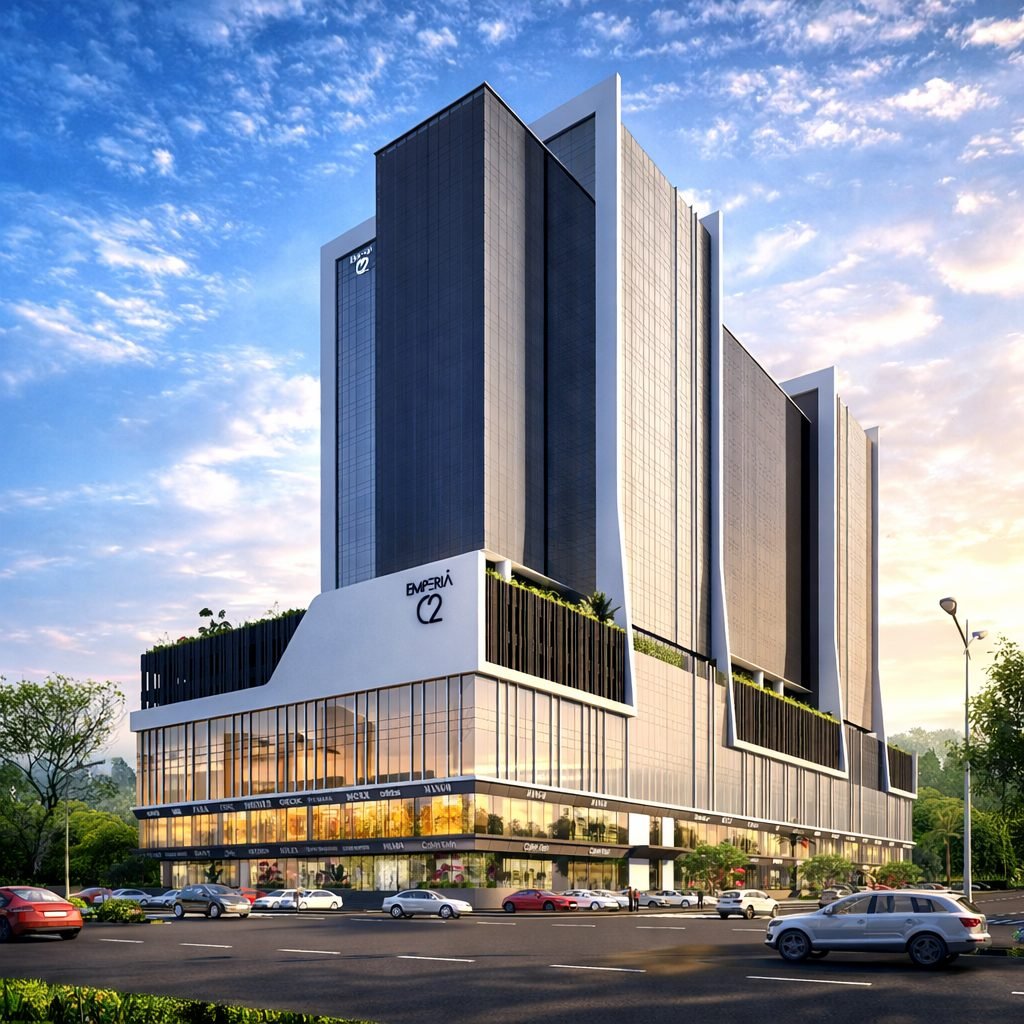
Turbhe and MIDC are the office spine. Close to the harbour line, the highways and the airport corridor, this stretch is where new Grade A office and showroom supply concentrates — see Emperia C2 in Turbhe.
Commercial is a different discipline. Tenant quality, lease structure, vacancy risk and GST all matter far more than they do for a home. The upside is real; so is the homework.
Buy a leasable asset in a connected node, RERA-clean, at launch. That is where the yield and the appreciation both concentrate. Our live commercial picks sit on exactly that map.
From our desk: the most common mistake we see is a residential investor buying commercial as if it were a bigger flat. Commercial value is made by the tenant and the lease, not the address alone. A connected unit with a strong, long-locked tenant beats a prettier vacant one in a thinner location almost every time. This guide is about reading the lease and the location together.
Direct answer: Navi Mumbai is one of the few places in the metropolitan region where the case for commercial property rests on fundamentals rather than hope — it is a planned city with an existing industrial and office base, deep and improving connectivity, a large and growing workforce, and now a live international airport that adds a structural new layer of business demand. For an investor who wants income today and appreciation over a cycle, that combination is rare, and 2026 sits at an unusually favourable point in it.
Start with what already exists. Navi Mumbai was not built around a single industry that can leave; it was planned node by node with industrial estates, office districts, a banking and government hub and retail cores designed in from the start. The MIDC belt through Turbhe and Mahape has decades of manufacturing, logistics and back-office tenancy behind it. The Belapur CBD houses banks, government offices and corporate headquarters. The Airoli–Ghansoli stretch has grown into a genuine IT and back-office belt. This is not a speculative business district waiting to be invented; it is a working one with established rent rolls, which is exactly what gives a commercial buyer confidence that a unit can actually be let.
Then layer on what is arriving. The Navi Mumbai International Airport is the single biggest commercial-demand trigger the region has seen in a generation, because an airport does not just move passengers — it pulls hotels, offices, cargo and logistics businesses, exhibition and convention space, and the whole aerocity economy toward itself. The Atal Setu sea-link collapses the distance to South Mumbai, the metro stitches the inner nodes together, and the NAINA plan opens a large new business region around the terminal. Each of these turns Navi Mumbai from a satellite of Mumbai into a destination in its own right, and destinations are where commercial rents compound.
The investor’s timing argument is simple. Much of this infrastructure is now live or near-live rather than promised, which removes a large slice of the old execution risk, yet a meaningful part of the commercial repricing has not yet happened because the airport’s full demand effect builds over years, not months. That gap — de-risked infrastructure but not-yet-realised demand — is the window a commercial buyer is looking for. The rest of this guide is about locating the specific nodes, asset types and lease structures where that window is widest, and avoiding the ones where the story is louder than the substance.
2. Commercial vs residential: the investor’s trade-off
Direct answer: Commercial property and residential property are different instruments, not different sizes of the same thing — commercial pays far higher rental yield and is valued largely on its tenant and lease, while residential pays low yield but is easier to finance, easier to sell and far simpler to own. The right choice depends on whether you want income or simplicity, and most investors move toward commercial only once they have the capital, the holding power and the appetite for the extra homework it demands.
The headline difference is yield. A residential flat in the region typically returns somewhere around 2–3.5% gross rent a year against its price, because home prices are driven by owner-occupier demand rather than rental maths. A well-located, well-let commercial unit — an office, a showroom, a warehouse — commonly returns 6–9% gross, because businesses pay rent out of revenue and value a good location enough to pay for it. Over a long hold, that yield gap compounds into a very large difference in cash returned, which is the core reason serious investors graduate into commercial.
The trade-offs are equally real and run the other way. Commercial loans carry lower loan-to-value ratios, higher interest rates and shorter tenures than home loans, so you bring more of your own capital. Vacancy hurts more, because a single tenant leaving an office can mean months of zero income, where a flat re-lets quickly into a deep residential pool. The legal and tax layer is heavier — GST applies to commercial rent and often to purchase, leases are complex contracts with lock-ins and escalations, and the diligence on a tenant and a title is more involved. And commercial is less liquid: the buyer pool is smaller and more discerning, so exits take longer and depend more on the asset’s lease at the time of sale.
The practical way to decide is to be honest about your stage and temperament. If you want a simple store of value with a clean exit and modest income, residential is the lower-effort instrument. If you want to maximise income and are willing to underwrite tenants, structure leases, manage vacancy and carry the heavier tax and financing load, commercial is the higher-return one. Many investors hold both — residential for stability and a clean exit, commercial for yield — and use the airport-belt growth in Navi Mumbai to anchor the commercial side of that barbell.
3. The types of commercial property
Direct answer: “Commercial property” covers several quite different assets — offices, retail and showroom space, warehousing and logistics, co-working and managed space, and specialised formats such as clinics or restaurants — and each has its own tenant pool, yield band, risk profile and ideal location. Choosing the type is the first real decision, because it determines almost everything else about how the asset behaves.
Offices are the largest and most familiar category. They range from small strata-sold cabins to whole Grade A floors, and their tenants are corporates, IT and back-office firms, professional services and start-ups. Offices reward connectivity to transit and a credible address, and in Navi Mumbai they cluster on the Turbhe–MIDC spine, in Belapur CBD and across the Airoli–Ghansoli IT belt. Yields are solid and tenants on good leases are sticky, but vacancy between tenants can be long, so the lease and the tenant covenant matter enormously.
Retail and showroom space is the high-street category — ground-floor shops, showrooms on arterial roads, and units in or near malls and high-footfall pockets. Its value is made by visibility and footfall, so a showroom on a busy main road in Vashi or near a station commands a premium that an identical unit on a quiet internal lane never will. Retail can yield very well with the right tenant — a bank branch, a brand showroom, a clinic — but it is the most location-sensitive category, and a poorly placed shop can sit vacant for a long time.
Warehousing and logistics is the category the airport and the highways most directly feed. Cargo, e-commerce fulfilment, cold storage and distribution all want large, well-connected sheds near the airport, the port and the expressways, and the Taloja, Mahape and outer-MIDC stretches are the natural home for them. Warehousing typically trades on long leases with strong industrial tenants, which makes income predictable, though entry tickets are larger and the asset is specialised. Alongside these sit newer formats — co-working and managed offices, which convert a vacant floor into a flexible income stream, and specialised units for clinics, restaurants and services — each of which can lift yield but adds operational or fit-out complexity. The investor’s job is to match the type to their capital, their risk appetite and the node’s actual demand, which the map in the next chapters lays out.
4. The commercial yield & EMI calculator
Direct answer: Before you fall in love with a unit, run the money on it as an income asset. A commercial purchase is judged on two numbers at once — the monthly EMI you pay the bank, and the monthly rent the unit earns — and a good deal is one where the rent comfortably services the loan and leaves a real net yield on your own capital. Set the value, tenure and rate below to see the EMI, then read the yield guide that follows to translate it into a return on the cash you actually put in.
Commercial property EMI calculator
Move the sliders. Indicative only — your sanctioned rate, LTV and amount decide the final number.
₹1,04,422
Total interest₹88.0 L
Total amount payable₹1.88 Cr
The way to read the output is in two steps. First, the EMI is what your financing costs each month — and notice that commercial loans usually carry a higher rate and a shorter tenure than a home loan, so the same ticket costs more per month than a residential one would. Second, set the EMI against the rent the unit can earn. If a unit costs one crore and lets for, say, sixty to seventy thousand a month, that is roughly a 7–8.5% gross yield, and whether it makes sense depends on how much of the price you borrowed and at what rate. The asset is genuinely working for you when the net rent, after maintenance, taxes and vacancy allowance, covers the EMI and still returns a healthy figure on your own equity.
Two cautions the calculator cannot show. Commercial rent attracts GST and your income is taxed, so the headline gross yield overstates what reaches you — always model the net. And vacancy is the silent killer of commercial returns: a unit that is empty for four months of a year has lost a third of its annual income, so a slightly lower rent from a strong, long-locked tenant often beats a higher rent from a shaky one. Use the EMI figure as the floor your rent must clear with room to spare, never as a number the rent merely matches. For the deeper mechanics, see our EMI and affordability guide.
5. The Navi Mumbai commercial map
Direct answer: Navi Mumbai’s commercial demand is not spread evenly — it concentrates along a clear spine of nodes, each with its own tenant type and yield character, and knowing the map is what separates a placed, leasable asset from a vacant one. The core stretches are the Turbhe–MIDC office and industrial spine, the Vashi retail-and-office core, the Belapur CBD banking hub, the Airoli–Ghansoli–Mahape IT belt, and the airport-facing logistics belt around Taloja and Dronagiri.
Think of the map as a few overlapping demand pools. The first is the office pool, which runs from Turbhe and the MIDC stretch up through Mahape, Ghansoli and Airoli into the IT belt, and anchors itself on Belapur CBD at the southern end. These nodes draw corporates, IT and back-office firms and professional services, and their value is made by transit access — proximity to the harbour line stations and the highways — and by the credibility of the address. The second is the retail pool, concentrated in the established cores of Vashi and Belapur and along the arterial roads, where footfall and visibility drive value. The third is the logistics pool, which has shifted outward toward Taloja, Mahape’s industrial edge and the airport-and-port-facing belt, where land is larger and cheaper and the tenants are cargo, e-commerce and distribution.
The connectivity overlay is what is changing the map right now. The harbour railway line has long defined where offices want to be, but the new layer — the airport, the Atal Setu sea-link, the metro and the upgraded road grid — is pulling demand toward the nodes that sit on the new connectivity rather than only the old. Turbhe is a clear beneficiary, because it sits where the established MIDC office spine meets the new airport corridor and the highways, giving it both an existing tenant base and a fresh growth driver. That dual position is exactly why the Turbhe stretch is worth a close look for a new commercial buyer, and why the next chapter goes deeper on it.
The investor’s discipline with the map is to buy where a node’s demand pool and its connectivity both point the same way. A unit is leasable when it sits in a node whose tenant type is established, on connectivity that is finished or near-finished, in a format that node actually absorbs. A unit struggles when it is the wrong type for its node — a high-street showroom on an internal industrial lane, or a large office in a node with no office tenants — however attractive the price. Read the map first, then the project.
6. Turbhe & MIDC: the office spine
Direct answer: The Turbhe and MIDC stretch is the practical heart of Navi Mumbai’s commercial office and showroom market, because it combines an established industrial and office tenant base with exactly the new connectivity — the highways, the harbour line and the airport corridor — that is driving the next wave of demand. For a commercial buyer it offers something rare: a node where the tenants already exist and the growth driver is still arriving.
Turbhe’s position on the map is its single biggest asset. It sits on the harbour railway line, close to the Thane–Belapur road and the Sion–Panvel artery, and within the airport-corridor catchment, which means a business located here can reach the rest of Navi Mumbai, the highways, the airport and the wider region with unusual ease. The surrounding MIDC industrial estate has decades of manufacturing, logistics, warehousing and back-office tenancy, so the area is not waiting to attract its first occupiers — it already has a deep, working base of businesses that need office, showroom and commercial space nearby.
What makes Turbhe interesting now rather than just stable is the new supply of organised, Grade A commercial space arriving to meet that demand. As older industrial plots redevelop and modern commercial projects come up, the stretch is shifting from purely industrial to a mixed office-and-showroom character, which is precisely the transition that lifts commercial values — better buildings command better tenants and better rents. A project such as Emperia C2 in Turbhe sits in exactly this position: organised commercial space on an established spine, with the airport corridor as a growth tailwind. For a buyer it is the kind of node where a leasable asset can be acquired at a stage where the tenant base is real but the airport repricing is not yet fully in the price.
The diligence on Turbhe is the diligence on any office node, sharpened to the spot. Confirm the exact walking distance to the nearest harbour-line station and the road access, because office tenants pay for transit. Check the building’s grade, floor plates, parking and power backup, since corporate and back-office tenants screen hard on these. Verify the project’s RERA status and the developer’s delivery record. And read the local tenant demand honestly — what kinds of businesses are actually leasing nearby, at what rents, and how quickly — so you buy the format the node absorbs. Turbhe rewards the buyer who treats it as a working office market with an airport tailwind, not as a speculative bet on the airport alone.
7. Vashi: the established retail-office core
Direct answer: Vashi is Navi Mumbai’s most mature and complete commercial core — the closest the city has to a finished high street and office district in one — which makes it the lowest-risk, highest-liquidity place to buy commercial, at the cost of the lower upside that comes with growth already in the price. For an investor who values certainty and an easy exit over raw appreciation, Vashi is the belt’s safest commercial address.
Vashi’s strength is its completeness. It has the established retail high streets, the malls and the footfall, a deep office base, excellent harbour-line connectivity and a settled, affluent residential catchment around it. That maturity means a well-placed showroom or office in Vashi rarely sits vacant for long — there is a real, standing pool of tenants and buyers — and that liquidity is itself valuable, because it makes both letting and exiting easier than almost anywhere else in Navi Mumbai. A bank branch, a brand showroom, a clinic or a corporate office in the right Vashi location is about as close to a blue-chip commercial holding as the city offers.
The trade-off is exactly what you would expect from a finished market: the yield and the appreciation are more modest, because the growth that a frontier node still promises has already been delivered and priced. You are paying for certainty and liquidity rather than for a growth story, which is the right deal for some investors and the wrong one for others. Vashi also rewards precision within the node — a unit on a busy retail street or near a station behaves completely differently from one on a quiet internal road — so the micro-location matters as much as the node.
For the new commercial buyer, Vashi is best understood as the anchor end of a portfolio rather than the growth end. It is where you put capital you want to keep safe and liquid, earning a steady, reliable yield, while you take your growth exposure in a connected, still-repricing node such as Turbhe. Used that way — Vashi for stability, the airport-corridor nodes for upside — the two ends of the Navi Mumbai commercial market complement each other rather than compete.
8. Belapur CBD: the banking & government hub
Direct answer: Belapur’s central business district is Navi Mumbai’s institutional core — the planned hub of banks, government offices, corporate headquarters and large organised office space — which gives it a distinctive tenant profile of stable, creditworthy, long-staying occupiers that many investors prize above all others. It is the node to consider when you want institutional-grade tenants and are buying office rather than retail.
The CBD was designed from the start as Navi Mumbai’s command centre, and that planning shows. It carries wide roads, large planned plots, a concentration of banking and government institutions, and the kind of organised Grade A office stock that big tenants require. Those tenants — banks, public-sector bodies, established corporates — are exactly the covenant a commercial landlord wants: they sign long leases, they pay reliably, and they rarely leave on short notice, which converts an office holding here into a predictable income stream rather than a vacancy gamble. Belapur also enjoys strong connectivity, sitting on the harbour line with good road links and metro access, which keeps it accessible to the workforce that fills those offices.
The flip side of institutional strength is that Belapur is a mature, large-format market that does not always suit a smaller individual buyer. Much of the prime stock is large floor plates aimed at big tenants, entry tickets can be high, and the growth, like Vashi’s, is substantially in the price already. A retail investor may find fewer right-sized, affordable units here than in a node like Turbhe, and the appreciation runway is gentler than on the airport-corridor frontier. Belapur is about quality and stability of income, not about a rapid repricing story.
For an investor, the way to use Belapur is as the institutional-quality slice of a commercial portfolio — the place to hold a well-let office with a strong tenant covenant for steady, low-drama income, if and when a right-sized unit is available at a sensible entry. Pair that stability with the growth of the Turbhe–MIDC spine and the upside of the airport corridor, and you have a commercial position that spans the full risk spectrum from blue-chip income to growth. As always, verify the specific building’s grade, tenant and lease before treating the node’s reputation as the unit’s guarantee.
9. Airoli, Ghansoli & Mahape: the IT belt
Direct answer: The northern stretch of Airoli, Ghansoli and Mahape is Navi Mumbai’s IT and back-office belt — a band of business parks, technology campuses and organised office space that draws software, IT-enabled-services and corporate back-office tenants — and it offers a commercial buyer exposure to the city’s most modern, fastest-growing white-collar demand pool. It is the node to consider when you want to ride the IT and corporate-services story specifically.
This belt grew up around the demand for large, modern, well-serviced office space that the IT and back-office industries need, and it shows in the building stock: organised business parks, bigger floor plates, better power and connectivity infrastructure, and a tenant base of technology and services firms rather than traditional industry. Airoli’s proximity to Thane and the Eastern Express Highway corridor, Ghansoli’s position on the harbour line, and Mahape’s established IT-park base together make this one of the most active office-demand pools in the city, with tenants who value modern space and good transit and are willing to pay for both.
For the connectivity story, this belt benefits from its links toward Thane and the central suburbs as well as the harbour line, and it stands to gain further as the wider Navi Mumbai transit and road grid deepens. The IT and back-office tenant pool is also relatively resilient and growing, which supports both occupancy and rent over a cycle, though it is more exposed than, say, government tenancy to swings in the technology sector’s hiring and space appetite. That cyclicality is the main risk to weigh: the belt does best when the IT and services economy is expanding, and softens when those firms pull back on space.
An investor looking at this belt should buy modern, well-specified office space in an organised project with genuine transit access, and should underwrite the tenant pool’s health rather than assume it. Check what kinds of firms are leasing nearby and on what terms, confirm the building’s grade and infrastructure since IT tenants screen hard on power, connectivity and floor plates, and verify the project’s RERA and delivery credentials. Used well, the Airoli–Ghansoli–Mahape belt adds modern, growth-oriented office exposure to a Navi Mumbai commercial portfolio, complementing the airport-corridor and CBD slices.
10. The airport effect on commercial demand
Direct answer: A major airport is one of the most powerful commercial-demand generators that exists, because it pulls an entire ecosystem of businesses toward itself — hotels, offices, cargo and logistics, exhibition and convention space, retail and services — and the Navi Mumbai International Airport is now beginning to exert exactly that pull on the commercial market around it. For a commercial investor, the airport is not a residential story borrowed for offices; it is a direct, structural new source of business tenancy.
The mechanism is well understood from airports the world over. Around a major terminal, a predictable cluster of commercial activity forms — an aerocity of hotels for travellers and crew, offices for the airlines, freight forwarders, customs and logistics firms that the airport’s operations require, large warehousing and cold-storage facilities for cargo, convention and exhibition space that proximity to an airport makes valuable, and the retail and services that all of this generates. This cluster is not speculative; it is the natural commercial footprint of a working airport, and it grows steadily as the terminal ramps up flights and freight.
For Navi Mumbai, this means the airport adds a new, distinct demand pool on top of the existing office, retail and IT pools — an airport-and-logistics pool concentrated in the nodes that face the terminal and sit on the cargo-and-highway corridors. The Turbhe spine, with its established office base and its position on the airport corridor and highways, is well placed to capture the office and showroom side of this demand, while the Taloja, Mahape-edge and airport-facing belts are positioned for the warehousing and logistics side. The sea-link, metro and road grid that serve the airport also lift the broader commercial accessibility of the whole region, deepening every demand pool at once.
The investor’s discipline here mirrors the residential one: buy the connectivity and the demand pool, not the airport headline. The commercial nodes that benefit are the ones genuinely on the airport’s business corridor with finished access, in formats the airport economy actually absorbs — offices and showrooms on the connected spine, warehousing on the logistics belt. A unit far from the corridor, or in a format the airport economy does not need, gains little from the terminal however close it looks on a map. Read the airport effect as a real but located force, concentrate where it lands, and verify the specific node’s access and tenant demand before paying an airport premium.
11. Rental yields: what commercial actually pays
Direct answer: The reason investors buy commercial is yield — a well-located, well-let commercial unit in Navi Mumbai commonly returns a gross 6–9% a year against its price, against roughly 2–3.5% for residential — but the number that matters is the net yield after maintenance, taxes, GST and a realistic vacancy allowance, which is always lower than the headline. Underwriting the net, not the gross, is the single most important habit in commercial investing.
Gross yield is simply the annual rent divided by the price, and it varies by asset type and node. Warehousing and logistics on long industrial leases can sit at the higher end of the band because the assets are cheaper per square foot and the leases are long; Grade A offices in strong nodes sit in the middle with solid, stable tenants; prime retail can spike high with the right footfall-driven tenant or disappoint badly with the wrong one. A realistic working range for a sensibly bought, well-let Navi Mumbai commercial unit is a gross yield somewhere in the 6–9% region, but treat any specific quote as a claim to verify against comparable lettings nearby, not as a promise.
Net yield is where the real return lives, and it is meaningfully below gross. From the rent you subtract maintenance and common-area charges you bear, property tax, the cost of any vacancy between tenants, brokerage on re-letting, and the tax on your rental income — and you account for GST, which applies to commercial rent and changes the cash flows. A unit advertised at an 8% gross yield might net closer to 6% once these are honestly modelled, and that net figure, measured against the equity you actually put in after the loan, is the true return on your capital. An investor who underwrites only the gross is consistently disappointed; one who models the net is rarely surprised.
The yield discipline also guides what to buy. A slightly lower gross yield from a strong, long-locked tenant in a connected node usually produces a higher and steadier net yield than a higher gross from a weak tenant in a thin location, because the second carries vacancy and re-letting risk the first does not. Yield is not just a number to maximise on day one; it is an income stream to protect over a hold, and protecting it means buying tenant quality and location as much as headline rent. Build your case on a conservative net yield that survives a vacancy or two, and the commercial maths works in your favour over a cycle.
Direct answer: In commercial property the lease is the asset, and its structure — the lock-in period, the rent-escalation clause, the security deposit and the common-area-maintenance arrangement — determines how much income you actually capture and how protected it is. Reading and negotiating these terms is the core skill of commercial investing, far more than choosing a pretty building.
The lock-in period is the tenant’s commitment. A commercial lease typically runs for a set term — often structured in blocks such as a longer overall term with a shorter lock-in — during which the tenant cannot leave without penalty. A longer lock-in with a creditworthy tenant is gold for a landlord, because it guarantees income and makes the asset far easier to finance and to sell; a short or weak lock-in leaves you exposed to early vacancy. When you evaluate a pre-leased unit, the strength and remaining length of the lock-in is one of the first things to check, because it is much of what you are paying for.
The escalation clause is how the rent grows. Commercial leases usually build in periodic rent increases — a fixed percentage every few years — so that your income rises over the hold rather than staying flat while costs and prices climb. A healthy escalation clause is what keeps a commercial yield from eroding in real terms over a long lease, and its absence or weakness is a quiet drag on returns. Alongside it, the security deposit — often several months of rent held against default and damage — protects your downside, and a thin deposit from a weak tenant is a warning sign.
Common-area maintenance, or CAM, is the often-overlooked detail that decides who bears the cost of running the building — lobbies, lifts, security, common power and upkeep. Whether CAM is the tenant’s responsibility or the landlord’s materially changes your net yield, and an investor who reads only the rent and ignores the CAM arrangement can be surprised by how much of the income the building’s running costs consume. The discipline across all of these is the same: the headline rent is only the start; the lock-in protects it, the escalation grows it, the deposit secures it and the CAM arrangement determines how much of it you keep. Read the whole lease, not just the number on the first page, and where you can, buy assets whose leases are structured in the landlord’s favour with strong tenants.
13. Grade A vs Grade B offices
Direct answer: Office space is informally graded by quality — Grade A means modern, well-built, well-managed buildings with good floor plates, power backup, parking and amenities, while Grade B means older or less-specified stock — and the grade drives the tenant pool, the rent, the vacancy risk and the resale liquidity. For most investors, a well-located Grade A unit is the safer long-term hold even at a higher entry price.
Grade A buildings attract the strongest tenants — corporates, established IT firms, professional-services companies — because these occupiers screen hard on building quality, infrastructure and address, and will not house their operations in sub-standard space. That tenant quality flows straight into the investment: stronger covenants, longer leases, more reliable rent, lower vacancy risk and a deeper pool of future buyers when you exit. The premium you pay for Grade A is, in effect, the price of a better and more durable income stream, and over a long hold it usually justifies itself through lower vacancy and stronger appreciation.
Grade B space can still be a reasonable investment in the right hands, but it carries more risk and demands more management. Its tenants are smaller, less established firms with weaker covenants and shorter leases, vacancy between tenants tends to be longer, and the resale pool is thinner. The case for Grade B is price — a higher headline yield on a lower entry — but that yield has to be discounted for the higher vacancy and re-letting risk, and the asset is harder to finance and to sell. Grade B suits an experienced, hands-on investor who can actively manage tenancy, not a first-time commercial buyer looking for a passive income asset.
The practical guidance for a new commercial buyer in Navi Mumbai is to favour well-located Grade A or near-Grade-A space in a connected node, even at a higher price, because it minimises the two things that hurt commercial returns most — vacancy and illiquidity. The modern organised projects coming up on the Turbhe–MIDC spine and across the IT belt are largely in this category, which is part of what makes them suitable entry points. Verify the specifics — floor plates, power backup, parking, lift and amenity provision, building management — rather than taking a marketing “Grade A” label at face value, because the grade is defined by the building’s actual specification and management, not by the brochure.
14. Pre-leased vs vacant commercial
Direct answer: A commercial unit can be bought either pre-leased — already let to a tenant on a running lease — or vacant, and the two are almost different investments. Pre-leased gives you immediate, known income and lower risk at a higher price and lower headline yield; vacant gives you a cheaper entry and higher potential yield in exchange for the risk and effort of finding a tenant. The right choice depends on your appetite for risk and your ability to let space.
Pre-leased commercial is the lower-risk path and the one most passive investors prefer. You buy an asset that is already producing rent from a known tenant on a known lease, so your income starts on day one and your underwriting is concrete — you can read the actual tenant covenant, lock-in, escalation and deposit rather than estimating them. The price reflects this certainty: pre-leased units trade at a premium and therefore a lower headline yield than equivalent vacant ones, because you are buying away the leasing risk. The key diligence shifts entirely to the lease and the tenant — how strong is the covenant, how long is the remaining lock-in, how market-aligned is the rent, and what happens at lease end — because those terms are most of what you are paying for.
Vacant commercial is the higher-risk, higher-effort path with more upside for the capable investor. You buy at a lower price, with no income until you let the unit, and you carry the full risk that letting takes longer or happens at a lower rent than you hoped. The reward is that you capture the full yield yourself rather than paying a previous landlord a premium for the lease they secured, and you control the tenant selection and lease terms. Vacant suits an investor who understands the local leasing market, has the holding power to carry an empty unit for a while, and can either find tenants directly or work effective brokers — in the right connected node with real demand, the leasing risk is manageable and the extra yield is genuine.
For a first-time commercial buyer in Navi Mumbai, the safer default is pre-leased in a strong node if a well-let unit at a sensible price is available, because immediate income and concrete underwriting reduce the learning-curve risk. A buyer with more experience, more risk appetite or a strong read on a specific node’s leasing demand — such as the office demand on the Turbhe spine — can do well buying vacant at launch and capturing the full yield by letting it themselves. Either way, the discipline is the same: with pre-leased, scrutinise the lease; with vacant, scrutinise the leasing market. The asset’s value lives in the tenancy either way.
15. GST & taxation on commercial property
Direct answer: Commercial property carries a heavier tax layer than residential — GST applies to the purchase of under-construction commercial units and to commercial rent, and your rental income and any capital gain are taxable — and ignoring this layer is one of the most common ways investors overstate their returns. Model commercial returns after tax, not before, and take professional advice on your specific position.
On purchase, GST applies to under-construction commercial property at the applicable rate, which is different from the concessional residential rates — so the tax on buying a commercial unit under construction is a real, sizeable addition to the price that must be built into your cost base from the start. A ready, completed commercial unit with its occupancy certificate is generally outside GST on the sale in the way a completed residential resale is, but the under-construction position is materially different, and you should confirm the exact treatment for your specific transaction. Our GST guide covers the residential side and the principles that carry over.
On rent, commercial leasing attracts GST in a way residential letting does not — renting commercial space is a taxable supply, which affects both your cash flows and your tenant’s costs, and changes how you must invoice and account for the rent. This is a key reason the gross yield overstates the net: the GST and compliance layer on commercial rent is a real cost of doing business that residential landlords simply do not face. Whether and how you can offset input tax credits depends on your specific structure, which is exactly the kind of thing to confirm with a tax professional before you buy rather than after.
On income and exit, your rental income is taxable as income, and any gain when you sell is subject to capital-gains tax, with the rate and any indexation or reinvestment relief depending on how long you held and the specifics of the law at the time. The practical investor’s habit is to model the whole tax journey — GST on purchase if under-construction, GST and income tax on rent through the hold, and capital-gains tax on exit — into the return from the outset, so the net figure you underwrite is the one you actually keep. Commercial property can still return very well after all of this, but only if the after-tax maths is done honestly upfront. Treat tax as a core part of the deal, not an afterthought, and take specific professional advice for your situation.
16. Stamp duty & registration on commercial
Direct answer: Buying commercial property in Maharashtra carries stamp duty and registration charges just as residential does, and these are a meaningful percentage of the price that must be in your cost base from the start — on a commercial purchase you should budget for stamp duty plus registration on top of the price, GST if under-construction, and the legal and transaction costs of a more complex deal. The headline price is never the whole cost.
Stamp duty is a state levy charged as a percentage of the property’s value, and it applies to the conveyance of commercial property in the same broad framework as residential, though you should confirm the exact applicable rate and any commercial-specific nuances for your transaction at the time of purchase. Registration charges are a further, smaller percentage to register the document with the sub-registrar, which is what gives your ownership its legal standing. Together these are not trivial — on a commercial ticket they translate into a substantial cash amount that you pay at completion and never recover, so they belong in your acquisition cost and your return calculation from day one. Our stamp duty and registration guide sets out the framework in detail.
Commercial transactions also tend to carry heavier surrounding costs than residential ones, because the diligence and documentation are more involved. You are more likely to need professional legal review of the title and the lease, a more careful examination of the developer’s commercial approvals, and more complex agreements — particularly if you are buying pre-leased and inheriting an existing tenancy. These professional and transaction costs are real and should be budgeted; trying to save on diligence in a commercial deal is a false economy, because the downside of a title or lease problem on a commercial asset is large.
The disciplined way to handle all of this is to build a complete acquisition cost before you commit — price, stamp duty, registration, GST if applicable, legal and diligence fees, and any brokerage — and to underwrite your yield and return against that full number rather than the sticker price. An investor who measures returns against the headline price alone consistently overstates them; one who measures against the all-in cost knows the real figure. Get a precise, current quote for stamp duty and registration on your specific transaction from a professional, because rates and concessions change, and confirm the exact treatment rather than relying on a general figure.
17. Financing a commercial purchase
Direct answer: Commercial property is financed differently from a home — lenders offer lower loan-to-value ratios, charge higher interest rates and grant shorter tenures than on home loans — so a commercial purchase demands more of your own capital and produces a higher monthly EMI per rupee borrowed than a residential one. Plan the financing as carefully as the asset, because the loan terms materially change the return on your equity.
The first difference is the loan-to-value ratio. Where a home loan might fund a large share of the property’s value, a commercial loan typically funds a smaller share, meaning you must bring more equity to the table. That higher equity requirement is the main reason commercial is a later-stage investment — it ties up more of your own capital per deal — and it is also why the return on equity, not just the yield on price, is the number that matters: a strong yield on a heavily self-funded purchase can still be a modest return on the cash you put in. Model the deal on the equity you actually deploy.
The second and third differences are rate and tenure. Commercial loans carry higher interest rates than home loans, reflecting the lender’s view that commercial assets are higher-risk, and they are usually granted over shorter tenures, which raises the monthly EMI for a given amount. The calculator earlier in this guide reflects this with a higher default rate and shorter tenure than a residential one would use. The practical effect is that the rent must clear a higher EMI hurdle to make the deal work, which reinforces the earlier discipline: buy assets whose net rent covers the EMI with real headroom, not ones where the rent merely matches it.
Lenders also underwrite commercial deals more rigorously, scrutinising the asset, the location, the developer, and — for a pre-leased unit — the tenant and lease, because a strong lease to a creditworthy tenant materially de-risks the loan. This means a well-let asset in a strong node is not only a better investment but also easier and cheaper to finance, while a vacant unit in a thin location is harder to fund. Approach financing as part of the diligence: get a clear read on the LTV, rate and tenure you will actually be offered before you commit, build the resulting EMI into your net-yield underwriting, and ensure your equity and holding power are sufficient to carry the asset through a vacancy. For the underlying EMI mechanics, see our EMI and affordability guide.
18. RERA & legal due diligence
Direct answer: Commercial property demands the same RERA and title diligence as residential plus an extra layer for the tenancy and the commercial approvals, and skipping it is far more dangerous on a commercial asset because the tickets are larger and the problems harder to unwind. Verify the project’s RERA registration, the clean title, the developer’s track record and — for pre-leased units — the lease and tenant, before you part with money.
Start with RERA. Commercial real-estate projects, like residential ones, are required to be registered with MahaRERA, whose portal carries the project’s registration, approvals, timelines and the developer’s other projects and any complaints against them. Confirming the registration and reading the filings tells you whether the project is legitimate, whether its approvals are in order, and whether the developer has a history of delivering on time or of disputes — all of which matter as much for a commercial buyer as a residential one. Our RERA verification guide walks through how to read the portal.
Next, the title and approvals. A clean, marketable title verified by a competent property lawyer is non-negotiable, and on commercial property you should also confirm that the project has the specific approvals and permitted use for commercial occupation — that the building and the unit are legally usable for the commercial purpose you intend, with the right zoning, occupancy and any trade-specific permissions. A unit that cannot be legally used as you intend, or whose title is clouded, is a far costlier mistake on a large commercial ticket than on a flat. Invest in proper legal review; it is cheap insurance against an expensive problem.
Finally, for pre-leased units, diligence the tenancy as carefully as the title. Read the actual lease — the tenant’s identity and creditworthiness, the lock-in, the escalation, the deposit, the CAM arrangement, the remaining term and what happens at its end — and verify that the rent is being paid and the lease is genuine and enforceable, not a paper arrangement to flatter the sale. For a vacant unit, the diligence is on the leasing market and the developer instead. Across all of this, the principle is that a commercial purchase rewards thorough, professional diligence more than almost any other property decision, because the downside of a legal, title or lease problem on a large, illiquid commercial asset is severe. Do the homework, use professionals, and verify before you commit.
19. The real risks & how to manage them
Direct answer: The genuine risks in commercial investing are vacancy, tenant default, oversupply, illiquidity, the cyclicality of business demand, and execution risk on under-construction projects — and each is manageable with the right asset selection and discipline rather than a reason to avoid commercial altogether. Knowing the risks and buying to mitigate them is what separates a sound commercial investor from a burned one.
Vacancy is the largest risk and the one that most often turns a good-looking yield into a poor return. A commercial unit between tenants earns nothing while still costing maintenance, tax and EMI, and commercial vacancy can run for months because the tenant pool is narrower than residential. You manage it by buying in connected nodes with real, deep demand for the asset type, favouring pre-leased units with long lock-ins or, for vacant units, only buying where you have a confident read on letting. Tenant default is the related risk — a tenant who stops paying or fails — managed by underwriting tenant creditworthiness, holding a solid security deposit, and preferring strong covenants over slightly higher rent from a weak one.
Oversupply and cyclicality are market-level risks. If a node sees a glut of new commercial supply, rents and occupancy soften for everyone, so it pays to read how much competing space is coming up before you buy. And commercial demand follows the business cycle — office and IT demand in particular rise and fall with corporate hiring and the economy — so an asset bought at the top of a cycle into a frothy market carries more risk than one bought into a recovering one with an infrastructure tailwind. The Navi Mumbai airport story is a genuine structural tailwind that partly offsets cyclicality, but it does not suspend the cycle, and you should not assume it does.
Illiquidity and execution risk round out the list. Commercial sells more slowly and to a narrower pool than residential, so plan a longer exit horizon and keep the asset’s lease strong, because a well-let asset sells far faster than a vacant one. On under-construction projects, execution risk — delay or developer failure — is managed by buying from credible, RERA-registered developers with delivery track records and by staging payments to construction. None of these risks is a reason to stay out of commercial; together they are a specification for how to buy it well — connected nodes, strong tenants, sound leases, credible developers, realistic horizons and honest underwriting. Manage the risks deliberately and the higher commercial return is available; ignore them and the higher yield is illusory.
20. How to evaluate a project at launch
Direct answer: Evaluating a commercial project at launch comes down to a disciplined checklist — the node and its demand pool, the developer’s credibility, the building’s grade and specification, the RERA and legal position, the realistic rent and yield, and the price against comparable space — run in order, with the deal-breakers checked first. Launch can offer the best entry price, but only if the project passes the homework.
Begin with the node and the demand, because no amount of building quality rescues the wrong location. Confirm that the project sits in a node whose tenant type is established and whose connectivity is finished or near-finished, in a format that node actually absorbs — an office on a connected office spine, a showroom on a high-footfall road, warehousing on a logistics belt. For Navi Mumbai, that means reading the commercial map from earlier in this guide honestly against the specific site: a well-located office launch on the Turbhe–MIDC spine, for example, sits in a node with real office demand and an airport tailwind, which is the kind of fundamental that supports a launch entry.
Then assess the developer and the building. Check the developer’s track record, financial strength and delivery history through their RERA filings and past projects, because at launch you are buying a promise and the developer’s credibility is your main protection against delay or failure. Examine the building’s grade and specification — floor plates, power backup, parking, lifts, amenities, management — against what the node’s tenants require, since the grade drives the tenant pool and therefore the rent and vacancy risk. A modern, well-specified building from a credible developer in the right node is the combination launch buyers are looking for.
Finally, run the money and the legal position together. Verify the RERA registration and have a lawyer confirm the title and the commercial approvals and permitted use. Establish a realistic rent by checking what comparable space actually lets for nearby, translate it into a conservative net yield after all costs and a vacancy allowance, and measure that against the all-in acquisition cost including stamp duty, GST and fees. Then judge the launch price against comparable space and against the upside the node’s growth story offers. A project that clears the node, the developer, the building, the legal and the yield tests at a launch price below comparable ready space is the kind of opportunity launch is meant to provide — and one that fails any of the deal-breaker tests is not rescued by a low price. Evaluate in that order, and use professionals for the legal and tax pieces.
21. Tenant profile & vacancy risk
Direct answer: In commercial property the tenant is much of the asset, so the tenant profile a unit can attract — and how reliably it can be kept occupied — is central to its value. The best commercial holdings draw strong, creditworthy, sticky tenants on long leases in formats and nodes with deep demand; the riskiest depend on a thin pool of weak tenants in locations where vacancy runs long.
Tenant quality is a spectrum, and where your unit sits on it shapes your whole experience as a landlord. At the strong end are institutional and corporate tenants — banks, established corporates, large IT and services firms — with solid covenants, long leases and a low propensity to leave, the kind concentrated in Belapur CBD and the better Grade A office stock. At the weaker end are small, young or under-capitalised firms with thin covenants and short horizons, more common in lower-grade space and thinner nodes. The stronger the tenant your unit can attract, the more reliable your income, the longer your leases, the lower your vacancy risk and the easier your eventual exit — which is why the quality of the achievable tenant pool, not just the headline rent, should drive your purchase.
Vacancy risk is the direct consequence of tenant pool depth, and it is the metric that most distinguishes a good commercial location from a bad one. A unit in a connected node with a deep, active demand for its asset type re-lets quickly when a tenant leaves, limiting the income gap; a unit in a thin or wrong-format location can sit empty for many months, devastating its effective yield. This is why the location and format discipline from the map chapters matters so much: you are buying the depth of the tenant pool as much as the building. Before you buy, ask honestly — if my tenant left tomorrow, how quickly and at what rent could I re-let this exact unit in this exact node? — and let the answer weigh heavily.
Managing tenant and vacancy risk is an active discipline through the hold, not just a purchase decision. Favour assets that attract strong tenants on long, well-structured leases with solid deposits; keep the building well-maintained and competitively positioned so it retains and attracts good tenants; stay aware of the local leasing market and competing supply so you can re-let promptly and price realistically; and build a vacancy allowance into your underwriting so a gap between tenants does not break your numbers. The airport-driven growth and the established demand pools in Navi Mumbai’s connected nodes give a careful investor access to good tenant pools, but the unit still has to be the right format in the right node with the right specification to capture them. Buy the tenant pool, protect the occupancy, and the income follows.
22. Five worked investor scenarios
Direct answer: The right commercial buy depends entirely on the investor’s capital, goal and risk appetite, so the clearest way to make this guide concrete is to walk through five distinct investor profiles and the Navi Mumbai commercial approach that fits each. Find the one closest to your situation and use it as a starting frame, not a prescription — then run the specific numbers and diligence the guide sets out.
The first-time commercial investor moving up from residential wants income without taking on too much risk while learning the asset class. The fitting approach is a smaller, pre-leased Grade A or near-Grade-A unit in a strong, connected node — an office on the Turbhe–MIDC spine with a sound tenant and a long lock-in, or a well-let unit in Vashi for maximum liquidity. Immediate income, concrete underwriting and an easy exit reduce the learning-curve risk, and the buyer pays a premium for that certainty knowingly. The yield-focused investor with more capital and experience wants to maximise net return and can underwrite tenants and structure leases. They might buy vacant at launch on the Turbhe spine and capture the full yield by letting it themselves, or take on warehousing on the logistics belt with a long industrial lease, accepting the higher effort and risk for the higher return.
The growth investor is buying the airport story for appreciation as much as income, and is comfortable holding through the middle of the cycle. Their approach is a well-located unit in a connected, still-repricing node on the airport corridor — an office or showroom on the Turbhe stretch where the tenant base is real but the airport premium is not yet fully in the price — held for the multi-year repricing as the terminal ramps up. The stability investor, by contrast, wants blue-chip income with minimal drama and is content with a gentler return. They look to Belapur CBD or prime Vashi for an institutional-quality tenant on a long lease, treating the holding as a bond-like income stream rather than a growth bet.
The portfolio investor with substantial capital wants to span the risk spectrum rather than concentrate in one bet. Their approach is a barbell: an anchor of stable, liquid income in Vashi or Belapur, a growth slice on the Turbhe–MIDC airport-corridor spine, and perhaps a higher-yield logistics holding on the outer belt — diversifying across node, asset type and risk so that no single tenant, node or cycle dominates the outcome. Across all five profiles the disciplines are constant: buy the connectivity and demand pool, underwrite the net yield and the tenant, structure or scrutinise the lease, account for the full tax and acquisition cost, and use credible developers and professional diligence. The profile sets the strategy; the discipline makes it work.
23. Exit & resale of commercial
Direct answer: A commercial asset is sold on its lease as much as its bricks, so the exit you can expect depends heavily on the tenancy at the time of sale — a well-let unit with a strong tenant and a long remaining lease sells faster and at a better price than an equivalent vacant one — and commercial is less liquid than residential, so plan a longer exit horizon and keep the asset sale-ready throughout the hold. Buy with the exit in mind.
The single biggest driver of a commercial exit is the lease. A buyer of commercial property is buying an income stream, so a unit that comes with a strong, creditworthy tenant on a long remaining lock-in with sound escalations is far more attractive — and commands a far better price and a quicker sale — than the same unit standing vacant, which forces the buyer to take on the full leasing risk. This is why keeping your asset well-let, with the lease in good order, is not just an income strategy through the hold but an exit strategy: the best time to sell is often when the asset carries a strong, long lease that the next investor will pay a premium for.
Liquidity is the constraint to plan around. The commercial buyer pool is narrower and more discerning than the residential one, so even a good asset can take longer to sell, and the achievable price is more sensitive to the asset’s lease, the node’s standing and the point in the business cycle. The practical implication is to hold commercial with a longer and more flexible exit horizon than residential, to avoid being a forced seller into a weak market, and to keep enough financial cushion that you can choose your moment rather than having it chosen for you. An investor who needs a quick, certain exit is better suited to residential or to the most liquid commercial nodes like Vashi.
Plan the exit mechanics from the start. Keep the title, the lease, the payment and tax records and the building documentation in clean order, because a fully papered, well-let asset transacts faster and at a better price than one with gaps a buyer’s lawyer must chase. Understand the capital-gains position on a commercial sale and factor brokerage and transaction costs into your expected net. And time the sale with both the asset’s lease and the cycle in mind — selling a strongly-let asset into a confident market, ideally as the airport-driven repricing matures, is how the structural gain actually lands in your pocket. The investors who treat the purchase as the whole transaction are surprised at exit; the ones who plan the round trip keep the return.
24. Your commercial buying checklist
Direct answer: A disciplined commercial purchase follows a clear sequence — fix your strategy and capital, choose the asset type and node, run the yield and financing maths, diligence the project, lease and legal position, and only then commit — with the deal-breakers checked before the nice-to-haves. Use this checklist as the spine of any Navi Mumbai commercial buy.
First, fix your strategy and your money. Decide which investor profile you are — income, growth, stability or a portfolio mix — and how much equity you can deploy given that commercial loans need more of your own capital. Get a realistic read on the loan-to-value, rate and tenure you will be offered so you know your true buying power and EMI. Then choose the asset type and node deliberately: match office, retail, warehousing or specialised space to a node whose demand pool and connectivity support it, using the map in this guide — for office and showroom exposure with an airport tailwind, the Turbhe–MIDC spine and projects like Emperia C2 are a natural starting point.
Second, run the numbers and the diligence in order. Establish a realistic, comparable-checked rent and translate it into a conservative net yield after maintenance, taxes, GST and a vacancy allowance, measured against your all-in acquisition cost including stamp duty, registration, GST and fees. Verify the project’s RERA registration, have a lawyer confirm a clean title and the commercial approvals and permitted use, and for a pre-leased unit, scrutinise the lease and the tenant covenant in detail. Check the developer’s track record and the building’s grade and specification against the node’s tenant requirements. Each of these is a potential deal-breaker; check them before falling in love with the unit.
Third, structure and commit with the exit already in view. Negotiate or scrutinise the lease for a strong lock-in, sound escalation, solid deposit and a clear CAM arrangement; ensure your financing and holding power can carry the asset through a vacancy; and keep every document in order from day one so the asset stays sale-ready. Buy the unit the next investor will also want — a well-located, well-specified, well-let asset in a connected node — and plan a realistic, flexible exit horizon. Run through this checklist on every deal, lean on professionals for the legal and tax pieces, and the higher returns that commercial offers become achievable with the risks deliberately managed rather than discovered the hard way.
25. Warehousing and logistics: the airport’s quiet winner
Direct answer: Warehousing and logistics is the commercial sub-sector most directly fed by the Navi Mumbai airport and the JNPT-to-highway cargo corridor, offering some of the highest gross yields in the market — commonly at the top of the 6–9% band — in exchange for larger ticket sizes, location specificity and tenants whose fortunes track trade and e-commerce volumes. For the investor with the capital and the right node, it is the cleanest way to own the airport story.
The logic is structural. A major airport does not only pull offices and hotels toward it; it pulls cargo, and cargo needs space — sorting hubs, cold storage, fulfilment centres, last-mile depots and bonded warehousing. Navi Mumbai already sits on the country’s busiest container-port corridor through JNPT, and layering an international cargo airport on top concentrates an enormous logistics demand pool on the connected belts: the Mahape and Taloja industrial estates, the Panvel and JNPT-facing corridors, and the highway-fed nodes that can move a truck to the terminal in minutes. The tenant here is not a software firm choosing a campus; it is a third-party logistics operator, an e-commerce platform or a manufacturer who needs throughput and will sign a long lease for the right shed in the right place.
What makes warehousing attractive to an investor is the combination of high yield and long, sticky leases. A well-located warehouse let to a serious logistics tenant can return a gross yield at the top of the commercial range, with lock-ins and escalations that a strong covenant will honour because relocating a fitted-out fulfilment centre is expensive and disruptive. The trade-offs are real and must be respected: ticket sizes are larger, the asset is more location-specific than an office (a warehouse in the wrong place is far harder to re-let than a Grade A office floor), and demand is tied to trade and consumption cycles that can soften. But for the investor who buys connectivity — genuine highway and corridor access, not a shed that merely sits near the airport on a map — warehousing is arguably the purest play on the demand the airport actually creates, and it deserves a place on any serious commercial shortlist alongside the office and retail options covered earlier in this guide.
26. REITs and fractional ownership: commercial without the whole ticket
Direct answer: If the equity, diligence and management load of owning a whole commercial unit is more than you want to take on, REITs and fractional-ownership platforms let you hold a slice of institutional-grade commercial property with a far smaller cheque, professional management and easier liquidity — at the cost of giving up control, capturing a diluted yield and accepting platform or market risk. They are a legitimate complement to direct ownership, not always a replacement for it.
A Real Estate Investment Trust pools investor money to own and operate income-producing commercial property, distributing most of its rental income as dividends and trading on the exchange like a share. For a Navi Mumbai investor this means you can take commercial-property exposure — including the office and logistics assets that the region’s growth is built on — with a modest, liquid investment, no leasing or maintenance to manage, and a diversified pool of tenants rather than a single covenant whose default empties your asset. The price is that you own a financial instrument, not a deed: you cannot choose the building, you capture a yield net of the trust’s costs and management fee, and the unit price moves with markets as well as with rents.
Fractional-ownership platforms sit between the REIT and direct purchase. They let a group of investors co-own a specific, identified commercial property — you can see the building, the tenant and the lease — with each holder taking a proportionate share of the rent and the eventual sale. The yield is closer to the asset’s true net yield than a REIT’s, and you retain a tangible link to a real building, but liquidity depends on the platform and a secondary market that is still maturing, and you take on platform and structuring risk that a listed REIT does not carry. The disciplined way to use both is as part of a portfolio: direct ownership of a unit like one on the Turbhe–MIDC spine for control and the full yield, a REIT or fractional holding alongside it for diversification and liquidity, sized to the capital and the involvement each investor actually wants.
27. Building a commercial portfolio over time
Direct answer: The investor who does best in commercial property treats it as a portfolio built deliberately over years — diversifying across asset type, node and tenant, staggering lease expiries, recycling capital from matured assets into new ones, and keeping enough liquidity and holding power to ride out a vacancy — rather than betting everything on a single unit. Navi Mumbai’s breadth of nodes and sub-sectors makes it a good place to build exactly that.
The first principle is diversification of risk, not just of assets. A portfolio of three commercial units let to three tenants in three different sub-sectors and nodes — say an office on the Turbhe spine, a showroom on a retail high street and a warehouse on the logistics belt — is far more resilient than three identical office floors in one building, because a downturn or oversupply in one sub-sector or one node does not empty the whole portfolio at once. Staggering lease expiries matters just as much: if every lease ends in the same year, you face all your vacancy and re-leasing risk simultaneously, whereas spread expiries keep income flowing while you re-let one asset at a time. The same airport-and-corridor thesis that anchors this guide can be expressed across several nodes rather than concentrated in one, which is itself a form of safety.
The second principle is capital recycling and discipline over time. A commercial portfolio is built in stages: acquire a well-let asset in a connected node, let the income and the area’s growth mature it, then either hold it for the compounding rent or sell into strength and redeploy the equity, plus the gain, into a larger or better-located asset. Each cycle should leave you with stronger covenants, longer leases and better-connected nodes than the last. Throughout, the non-negotiables stay the same as for a single purchase — underwrite the net yield, scrutinise the lease, verify RERA and title, keep documents sale-ready, and never deploy so much that a vacancy in one asset threatens the whole. Build the portfolio this way and commercial property delivers what it promises: a high, growing, diversified income stream that residential cannot match, with the risks spread deliberately across the map rather than concentrated in one unit and one tenant.
Commercial value is made by the tenant and the lease, not the address alone. Buy the connectivity, underwrite the net yield, scrutinise the lease — and the higher return is yours.
Investing in Navi Mumbai commercial? Start on the right spine.
We place investors in leasable, RERA-checked commercial inventory across Navi Mumbai — offices and showrooms on the Turbhe–MIDC spine, Vashi and the wider map — at the launch price, with the lease and the location read together. See Emperia C2 in Turbhe or talk to a specialist.
Is commercial property a better investment than residential? It depends on your goal. Commercial pays far higher rental yield — commonly 6–9% gross against 2–3.5% for residential — which is why income-focused investors prefer it. But it needs more equity, carries higher vacancy and tax complexity, and is less liquid. Residential is simpler, easier to finance and exit. Many investors hold both: residential for stability, commercial for yield. Commercial suits investors with the capital, holding power and appetite for the extra homework.
What rental yield can I expect from commercial in Navi Mumbai? A well-located, well-let commercial unit commonly returns a gross 6–9% a year against its price, varying by asset type and node — warehousing and value nodes at the higher end, prime offices in the middle, retail spread wide depending on footfall. But the number that matters is the net yield after maintenance, property tax, GST, a vacancy allowance and income tax, which is meaningfully lower. Always underwrite the net, not the headline gross, and verify any quoted rent against comparable lettings nearby.
Why is Turbhe a good node for commercial? Turbhe combines an established MIDC office and industrial tenant base with new connectivity — the harbour line, the highways and the airport corridor — so it offers something rare: a node where the tenants already exist and the growth driver is still arriving. Organised Grade A commercial space is now coming up there to meet that demand, which is the transition that lifts values. It lets a buyer acquire a leasable asset at a stage where the tenant base is real but the airport repricing is not yet fully in the price.
Should I buy pre-leased or vacant commercial? Pre-leased gives immediate, known income and lower risk at a higher price and lower headline yield — you buy away the leasing risk and diligence the lease and tenant instead. Vacant gives a cheaper entry and higher potential yield in exchange for the risk and effort of finding a tenant. For a first-time commercial buyer, pre-leased in a strong node is the safer default; an experienced investor with a strong read on a node’s leasing demand can do well buying vacant and capturing the full yield themselves.
How much more equity does a commercial loan need? Commercial loans carry lower loan-to-value ratios than home loans, so you bring more of your own capital, and they charge higher interest rates over shorter tenures, so the EMI per rupee borrowed is higher. This is why commercial is usually a later-stage investment and why return on equity, not just yield on price, is the number to track. Get a clear read on the LTV, rate and tenure you will actually be offered before you commit, and ensure your equity and holding power can carry the asset through a vacancy.
Does GST apply to commercial property? Yes, more than to residential. GST applies to the purchase of under-construction commercial units at the applicable rate, and commercial rent is a taxable supply, unlike residential letting. A completed unit with its occupancy certificate is generally treated differently on sale. This heavier tax layer is a key reason gross yield overstates net — model returns after GST and income tax, not before, and take professional advice on your specific structure and any input-credit position.
What is the biggest risk in commercial investing? Vacancy. A commercial unit between tenants earns nothing while still costing maintenance, tax and EMI, and commercial vacancy can run for months because the tenant pool is narrower than residential. You manage it by buying in connected nodes with deep demand for the asset type, favouring pre-leased units with long lock-ins or only buying vacant where you can confidently let. Tenant default, oversupply, cyclicality and illiquidity are the other risks — all manageable with the right asset selection and honest underwriting.
How does the airport help commercial property? A major airport pulls an entire ecosystem of business demand toward it — hotels, airline and logistics offices, cargo warehousing, convention space, retail and services — adding a structural new demand pool on top of the existing office, retail and IT pools. For Navi Mumbai this concentrates on the connected nodes facing the terminal and the cargo-and-highway corridors: offices and showrooms on the Turbhe spine, warehousing on the logistics belt. Buy the connectivity and the demand pool, not the airport headline.
What does a commercial lease actually contain? The terms that make or break your income: the lock-in period (how long the tenant is committed), the escalation clause (how the rent grows over the lease), the security deposit (your protection against default), and the common-area-maintenance arrangement (who bears the building’s running costs). The headline rent is only the start — the lock-in protects it, the escalation grows it, the deposit secures it and the CAM determines how much you keep. Read the whole lease, and prefer assets whose leases favour the landlord with strong tenants.
How do I actually start buying commercial in Navi Mumbai? Fix your investor profile and the equity you can deploy, get a read on your commercial loan terms, and choose an asset type and node whose demand and connectivity support it — for office and showroom exposure with an airport tailwind, the Turbhe–MIDC spine is a natural start. Then run a conservative net yield against the all-in cost, verify RERA, title and commercial approvals, scrutinise the lease or the leasing market, and use professionals for the legal and tax pieces before you commit.
Is warehousing a good commercial investment near the Navi Mumbai airport? For investors with the capital and the right node, yes. Warehousing and logistics is the sub-sector most directly fed by the airport and the JNPT-to-highway cargo corridor, and it offers some of the highest gross yields in the market with long, sticky leases to serious logistics tenants. The trade-offs are larger ticket sizes, greater location specificity — a warehouse in the wrong place is hard to re-let — and demand tied to trade and consumption cycles. Buy genuine corridor and highway connectivity, not a shed that merely sits near the airport on a map, and it is arguably the purest play on the demand the airport actually creates.
Can I invest in commercial property without buying a whole unit? Yes. REITs let you hold a liquid, exchange-traded slice of institutional commercial property with a small cheque, professional management and tenant diversification, at the cost of control and a yield diluted by the trust’s costs. Fractional-ownership platforms let a group co-own a specific identified building, giving you a yield closer to the asset’s true net and a tangible link to a real property and lease, but with platform risk and liquidity that depends on a still-maturing secondary market. Both are legitimate complements to direct ownership, sized to the capital and involvement you want.
How should I build a commercial property portfolio? Deliberately and over years. Diversify across asset type, node and tenant rather than buying three identical floors in one building; stagger lease expiries so you are never re-leasing everything at once; recycle capital by maturing a well-let asset and redeploying the equity plus any gain into a larger or better-located one; and always keep enough liquidity and holding power to ride out a vacancy in any single asset. Navi Mumbai’s breadth of nodes and sub-sectors — office, retail, logistics — makes it a good place to express the same airport-and-corridor thesis across several assets rather than concentrating it in one.
Glossary: the commercial terms
Gross yield The annual rent a commercial unit earns divided by its price, before costs — the headline return figure, commonly 6–9% for well-let Navi Mumbai commercial. It overstates what reaches you; always work to the net yield after costs and tax.
Net yield The return after subtracting maintenance, property tax, GST, vacancy allowance and income tax from the rent, measured against your equity. This is the true return on capital and the number a disciplined investor underwrites, not the gross.
Pre-leased A commercial unit sold already let to a tenant on a running lease, giving immediate known income and lower risk at a higher price and lower headline yield. The opposite is a vacant unit, bought cheaper with the leasing risk and reward retained by the buyer.
Lock-in period The minimum term during which a tenant cannot leave a commercial lease without penalty. A long lock-in with a creditworthy tenant guarantees income and makes the asset easier to finance and sell; a short or weak lock-in leaves the landlord exposed to early vacancy.
Escalation clause The lease term that raises the rent periodically — typically a fixed percentage every few years — so income grows over a long lease rather than eroding in real terms. Its strength is a quiet but important driver of total return.
CAM (common-area maintenance) The cost of running a building’s shared spaces — lobbies, lifts, security, common power and upkeep. Whether the tenant or the landlord bears CAM materially changes the landlord’s net yield, so it must be read alongside the rent.
Grade A / Grade B The informal quality grading of office space. Grade A means modern, well-built, well-managed buildings with good floor plates, power, parking and amenities that attract strong tenants; Grade B is older or less-specified stock with weaker tenants and higher vacancy risk.
Covenant The strength and creditworthiness of a tenant — how reliably they will pay rent and honour the lease. A strong covenant (a bank, an established corporate) is one of the most valuable things a commercial asset can carry; a weak one is a vacancy risk in waiting.
MIDC The Maharashtra Industrial Development Corporation — the agency behind the industrial estates that anchor commercial nodes such as Turbhe and Mahape, providing the established manufacturing, logistics and back-office tenant base that underpins commercial demand there.
CBD Central Business District — in Navi Mumbai, the Belapur CBD, the planned institutional core of banks, government offices and large organised office space, prized for its stable, creditworthy, long-staying tenant profile.
Vacancy risk The risk that a commercial unit stands empty between tenants, earning nothing while still costing maintenance, tax and EMI. The largest risk in commercial investing, managed by buying connected nodes with deep demand and strong, long-locked tenants.
RERA / MahaRERA The Real Estate (Regulation and Development) Act and its Maharashtra authority. Commercial projects must be registered with MahaRERA, whose portal carries the registration, approvals, timelines and the developer’s record — the first stop in any diligence.
3PL (third-party logistics) A company that runs warehousing, fulfilment and distribution on behalf of other businesses. 3PL operators are the anchor tenants of the warehousing sub-sector, signing long leases on well-connected sheds because relocating a fitted-out fulfilment centre is costly — making a strong 3PL covenant one of the most valuable things a logistics asset can carry.
REIT (Real Estate Investment Trust) A listed vehicle that pools investor money to own income-producing commercial property and distributes most of its rent as dividends, traded like a share. It gives small, liquid, diversified commercial exposure with professional management, in exchange for control and a yield net of the trust’s costs.
Fractional ownership A structure in which several investors co-own a specific identified commercial property, each taking a proportionate share of the rent and eventual sale. It sits between a REIT and direct purchase — a tangible link to a real building and a near-true net yield, but with platform risk and liquidity that depends on a maturing secondary market.
Capital recycling The practice of maturing a well-let commercial asset, then selling into strength and redeploying the equity plus the gain into a larger or better-located property. Done in cycles, it is how a disciplined investor builds a portfolio with progressively stronger covenants, longer leases and better-connected nodes.
Occupancy certificate (OC) The municipal certificate confirming a commercial building is complete, compliant with approved plans and fit for use. A unit with its OC is treated differently for GST and is safer to buy and let; its absence is a red flag in diligence, signalling an incomplete or non-compliant building that can complicate financing, leasing and resale.
Carpet vs super built-up area Carpet area is the usable floor space inside a commercial unit; super built-up adds a share of common areas and loading. Rent and price are often quoted on different bases, so always confirm which area a yield is calculated on — comparing a rent on carpet against a price on super built-up quietly distorts the true return.
The Navi Mumbai International Airport (NMIA) is the single biggest infrastructure trigger the MMR has seen in a generation — and in 2026 it is quietly re-pricing every node around it. This is the complete buyer’s guide to the airport effect, with a node-by-node price map and a home-cost calculator.
Buying near NMIA in 2026, in 60 seconds
An airport is a permanent demand magnet. Jobs, hotels, cargo, offices and millions of passengers cluster around it for decades. That is why land within a 20–30 minute ring of a new international airport almost always re-rates — and NMIA is now live, not a render on a hoarding.
The gains are not uniform. Ulwe and Panvel sit at the airport’s doorstep; Kharghar, Taloja and Dronagiri ride the access roads; Vashi, Nerul and Turbhe gain as the business spine deepens. Each belt has a different price, a different risk and a different runway.
Three roads multiply the airport. The Atal Setu sea-link to South Mumbai, Navi Mumbai Metro Line 1 and the coastal and NAINA road grid mean the airport is not an island — it is wired into the whole harbour.
You still buy more per rupee here than in any comparable Mumbai suburb — more carpet, newer build, planned roads — with an infrastructure tailwind most island-city addresses simply do not have.
Buy near a confirmed access node, in a RERA-clean project, at launch. That is where the airport premium concentrates. Our live Navi Mumbai picks sit on exactly that map — see New Projects in Navi Mumbai.
From our desk: the word “airport” sells flats, and that cuts both ways. We see buyers overpay for a tower that is technically 45 minutes from the terminal and underpay for one that is genuinely 15 minutes along a finished road. This guide is about reading the access map correctly, not just the airport headline.
Direct answer: A working international airport is the rarest kind of infrastructure — it creates permanent, self-reinforcing demand for everything around it. Homes for staff, hotels for travellers, warehouses for cargo, offices for the businesses that cluster near a terminal, and retail for all of them. That demand does not switch off; it compounds for decades. When such an airport opens inside an already-planned city like Navi Mumbai, every node within a reasonable drive of the terminal gets re-rated, because suddenly the same flat sits inside a far larger economy than it did the year before.
Mumbai has lived with a single, saturated airport at Santacruz–Sahar for a generation. It runs at the edge of its capacity, hemmed in by the city on every side, with no room to grow. The entire premise of the Navi Mumbai International Airport is to add a second, larger, greenfield gateway on the mainland side of the harbour — one that can scale in phases to a passenger volume the old airport can never reach. For a property buyer, the importance is not the aviation statistics. It is what an airport of that size pulls toward it: an aerocity of hotels and offices, a cargo and logistics belt, a maintenance and ground-handling workforce, and the road and rail upgrades that have to be built to feed it.
The reason the airport matters more here than almost anywhere else is that Navi Mumbai was planned for it. CIDCO laid out the nodes, the sector grid, the rail spine and the road reservations decades ago with this airport pencilled into the master plan. So unlike a typical Indian airport that lands on a patchwork of unplanned villages, NMIA opens into a city that already has the bones to absorb its growth — metro, suburban rail, wide arterial roads, water and power. That is why the airport effect here is not a gamble on future planning; it is the activation of planning that already exists.
There is a second, subtler force. An airport does not just create demand — it removes the single biggest objection buyers had to the far side of Navi Mumbai, which was distance. The old story was that nodes like Ulwe, Dronagiri and outer Panvel were “too far”. An airport on their doorstep, plus the Atal Setu sea-link to South Mumbai and a metro grid, inverts that argument. The places that were once the edge of the map become the gateway to it. That re-framing — from periphery to gateway — is precisely what drives the early, largest gains, and it is why launch-stage buyers in the right node tend to capture the most.
This guide takes that logic and makes it specific. We will map which nodes actually sit inside the airport’s effective ring, separate the ones with finished access from the ones still waiting on a road, and show you how to translate the airport story into a concrete, RERA-clean purchase rather than a hoarding slogan.
One framing helps before you read further: an airport does not lift every flat around it by the same amount, and treating “near NMIA” as a single market is the most common and most expensive mistake buyers make. The repricing flows unevenly — along the finished roads and rail rather than in a neat ring, into connected and serviced sectors rather than isolated ones, and on the timeline of jobs and flights rather than the day of a ribbon-cutting. The chapters that follow break the belt down node by node and road by road precisely so you can locate the specific pockets where the airport effect is real and earned, and avoid paying an airport premium for a flat the airport will barely touch.
2. NMIA at a glance
Direct answer: The Navi Mumbai International Airport is a greenfield airport on the mainland side of the harbour, built as a public-private project with CIDCO and the Adani group, designed to open in phases and scale to a passenger capacity several times that of a typical single-runway airport. It is positioned near the Ulwe–Kopar–Panvel belt and is wired to South Mumbai by the Atal Setu sea-link. For a buyer, the headline facts that matter are its location, its phasing and the road and rail that connect it.
Treat the precise capacity and date numbers you read on any hoarding with care — they shift as phases are commissioned, and you should always confirm the current status from official CIDCO and airport sources before you sign anything. What does not shift is the structural picture: this is a multi-phase, large-capacity international gateway, and each phase that opens deepens the demand around it. The table below frames the airport the way a property buyer should read it.
What it is
Why a home buyer cares
Greenfield site near Ulwe / Kopar / Panvel
Defines the inner ring — nodes within roughly 20–30 minutes gain the most direct airport demand.
Public-private build (CIDCO + Adani)
Deep-pocketed operator and state planner means the aerocity, cargo and commercial estate around it are likely to be built out, not left as empty land.
Phased capacity, scaling over time
Demand arrives in waves; early phases seed staff and airline demand, later phases bring the big aerocity and cargo jobs. Long runway for appreciation.
Connected by Atal Setu (MTHL) to South Mumbai
Collapses the drive to the island city, so the airport belt is not isolated — it is a 30-ish-minute hop from Sewri.
Fed by Metro, suburban rail & arterial roads
Multiple access modes mean broader, more resilient demand than a road-only airport town.
The mental model to carry forward is simple. The airport is the engine. The roads and rail are the driveshaft. The nodes are the wheels. A node only moves as fast as the driveshaft that reaches it — which is why, in the price map that follows, finished connectivity matters as much as raw distance to the terminal.
Verify before you trust: any specific opening date, runway count or passenger figure should be checked against current official sources at the time you buy. The structural case for the belt does not depend on any single date; the marketing claim attached to a single tower sometimes does.
3. The airport-effect price map
Direct answer: The airport premium falls off with effective travel time, not straight-line distance — so the right way to read the belt is in rings defined by finished access. Ulwe and Panvel form the inner ring at the doorstep; Kharghar, Taloja, Kalamboli and Dronagiri form a value ring along the access roads; and the established Vashi–Nerul–Turbhe spine forms an outer, premium ring that gains from the deepening business economy rather than from raw proximity. Price broadly rises with formed-ness and falls with rawness, while appreciation runway does the opposite.
Here is the belt as we read it for buyers in 2026. Treat the per-square-foot bands as indicative ranges that move with the market and the exact micro-location — a tower facing a finished road or a metro station sits at the top of its node’s band, an interior plot at the bottom.
Node / belt
Ring
Indicative price band
What you are buying
Ulwe
Inner / doorstep
Mid
Closest large residential node to the terminal; metro + Atal Setu access; strong appreciation runway as the aerocity fills in.
Panvel (greater)
Inner / junction
Low–mid
The rail and road mega-junction; huge land bank, NAINA growth, but very location-specific — old Panvel differs sharply from the new growth pockets.
Kharghar / Upper Kharghar
Value / lifestyle
Mid–high
The lifestyle node — greenery, schools, metro — with airport access via the road grid. Our deep dive lives in the Kharghar guide.
Taloja
Value / industrial-edge
Low
Affordability and the metro; an industrial backdrop, so choose the pocket carefully.
Kalamboli / Kamothe
Value / connector
Low–mid
Established mid-market nodes on the road spine to the airport and Pune expressway.
Dronagiri
Frontier / coastal
Low
Raw, early, coastal node near the port and airport; highest risk and, on paper, the longest runway.
Turbhe
Spine / commercial
Mid–high
The business and logistics belt; our commercial pick Emperia C2, Turbhe sits here beside IKEA.
Vashi / Nerul / Belapur
Outer / premium
High
The mature core — fully formed, top schools and offices, gains from the deepening economy rather than raw proximity.
Read this table as a trade-off curve. As you move from the premium core toward the frontier, the entry price falls and the theoretical appreciation runway lengthens — but so does the execution risk, because you are betting more heavily on infrastructure that is still being delivered. The disciplined play for most buyers is the middle of the curve: a value or lifestyle node with finished or near-finished access, where you get a real airport tailwind without staking everything on a single future road.
20–30 mineffective drive that defines the high-premium inner ring
3access multipliers: Atal Setu, Metro, NAINA roads
Decadesover which airport-led demand compounds, not years
Launchstage where the airport premium is cheapest to capture
4. The NMIA-belt home cost calculator
Direct answer: Before you fall in love with a node, run the money. Most buyers in this belt are deciding between a smaller home in a premium node and a larger home in a value node, and the deciding factor is almost always the monthly EMI, not the sticker price. Set the property value, tenure and rate below to see the monthly EMI, total interest and total outgo. Then remember to add stamp duty, registration and GST on under-construction homes on top — we link those guides right after.
NMIA-belt home EMI calculator
Move the sliders. Indicative only — your sanctioned rate and amount decide the final number.
₹86,782
Total interest₹1.08 Cr
Total amount payable₹2.08 Cr
Two reminders before you treat the EMI as your full cost. First, lenders usually fund up to about 80% of the value, so plan for a down payment of roughly a fifth of the price from your own funds, plus the registration-stage costs. Second, those registration-stage costs are real money: in Maharashtra you pay stamp duty and registration, and on an under-construction flat near the airport you also pay GST. For a deeper affordability view that works backwards from your income, use our home-loan affordability calculator.
The calculator also settles the premium-versus-value debate honestly. Plug in the price of a compact two-bedroom in Kharghar and a larger one in Taloja or Dronagiri, and look at the EMI gap rather than the price gap. Often the monthly difference is smaller than buyers expect — which is the real argument for paying up for a node with finished access, because you carry that better location for a manageable monthly premium while capturing a more reliable airport tailwind.
5. The roads that multiply the airport
Direct answer: An airport is only as valuable to a node as the road or rail that connects them, so the three connectivity projects wrapped around NMIA matter as much as the terminal itself. The Atal Setu sea-link ties the airport belt to South Mumbai; Navi Mumbai Metro Line 1 stitches the inner nodes together and to the terminal corridor; and the NAINA and coastal road grid opens the land around the airport for the new city. Together they convert raw distance into short, reliable travel time — which is what actually shows up in price.
Start with the Atal Setu, the Mumbai Trans Harbour Link. This is the long sea bridge from Sewri on the island city to the Nhava–Chirle side of the mainland, and its significance for the airport belt is that it removes the harbour as a barrier. A buyer in Ulwe or Panvel is suddenly a short bridge-hop from South Mumbai rather than a long detour through Vashi and Sion. For anyone who works in the island city but wants new, larger, better-value housing, the sea-link is the single fact that makes the airport belt liveable for them — and it is already open, not pending.
Next, the metro. Navi Mumbai Metro Line 1 already runs through the Belapur–Kharghar–Pendhar corridor, and the network is planned to extend toward the airport and the newer nodes. Rail access matters more than road for daily commuters because it is immune to traffic; a tower within walking distance of a metro station carries a durable premium that a road-only location cannot match. As you read each node below, the presence or absence of a confirmed, operational station is one of the strongest signals of which towers will hold value.
Finally, the NAINA and coastal road grid. NAINA — the Navi Mumbai Airport Influence Notified Area — is the large planned region around the airport that CIDCO is developing as effectively a new city, with its own road network, town-planning schemes and growth centres. The coastal and arterial roads being laid through it are what will turn today’s open land into tomorrow’s neighbourhoods. For a buyer, NAINA is both the opportunity and the caution: the opportunity is enormous future supply and infrastructure; the caution is that much of it is still on the drawing board, so you must separate the parts being built now from the parts that are still a plan.
An airport creates the demand. The Atal Setu, the metro and the NAINA roads decide which node actually gets to capture it.
The practical takeaway: when a project markets itself on airport proximity, ask which of these three multipliers it actually sits on. A tower on a finished metro corridor with sea-link access is a different investment from one that is close to the terminal on a map but depends on a road that is still a few years away. The first is buying activation; the second is buying a promise.
6. Ulwe: the airport’s front door
Direct answer: Ulwe is the large residential node sitting closest to the airport and the Atal Setu landfall, which makes it the most direct beneficiary of the airport effect among Navi Mumbai’s housing nodes. It offers newer stock, a metro connection and genuine doorstep proximity to the terminal, at prices still below the mature core — which is precisely why it has been one of the most actively re-rated nodes in the belt. The trade-off is that it is still maturing as a neighbourhood, so social infrastructure lags the established nodes.
What makes Ulwe structurally special is the convergence of three things in one place: the airport on its edge, the Atal Setu landing nearby that connects it to South Mumbai, and a metro link that ties it into the rest of Navi Mumbai. Very few nodes in the entire MMR sit at the intersection of a new international airport and a new sea-link simultaneously. That convergence is the whole investment thesis for Ulwe — you are buying the single node where the most infrastructure lands at once.
The honest counterweight is maturity. Ulwe has filled in fast, but it is still a node where some sectors feel half-built, where the schools, hospitals and high-street retail are arriving rather than established, and where the daily texture of life is closer to a frontier than to settled Vashi or Nerul. For an end-user who needs top schools and hospitals on day one, that is a real consideration. For an investor, or for a younger buyer willing to grow with the node, the same immaturity is the source of the upside — you are buying before the social infrastructure catches the connectivity.
How to buy Ulwe well: prioritise sectors with confirmed metro access and finished internal roads, favour RERA-registered projects from developers with a delivery record in Navi Mumbai, and treat the airport not as a reason to overpay but as a reason the node will keep filling in. The airport guarantees the demand; your job is to buy the tower that the demand will actually reach first.
For a buyer, the practical read on Ulwe is to weigh its raw proximity against its still-maturing daily life. The flats here are newer and the price-to-distance ratio is among the most attractive on the whole belt, which is exactly why it draws appreciation-focused buyers. But verify the specifics before you commit: confirm the metro station nearest your tower and its operational status, check that the connecting roads and the sea-link approach actually shorten your real journey rather than just your map distance, and walk the sector to see how much retail, schooling and healthcare is already open versus promised. Ulwe rewards the buyer who is comfortable living slightly ahead of the infrastructure curve and holding for the possession wave.
7. Panvel: the mega-junction
Direct answer: Panvel is the great connector of the southern MMR — the point where the suburban rail terminus, the Mumbai–Pune Expressway, the Sion–Panvel highway, the coming high-speed rail and the airport’s road network all converge. That junction status gives it an enormous, durable demand base and a vast land bank, but it also makes Panvel intensely location-specific: old Panvel town and the new growth pockets of greater Panvel are almost different markets, so the node name alone tells you very little.
The case for Panvel is connectivity in every direction. Few places in India sit on as many transport spines at once, and the airport adds aviation to a list that already includes one of the country’s busiest suburban rail terminals and the gateway to the Pune corridor. For logistics, for businesses that need to move people and goods, and for buyers who value being able to reach everywhere, Panvel is unmatched in the belt. That is why so much organised, large-format development — townships, malls, institutional campuses — has gravitated here.
The caution is dispersion. Panvel is huge, and the difference between a well-connected new township near a station and an interior plot far from any spine is the difference between a strong buy and a weak one. The node also carries the usual frontier-edge risks in its outer pockets: infrastructure that is promised rather than finished, and a social fabric that is still forming. Reading Panvel correctly means ignoring the node-level headline and underwriting the specific pocket, its specific access and its specific developer.
How to buy Panvel well: anchor on the established spines — proximity to the rail terminus, the expressway interchange or a confirmed metro and road link — and use the airport as a long-term tailwind rather than the core reason to buy. In greater Panvel and the NAINA growth centres, the upside is real but the timeline is long, so size your patience to match.
Panvel’s case rests on its role as a junction rather than a single residential pocket, and that is both its strength and the thing to diligence. Because rail, road and the airport corridor converge here, Panvel offers genuine optionality — you are connected in several directions at once, which supports both end-use and resale. The flip side is that Panvel is large and uneven, ranging from established town sectors to raw new launches, so the node-level story tells you little; the sector and the project tell you everything. Pin down the exact distance to the station you would actually use, the developer’s track record, and whether the surrounding sector is a finished neighbourhood or a construction frontier before you treat the junction premium as earned.
8. Kharghar & Upper Kharghar
Direct answer: Kharghar is the lifestyle node of Navi Mumbai — the greenest, best-planned and most amenity-rich of the group — and the airport adds an aviation tailwind to a node that was already strong on its own fundamentals. It is not the closest node to the terminal, but it has the metro, the schools, the hospitals, the Central Park and the hill backdrop, plus airport access via the road grid. That combination of established lifestyle and infrastructure tailwind is why it is the default end-user pick on this side of the harbour.
Because Kharghar deserves a guide of its own, we have written one: the full sector-by-sector Kharghar real-estate guide covers the price map, the Central versus Upper Kharghar split, the schools and hospitals, the rental market and the launch pipeline in depth. For the purposes of the airport story, the headline is that Kharghar gives you the most complete life of any node in the belt while still riding the same infrastructure wave — you are not trading lifestyle for the airport thesis, you are getting both.
Within the node, Upper Kharghar — broadly the Sector 30s rising toward the hills — is where most current launches and the strongest appreciation runway sit. It is the newer frontier of an already-formed node, which is an unusually attractive combination: the social infrastructure of mature Kharghar is a short drive away, while the prices and the upside belong to a fresh launch belt. Our own pick in this belt is Sovereign Hill, Upper Kharghar, which captures exactly that profile of new stock against the hills with the established node behind it.
How to buy Kharghar well in the airport context: do not buy it only for the airport — buy it for the lifestyle and let the airport be the tailwind. A tower near a working metro station, facing the hills or the park, in a RERA-clean Upper Kharghar launch, gives you the best of the node and the best of the belt at once.
Kharghar deserves emphasis as the belt’s benchmark for finished living, because it answers the single biggest objection to the frontier nodes — that you must wait years for a real neighbourhood. In central Kharghar the neighbourhood already exists: schools, hospitals, the golf course and hills, an operational metro, wide planned roads and a settled retail base. Upper Kharghar extends that quality into newer launch inventory at more accessible entry prices, which is why it suits a buyer who wants the Kharghar lifestyle without the formed-sector premium. The diligence here shifts from “will the area arrive” to “is this specific project and sector well connected to the finished core”, which is a far more comfortable question to be asking.
9. Taloja, Kalamboli & Dronagiri: the value belt
Direct answer: These three nodes are where the airport story meets affordability. Taloja offers the lowest entry on a metro corridor with an industrial backdrop; Kalamboli and the adjacent Kamothe are established mid-market nodes on the road spine to the airport and the Pune expressway; and Dronagiri is the raw, coastal frontier near the port and the terminal, where the entry price is lowest and the runway, on paper, is longest. Each rewards a different risk appetite.
Taloja is the affordability play with a real connectivity anchor — the metro reaches it, which lifts it above a pure price-led purchase. The caveat is the industrial character of parts of the node; you are choosing the residential pocket carefully and accepting an industrial neighbour for a lower price and a metro on the doorstep. For a first-time buyer or an investor focused on rental yield rather than prestige, that trade can make sense.
Kalamboli and Kamothe are the established middle of this belt. They are formed, liveable nodes with their own markets, retail and schools, sitting on the road network that feeds both the airport and the Pune expressway. They lack the headline glamour of Ulwe’s proximity or Kharghar’s greenery, but they offer a settled, mid-market life at a sensible price with a genuine connectivity story. For buyers who want a finished neighbourhood rather than a frontier, this is the pragmatic middle.
Dronagiri is the highest-risk, highest-runway end. It is a coastal node near the port and the airport’s southern side, still early in its build-out, where prices are among the lowest in the belt and the entire thesis rests on infrastructure that is still arriving. It is a node for investors with patience and risk tolerance, not for an end-user who needs a finished life now. If you buy here, you are explicitly buying the frontier — underwrite the developer, the RERA status and the specific access road with extra care, because the margin for error is thinner.
Rule of thumb for the value belt: the lower the price, the more of your return depends on infrastructure that has not been delivered yet. That is fine — as long as you size the position to the risk and never assume a promised road is a finished one.
The value belt of Taloja, Kalamboli and Dronagiri is where the lowest entry prices on the map sit, and the trade-off is correspondingly clear: you are buying earlier in the maturity curve in exchange for the cheapest exposure to the airport story. Taloja gains from its metro link and industrial base; Kalamboli from its road junction; Dronagiri from sheer proximity to the airport and port, tempered by coastal-zone rules you must confirm project by project. For a budget-led or patient investor these nodes can offer the strongest percentage upside on the belt, but only with eyes open: verify connectivity timelines, the developer’s delivery record, and on the coastal side the CRZ status, because here more than anywhere the gap between the marketing and the finished reality is widest.
10. Turbhe, Vashi & Nerul: the business spine
Direct answer: The Turbhe–Vashi–Nerul–Belapur belt is the mature business and lifestyle spine of Navi Mumbai, and it gains from the airport not through raw proximity but through the deepening of the economy the airport feeds. As cargo, offices and corporate occupiers cluster around the terminal, the established commercial belt that already has the workforce, the infrastructure and the address becomes more valuable, not less. This is the premium, formed end of the belt — you pay more and you buy certainty.
Turbhe is the commercial and logistics heart of this spine, and it is where we focus on the business side of the market. Our commercial pick here, Emperia C2 in Turbhe, sits beside IKEA on the node’s prime retail-and-office stretch, and the airport thesis for a commercial buyer is direct: more flights and more cargo mean more businesses needing offices, warehouses and showrooms within easy reach of the terminal, and Turbhe is exactly that catchment. If you are weighing commercial rather than residential, the airport case is arguably stronger here than anywhere, because the airport’s direct economic output — logistics, business travel, trade — lands first on the commercial spine.
Vashi and Nerul are the lifestyle core — the most formed, best-connected, highest-amenity residential addresses in Navi Mumbai, with the top schools, the established malls and the deepest rental markets. They are the safe, premium end of the belt: you will pay the highest per-square-foot in the table, and in exchange you get a fully finished life and the lowest execution risk. The airport adds a long-term tailwind, but you are mostly buying a proven, mature address. For risk-averse end-users and for investors who prize liquidity and a deep resale market, this is the natural home.
How to read the spine: it is the certainty end of the airport trade. You give up the explosive frontier upside of Ulwe or Dronagiri and you get a formed, liquid, low-risk market that quietly compounds as the airport economy deepens around it. For a buyer whose priority is sleeping well rather than maximising theoretical upside, the spine is the answer — and on the commercial side, Turbhe in particular is where the airport’s economic output is most directly captured.
The business spine of Turbhe, Vashi and Nerul is the part of the belt that is already complete, and its relevance to the airport story is that it is where the offices, showrooms and commercial demand concentrate. These nodes will not give you the raw appreciation percentage of a frontier node, because the growth is already in the price; what they give instead is liquidity, rental depth and certainty — a finished, working market you can buy into and exit from easily. For a commercial buyer the Turbhe–MIDC stretch is the natural home, and for a residential buyer who values a settled life over a speculative one, Vashi and Nerul are the belt’s safest, most liquid choices.
11. NAINA: the new city around the airport
Direct answer: NAINA — the Navi Mumbai Airport Influence Notified Area — is the large planned region around the airport that CIDCO is developing as effectively a new city, with its own town-planning schemes, road grid and growth centres. For a buyer it represents the single largest future supply story in the belt and a genuine ground-floor opportunity, but it is also the part of the map where the gap between plan and reality is widest, so it demands the most careful underwriting.
The scale of NAINA is what makes it matter. This is not a node; it is a multi-village region master-planned to absorb decades of growth driven by the airport. CIDCO’s approach — pooling land, laying trunk infrastructure and releasing serviced plots through town-planning schemes — is the same disciplined model that built the original Navi Mumbai, which is the strongest reason to take it seriously. If it is executed the way the original nodes were, NAINA becomes a vast new market over the coming decades, and the earliest credible buyers capture the most.
The caution is timeline and selectivity. A planned growth centre with trunk infrastructure under construction is a very different proposition from a parcel that is notified on a map but has no road, water or power yet. Within NAINA, the spread between the two is enormous. For most home buyers, the disciplined approach is to wait for the growth centres where infrastructure is visibly being delivered and where RERA-registered projects from credible developers are launching, rather than to buy raw land on the strength of the master plan alone.
How to play NAINA: treat it as a long-horizon, high-conviction opportunity for a portion of capital you can leave invested for years, not as a place to put money you will need soon. Anchor on growth centres with active infrastructure, insist on RERA registration and clean title, and remember that the original Navi Mumbai rewarded patient early buyers precisely because they waited for CIDCO’s planning to convert land into a city. NAINA is that story, replaying.
12. The jobs & airport economy
Direct answer: Homes near an airport are ultimately underwritten by the jobs the airport creates, and an international gateway creates an unusually broad spread of them — direct aviation roles, a large cargo and logistics workforce, hospitality in the aerocity, and the offices of every business that wants to be near a terminal. That employment base is what converts an airport from a transit point into a permanent economic engine, and it is the real foundation under the property thesis.
Start with the direct aviation economy: ground handling, security, maintenance and ground operations, retail and food inside the terminal, and the airline and operator staff themselves. These are thousands of jobs that need housing within a reasonable commute, and they arrive in waves as each phase commissions. Crucially, they span the income spectrum — from senior airline and corporate staff who buy in Kharghar or Nerul to operational staff who rent in Ulwe, Taloja and Panvel — which is why the airport supports demand across the whole price range, not just at one end.
Then the cargo and logistics belt. A large airport is a freight node, and freight pulls warehousing, cold storage, customs and forwarding businesses toward it. That is a major employment and commercial-real-estate story in its own right, and it lands most directly on the Turbhe–Taloja logistics corridor — which is exactly why the commercial case in Turbhe tracks the airport so closely. For a residential buyer, the logistics economy matters because it anchors rental demand from a workforce that needs to live near the corridor.
Finally the aerocity and the office clusters. Mature airports grow a ring of hotels, convention space, corporate offices and business parks — the aerocity — because proximity to a terminal is valuable to any business that travels. As NMIA’s aerocity fills in, it adds the highest-value layer of employment and the corporate occupiers who drive premium residential demand in the surrounding nodes. This is the slowest layer to arrive but the most powerful, and it is the reason the airport’s effect on prices compounds over a decade rather than spiking once and fading.
13. The rental market & airport-staff demand
Direct answer: The airport is, for an investor, fundamentally a rental-demand machine. A large terminal needs a standing workforce that lives nearby, and that workforce — operational staff, cargo and logistics workers, hospitality teams, contractors during build-out — rents rather than buys in the early years. That gives the inner and value nodes an unusually durable tenant base, which supports both occupancy and yield in a way that a purely residential suburb cannot match.
The shape of the rental demand follows the jobs. Operational and logistics staff cluster in the affordable, well-connected nodes — Ulwe, Taloja, Kamothe, parts of Panvel — because they want a short commute at a manageable rent. Senior and corporate staff, and the professionals the aerocity attracts, lean toward the lifestyle nodes such as Kharghar and Nerul. For an investor, that means the node you choose determines the tenant you get: a compact, well-located unit in an inner node rents to the operational workforce, while a premium unit in a lifestyle node rents to the corporate tier. Both are valid; they are just different businesses.
Yields in the belt have historically been respectable by Mumbai standards precisely because entry prices are lower while rental demand is real, and the airport strengthens the demand side of that equation. As always, the highest yields tend to sit in the value nodes where prices are low and tenant demand is high, while the premium nodes trade some yield for capital appreciation and liquidity. The airport-staff tailwind is strongest in the value and inner belts, which is one more reason a yield-focused investor leans toward Ulwe, Taloja and the affordable Panvel pockets rather than the premium core.
How to buy for rental in the belt: favour compact, efficient layouts near a confirmed transit link, because that is what the airport workforce actually rents; insist on RERA registration so your asset is clean and resellable; and underwrite the yield on today’s rents, treating the airport-driven uplift as upside rather than as something you have already paid for. Our wider Navi Mumbai guide goes deeper on the rental dynamics across the nodes.
14. Price trends & the appreciation case
Direct answer: The appreciation case for the NMIA belt rests on a simple, durable mechanism: a large new airport, plus the roads and rail that feed it, expands the economy a flat sits inside, and prices follow that expansion over years. The belt has already re-rated meaningfully as the airport moved from plan to reality, and the structural argument is that the process is far from finished — the aerocity, the cargo economy and the NAINA build-out are still ahead, which is where the next legs of demand come from.
It helps to think in three phases. The first is the anticipation phase, where prices move on the expectation of the airport and the announcement of the connecting infrastructure — much of this has already played out. The second is the activation phase, where the airport and its roads actually open and the early jobs, flights and businesses arrive; this is where the belt sits now, and it is typically the most reliable phase because the catalysts are real rather than promised. The third is the maturation phase, where the aerocity and the surrounding economy fill in over a decade and prices compound on a deepening base. That third phase is the long tail of the opportunity, and it is why a patient buyer in the right node is not late.
The honest caveat is that not every node captures the trend equally, and not every year moves up. Property is cyclical, infrastructure timelines slip, and a node whose thesis rests entirely on a delayed road can stagnate for years. The way to protect yourself is the same discipline this whole guide preaches: buy a node with finished or near-finished access, a real lifestyle or rental base of its own, and a clean RERA-registered project, so that you are not wholly dependent on a single future catalyst to make the purchase work.
The airport has already moved the belt once on anticipation. The activation and maturation legs — the aerocity, the cargo economy, NAINA — are still ahead.
Set expectations like an investor, not a gambler. The realistic case is steady, infrastructure-led appreciation over a multi-year horizon, strongest where access is finished and demand is real, punctuated by the usual cyclicality of the market. The unrealistic case — the one the hoardings imply — is a straight line up from any plot with “airport” in the pitch. Buy the first case and ignore the second.
15. Residential vs commercial near the airport
Direct answer: An airport drives both residential and commercial demand, but it drives them differently, and the choice between them should follow your goal, your risk appetite and your tax position. Residential is the simpler, more liquid, more financeable asset with a deep buyer pool and lower entry; commercial — offices, retail, warehousing — captures the airport’s direct economic output more powerfully but demands more capital, more diligence and more management. Near NMIA, the residential case is broad-based while the commercial case is concentrated on the logistics-and-office spine.
The residential case is the default for most buyers because it is easy to finance, easy to rent, easy to resell and emotionally straightforward — you can live in it. The airport supports residential demand across the whole belt through the workforce it houses, and home loans, lower entry tickets and a deep resale market make it the accessible choice. For an end-user, there is really no contest; you buy a home in the best node you can afford and let the airport be the tailwind.
The commercial case is sharper but narrower. Offices, showrooms and warehouses near a major airport capture the freight, the business travel and the corporate clustering directly, and they can deliver higher rental yields than residential — but they come with bigger tickets, more complex financing, higher GST and stamp-duty treatment, tenant-dependent income, and the need for genuine diligence on the catchment and the developer. This is where a project like Emperia C2 in Turbhe fits: a commercial product on the logistics-and-office spine that most directly tracks the airport’s economic output, suited to an investor who wants the airport’s commercial upside and is equipped to manage a commercial asset.
How to choose: if you want a home, simplicity, financing and liquidity, buy residential in a strong node. If you are an experienced investor with the capital and appetite for a higher-yield, higher-management asset that rides the airport’s direct economy, commercial on the Turbhe–Taloja spine is the sharper instrument. Many serious investors in the belt end up holding both — residential for stability and liquidity, a commercial unit for the concentrated airport-economy exposure.
16. Under-construction vs ready possession
Direct answer: The choice between an under-construction launch and a ready flat is the classic price-versus-certainty trade, and the airport context sharpens it. Under-construction launches in the belt are cheaper, offer staged payments and capture the most of the airport’s future appreciation, but they carry construction and timeline risk and attract GST. Ready possession costs more and gives you a finished home with no GST and no execution risk, but you have already paid for much of the airport story that an early buyer captured for less.
The case for under-construction is strongest exactly where this guide points — in a belt with a long infrastructure runway ahead. Buying at launch in a RERA-clean project means you enter at the lowest price in that project’s life, pay in stages that track construction, and own the appreciation between launch and possession. In an airport belt where the aerocity and NAINA legs are still ahead, that captured appreciation can be the largest single component of your return. The risk is real — delays, developer execution, the gap between brochure and delivery — which is why launch buying must be paired with rigorous RERA and developer diligence. Our dedicated guides on why buying at launch works and the Navi Mumbai launch playbook cover this in depth.
The case for ready possession is certainty. You see the actual flat, the actual building, the actual neighbourhood; you move in immediately; you avoid GST on the purchase; and you take no construction risk. The cost is price — a ready unit has already absorbed the appreciation that the launch buyer captured — and reduced choice, since the best units in a desirable project are usually gone by completion. For a buyer who values certainty over maximised upside, or who needs to move in now, ready possession is the rational choice.
How to decide in the airport belt: if you have time, risk tolerance and the diligence discipline, under-construction at launch in a credible project captures the most of the airport’s remaining runway. If you need certainty, a finished home or immediate occupation, ready possession is worth the premium. The payment structure also matters — understand whether a project is on a construction-linked plan or a subvention scheme, which we unpack in our payment-plan guide.
17. Risks & what to check before you buy
Direct answer: The airport belt is a strong long-term story, but it carries specific risks that a disciplined buyer must check before signing: infrastructure timelines that slip, the gap between a node’s marketing and its finished reality, frontier-node execution risk, CRZ and flood-line considerations on the coastal nodes, and the usual developer and title risks that apply to any purchase. None of these invalidate the thesis; all of them can sink an individual purchase if ignored.
The first risk is timeline. The airport thesis depends on roads, metro extensions and the aerocity arriving on schedule, and infrastructure in India routinely slips. A purchase that only works if a particular road opens by a particular year is exposed; protect yourself by favouring nodes with access that is already finished, so that a delay elsewhere does not strand your asset. The second risk is the marketing-reality gap — a tower advertised as “minutes from the airport” may depend on an unbuilt road, so always measure the current drive on a real map, not the brochure’s promise.
The third risk is frontier execution. In the rawest nodes — Dronagiri, outer NAINA, parts of greater Panvel — you are buying ahead of the infrastructure, which means the developer’s credibility and financial strength matter enormously, because a stalled project on the frontier has little finished surroundings to fall back on. The fourth, specific to the coastal belt, is CRZ and flood-line: nodes near the water can carry Coastal Regulation Zone restrictions and flood considerations, so confirm the project’s clearances and the plot’s flood-line status before you buy.
The fifth set is the universal diligence that applies everywhere but matters more on the frontier: confirm RERA registration and check the project on the MahaRERA portal yourself — our RERA verification guide walks through it — verify clean and marketable title, scrutinise the developer’s delivery record, and read the agreement for the true all-in cost including stamp duty and registration and GST. The airport does not exempt any project from this checklist; if anything, the excitement around it makes the checklist more important, because hype is where diligence slips.
The one-line risk test: does this purchase still make sense if the next promised road or phase is delayed by two years? If yes, you have bought access and a real node. If no, you have bought a promise — reconsider or renegotiate.
18. How to buy at launch near NMIA
Direct answer: Buying at launch is how you capture the most of the airport’s remaining appreciation runway at the lowest entry price, but it only works when paired with discipline. The method is to identify a node with finished or near-finished access, shortlist RERA-registered launches from developers with a real Navi Mumbai delivery record, confirm the legal and RERA status yourself, secure the best units and the launch price in the first allocation, and structure payments to track construction. Done right, you enter low, pay in stages and own the gain to possession.
The first step is node discipline, which is the entire point of this guide: choose a belt where the access is real today, so your launch purchase is not hostage to a single future road. Within that node, the launch advantage is concentrated in the first allocation — the best layouts, floors and views go first, and the launch price is the lowest the project will ever offer. That is why being early, with a serious buyer’s intent and the paperwork ready, materially improves what you get.
The second step is diligence before commitment. Confirm RERA registration on the MahaRERA portal, verify title and approvals, and underwrite the developer’s track record on delivery and quality — a launch is a bet on a building that does not yet exist, so the builder’s credibility is most of the bet. The third step is payment structure: understand whether the project runs a construction-linked plan, where you pay as the building rises, or a subvention scheme, and choose the structure that fits your cash flow and risk, using our payment-plan comparison to decide.
This is exactly the role we play for buyers in the belt. We shortlist the RERA-clean launches that sit on real access, secure the first allocation and the launch price, and walk you through the diligence so the airport upside is captured without the frontier risk. Our live Navi Mumbai inventory — including Sovereign Hill in Upper Kharghar and the projects on our New Projects in Navi Mumbai page — is selected on precisely this map.
Direct answer: The price a developer quotes is never the cheque you write. In Maharashtra, a buyer in the airport belt adds stamp duty, registration, GST on under-construction homes, and a clutch of statutory and society charges on top of the agreement value. Budget for these from the start, because they typically add a meaningful percentage to the headline price and surprise buyers who only planned for the down payment and the EMI.
Stamp duty and registration are the two unavoidable statutory costs at the point of transfer, levied as a percentage of the agreement value, and they are the same whether the airport is next door or not — our stamp-duty and registration guide sets out the current rates, the women-buyer concession on residential property and the mechanics of paying them. On an under-construction flat you also pay GST, and the rate differs between standard and affordable housing; our GST guide explains which rate applies and why a ready-possession home avoids it entirely.
Then there are the project-level and society charges that developers add: corpus or sinking fund, advance maintenance, share-money and legal charges, club or amenity charges, and often a separate charge for parking. These vary by project and are frequently negotiable or at least worth questioning. The discipline is to ask for a complete, itemised cost sheet before you commit, so that the all-in number — agreement value plus stamp duty, registration, GST and every project charge — is what you compare across options, not the marketing price.
One more honest point on carpet area. The price you compare must be on a like-for-like area basis, because a quote on built-up or super-built-up area flatters the per-square-foot number relative to a carpet-area quote. RERA mandates carpet-area pricing for exactly this reason; our carpet-area guide shows how to normalise quotes so you are comparing the actual usable space you are paying for.
20. The pre-purchase legal & RERA checklist
Direct answer: Before you pay any serious money, run a fixed legal and RERA checklist: confirm the project’s MahaRERA registration and read its disclosures, verify clean and marketable title and the chain of ownership, check that the land use and approvals are in order, scrutinise the developer’s delivery record, and read the agreement for the real cost and the real possession terms. In an airport belt where excitement runs high, this checklist is your protection against buying hype instead of a clean asset.
Start with RERA. Every project being sold must be registered with MahaRERA, and the portal carries the registration number, the approved plans, the timeline, the litigation history and the quarterly progress disclosures. Checking it yourself — not taking the salesperson’s word — is the single most valuable thing you can do, and our RERA verification walkthrough shows exactly how. A project that is not registered, or whose disclosures do not match the pitch, is a stop sign.
Next, title and approvals. Confirm that the developer has clear, marketable title to the land, that the chain of ownership is clean, and that the necessary approvals — land use, building plan sanction, commencement certificate, environmental and, on coastal nodes, CRZ clearances — are in place. On the frontier nodes especially, where land histories can be complicated, a competent property lawyer reviewing the title and approvals is money well spent. Do not let airport excitement substitute for this; the terminal does not clean a title.
Finally, the developer and the agreement. Underwrite the builder’s track record — completed projects, delivery timelines, build quality, and how they handled past delays — because at launch you are buying their credibility as much as their concrete. Then read the sale agreement carefully for the all-in cost, the possession date and the penalty for delay, the specification of what is actually included, and the terms around carpet area and any changes. A clean RERA record, clean title, a credible developer and a fair agreement are the four pillars; if any is missing, walk.
21. An NRI’s guide to buying near NMIA
Direct answer: NRIs can buy residential and commercial property in the NMIA belt freely under the general RBI permissions — the main restriction is on agricultural land, plantations and farmhouses, not on flats or offices. The practicalities are banking the purchase correctly through NRE or NRO accounts, completing the transaction by Power of Attorney if you cannot be present, understanding the TDS and tax treatment, and applying the same RERA and title diligence as a resident, ideally with professional help on the ground.
On eligibility, an NRI or person of Indian origin can purchase residential and commercial property in India without special approval, funding the purchase through normal banking channels from an NRE or NRO account or by inward remittance. The airport belt is a popular NRI target precisely because it combines new, well-built stock with an infrastructure story that is easy to understand from abroad, and because the entry prices are lower than the equivalent Mumbai suburb, so the same capital buys more. Home loans are available to NRIs from Indian lenders, with documentation and eligibility tuned to overseas income.
The mechanics matter more for an NRI than for a resident. If you cannot attend the registration in person, a properly drafted and executed Power of Attorney to a trusted person in India lets the purchase complete in your absence — this must be done carefully and ideally vetted by a lawyer. Be aware of the TDS that applies on property transactions and the tax treatment of rental income and eventual capital gains, and consider the repatriation rules if you may want to take the proceeds out later. A good chartered accountant who handles NRI property is invaluable here.
The diligence is identical to a resident’s but harder to do from abroad, which is the main reason NRIs benefit from a trustworthy local partner. RERA verification, title checks, developer underwriting, the all-in cost sheet, and a physical view of the project and node are all things that are easy to skip when you are buying remotely on the strength of a brochure and an airport headline — and skipping them is exactly how remote buyers get hurt. We regularly act as that on-the-ground partner for NRI buyers in the belt; reach us through the contact page and we will run the checklist and the shortlist for you.
22. Financing: loans, eligibility & the EMI plan
Direct answer: Most buyers in the belt finance the purchase with a home loan that funds up to roughly 80% of the value, leaving you to arrange the remaining fifth as a down payment plus the registration-stage costs from your own funds. Your eligibility is driven by your income, existing obligations and credit history, and the smart sequence is to get pre-approved first, so you shop with a firm budget, then choose the project and the payment structure that fit your cash flow.
On the loan itself, lenders typically finance up to about 80% of the property value for most ticket sizes, which means a buyer must bring the down payment — roughly a fifth of the price — plus stamp duty, registration and, on an under-construction home, GST, all from their own resources. Plan for the full own-funds requirement, not just the headline down payment, because the registration-stage costs are substantial and are not financed. Use the calculator above to size the EMI, and our affordability tool to work backwards from your income to a sensible price ceiling.
Eligibility comes down to your net income after existing EMIs, your credit score and your employment stability. Lenders cap your total EMIs at a share of your income, so reducing other debt before you apply directly raises how much you can borrow. Getting pre-approved before you start shopping is the single most useful financial step — it tells you your real budget, strengthens your hand at launch when you are negotiating for the best units, and lets you move quickly when the right project appears.
Finally, match the payment structure to your situation. A construction-linked plan spreads payments as the building rises, which suits a buyer with steady income who wants to limit early outflow; a subvention scheme shifts the early burden differently and must be read carefully for its true cost. Our payment-plan guide compares them so you choose with open eyes. The goal is an EMI you can carry comfortably through the full tenure, with a down payment and registration buffer arranged in advance — not a stretch that the airport story has to keep bailing out.
23. Five worked buyer scenarios
Direct answer: The right node in the airport belt depends entirely on who you are and what you want, so here are five concrete buyer profiles and the node, product and approach that fit each. Use them as a mirror — find the profile closest to yours and let it anchor your shortlist, then refine with the diligence the rest of this guide describes.
Buyer
Goal
Best fit
First-home, value-led couple
Maximum home for the budget, real connectivity, room to grow
Taloja or an affordable Panvel pocket on the metro; a compact 1–2 BHK at launch in a RERA-clean project.
End-user family
Finished lifestyle — schools, hospitals, greenery — with an airport tailwind
Strong rental demand from airport workforce, respectable yield
Ulwe or Taloja; a compact, efficient unit near a confirmed transit link, underwritten on today’s rents.
Appreciation-led investor
Longest runway, willing to ride infrastructure delivery
Ulwe, Dronagiri or a NAINA growth centre; launch entry, sized to risk, with rigorous developer diligence.
Commercial investor
Capture the airport’s direct economic output, higher yield
Turbhe logistics-and-office spine; an office or showroom such as Emperia C2, with full commercial diligence.
Notice the through-line: every profile pairs a node chosen for the buyer’s actual goal with a launch-stage, RERA-clean product and proper diligence. The airport is the common tailwind, but it never substitutes for matching the node to the buyer. The most common mistake we see is a value-led first-home buyer stretching for a premium node on the strength of the airport story, or an appreciation investor over-paying for a finished premium address that has already priced the airport in. Buy the profile, not the hype.
24. Your 90-day NMIA-belt buying timeline
Direct answer: A disciplined purchase in the belt fits comfortably into about ninety days, broken into three roughly month-long phases: research and financing, shortlisting and diligence, and decision and registration. Working to a timeline keeps you from both rushing into a hype-driven purchase and drifting indefinitely while the best launch units sell. Here is the sequence we run with buyers.
Days 1–30 — clarify and qualify. Fix your budget honestly using the calculator and the affordability tool, get pre-approved for a home loan so you know your real ceiling, and decide your buyer profile from the scenarios above — value, end-user, yield, appreciation or commercial. Read the node sections that fit your profile, study the access map, and narrow to two or three nodes where the access is real today. End this phase with a firm budget, a pre-approval and a shortlist of nodes, not yet projects.
Days 31–60 — shortlist and diligence. Within your chosen nodes, identify RERA-registered launches from credible developers, and visit them — the site, the access roads, the surrounding node — in person where you can, because a brochure cannot show you a half-built road or a noisy industrial neighbour. Run the diligence: verify RERA on the portal, have the title and approvals checked, underwrite the developer, and get a complete itemised cost sheet for each option so you are comparing all-in numbers. End this phase with one or two projects that have passed the checklist.
Days 61–90 — decide, negotiate and register. Choose the project and the specific unit, negotiate the price and the payment structure, and secure the launch price and the first-allocation unit. Finalise the loan, line up the down payment and the registration-stage funds, and complete the agreement and registration with stamp duty paid. Read the agreement carefully one last time for the cost, the possession date and the delay penalty before you sign. You finish owning a RERA-clean asset on real access, bought at the launch price — the airport upside captured without the frontier risk.
Where we fit: we compress the middle phase for you — the shortlist of RERA-clean launches on real access, the diligence, the first-allocation pricing — so your ninety days are mostly decision, not search. Start the conversation on the contact page.
25. Living near the airport, day to day
Direct answer: Living in the NMIA belt in 2026 means newer, larger, better-planned homes than the equivalent Mumbai suburb, with the convenience of an international airport close by and an improving fabric of schools, hospitals, retail and transit — tempered by the reality that the frontier nodes are still filling in, so daily life ranges from fully formed in Vashi or Kharghar to genuinely early in Ulwe or Dronagiri. The right expectation depends entirely on which node you choose.
The upsides of belt life are real and underrated. You get the space and the planning that the island city cannot offer — wider roads, more greenery, newer construction, more carpet per rupee — plus the genuine convenience of an airport within easy reach, which matters enormously if you or your family travel. The metro and the Atal Setu mean the rest of the harbour and South Mumbai are accessible without the old sense of being marooned on the far side. For families, the lifestyle nodes deliver good schools, hospitals and parks; for younger buyers and investors, the inner and value nodes deliver affordability and momentum.
The honest counterweight is maturity, which varies sharply by node. In the formed nodes — Vashi, Nerul, Belapur, much of Kharghar — daily life is settled and complete. In the frontier nodes, you are living alongside construction, with social infrastructure arriving rather than established, and you must be the kind of buyer who is comfortable growing with a neighbourhood rather than moving into a finished one. There is no right answer; there is only the right match between your tolerance for a work-in-progress and the node you choose.
The closing thought ties the whole guide together. The NMIA belt is one of the clearest infrastructure-led property stories in the country right now — a large new airport, a sea-link, a metro and a planned new city, all converging on an already-planned set of nodes. The opportunity is real, the runway is long, and the early, disciplined buyer in the right node captures the most. But the airport is a tailwind, not a guarantee; it rewards the buyer who reads the access map, does the diligence, and buys a clean asset at launch — and it punishes the one who buys the headline. Do the first, and the belt is one of the best places in the MMR to put your money to work.
26. What past airport booms teach us
Direct answer: NMIA is not the first airport to re-price the land around it, and the pattern from earlier examples is consistent enough to be useful: prices move in three waves — an announcement wave on hype, a quiet middle as construction drags, and a durable possession wave when the terminal actually opens and the jobs and flights arrive. Buyers who understand which wave they are standing in make better decisions than those who only watch the headline.
Look at how Hyderabad behaved when its greenfield airport opened at Shamshabad. The land on the corridor toward the new terminal was farmland and scattered plots for years; the announcement lifted prices, then they stalled through the long build, and then they climbed steadily once the airport was live and the financial-district and IT growth followed the connectivity. The buyers who did best were not the ones who paid the frothy announcement price, nor the ones who waited until everything was finished and obvious, but the ones who bought in the quiet middle — after the project was clearly real and de-risked, but before the possession wave had repriced everything.
Delhi’s experience around its aired-up Dwarka and Gurgaon corridors tells a related story: the value did not spread evenly outward in a ring, it ran along the roads and the metro lines. Pockets two kilometres from a station stayed cheap while pockets beside a station ran hot. Bengaluru’s Devanahalli corridor toward its airport showed the same thing on a longer timeline — slow for years, then sharp once the connecting expressway and the business parks landed. The lesson that travels to NMIA is simple: buy the connectivity, not the postcode, and respect the middle wave rather than chasing the announcement.
The honest caveat is that no two airports are identical, and past appreciation is not a promise of future returns. NMIA sits inside an unusually strong frame — an existing planned city, a live sea-link, a working metro spine and a single disciplined planning authority — which is more supporting infrastructure than most greenfield airports enjoyed at their opening. That frame is the reason the structural case is strong; it is not a reason to overpay or to skip the node-by-node, road-by-road diligence the rest of this guide insists on.
27. Water, power and the civic backbone
Direct answer: The infrastructure that decides whether a node is pleasant to live in is not only the airport and the metro — it is the unglamorous civic backbone of water supply, drainage, power, sewage and solid-waste handling, and across the formed Navi Mumbai nodes this backbone is genuinely strong, while on the frontier nodes it is still being laid. Checking it is one of the most overlooked parts of buying in a fast-growing belt, and one of the most predictive of daily satisfaction.
Navi Mumbai’s advantage here is its origin. Because CIDCO planned the city node by node with utilities designed in from the start, the mature nodes carry wider roads, planned trunk drainage and an organised water network rather than the retrofitted, overloaded systems of an organically grown suburb. In a finished sector of Vashi, Nerul, Belapur or central Kharghar, the civic backbone is one of the quiet reasons the quality of life is high and stable. That is a real, bankable difference from comparably priced housing in older, denser parts of the metropolitan region.
On the frontier nodes the picture is a work in progress, and it is worth your specific diligence. Ask, for the exact sector you are considering: is the piped municipal water supply commissioned, or is the tower currently relying on tankers and borewells. Is the sector’s stormwater drainage built for monsoon load, or does the road flood. Is there a sewage network and a treatment plant in service, or an interim arrangement. Is the power supply from a finished substation with reliable load, or is the grid still catching up to the towers. These are not abstract questions; they are the difference between a home that is comfortable from day one and one that is a building site with a roof for two or three years.
The practical test is to visit during or just after heavy monsoon rain, talk to residents already living in the nearest occupied tower, and read the project’s RERA filings for the status of external infrastructure. A developer in a genuinely serviced sector will be happy to show you commissioned connections; vague answers about water and drainage are a signal to slow down. The airport will arrive on its own timeline; the civic backbone of your specific sector arrives on the planning authority’s, and you live inside the gap between the two.
28. Resale, exit and the ten-year view
Direct answer: A good purchase is bought with its sale already in mind, and in the airport belt the exit you can expect depends on what you buy and when you sell — the most liquid, easiest-to-exit assets are well-built two and three-bedroom homes in connected, finished or near-finished sectors, and the right horizon for most buyers to capture the airport’s full repricing is roughly the five-to-ten-year window around and after the terminal reaching steady operation.
Liquidity is the part new investors underrate. The headline appreciation of a node means nothing if you cannot find a buyer when you want one; an asset that rose on paper but sits unsold for a year has cost you far more than its theoretical gain. The most liquid units in the belt are mainstream family homes — compact and mid-sized two and three-bedroom flats — in towers near a station or a finished arterial road, in projects from credible developers. The least liquid are oversized luxury units in thin frontier markets, and small studio or one-bedroom units that depend entirely on a rental story that has not yet matured. Buy the unit the next buyer will also want.
Timing the exit is about waves, not luck. Following the three-wave pattern, the cleanest exits cluster in the possession-and-operations wave — the period when the terminal is live, the flights and jobs are visibly arriving, and the buyers who waited for certainty are finally entering the market and paying for it. Selling into that demand, rather than during the quiet middle when liquidity is thin, is how the structural appreciation actually lands in your pocket. For an under-construction launch buyer, that typically means a horizon of several years from booking, which is why financing and holding power matter as much as the entry price.
Plan the exit mechanics before you enter. Keep every document in order — the registered agreement, the chain of payments, the occupancy certificate, the society and tax records — because a clean, fully papered title sells faster and at a better price than an equivalent flat with gaps a buyer’s lawyer has to chase. Understand the capital-gains position on your sale and the indexation and reinvestment rules that apply, and factor brokerage and transfer costs into your expected net. The buyers who treat the purchase as the whole transaction are surprised at exit; the ones who plan the round trip from the start are the ones who keep the gain.
The deeper point about living near the airport is that the belt asks you to buy a trajectory, not just a flat. The best purchases here are made by people who are honest about their own horizon and temperament — a frontier node rewards the patient buyer who can live slightly ahead of the infrastructure and hold for the possession wave, while a formed node suits the buyer who wants a complete life from the first day and is content with steadier, more certain growth. Match the node to your own profile rather than to the loudest marketing, keep your documents and financing in order for the round trip, and the airport belt becomes one of the more rational large bets available in the region rather than a speculative gamble.
Buying in the airport belt? Start with the right node.
We place families and investors in the best launch inventory across the NMIA belt — Kharghar, Ulwe, Turbhe and the wider Navi Mumbai map — RERA-checked, at the launch price, on real, finished access. Tell us your budget and goal and we will shortlist the right fit.
Will the Navi Mumbai airport really push up property prices? Yes, structurally, though not uniformly and not in a straight line. A large new international airport, together with the Atal Setu sea-link, the metro and the NAINA road grid, expands the economy that a flat sits inside — through jobs, cargo, hotels and offices — and prices follow that expansion over years. The belt has already re-rated on anticipation; the activation and maturation legs are still ahead. The gains are strongest in nodes with finished access and a real demand base, and weakest where the thesis rests on a single delayed road.
Which node near NMIA is best to buy in? It depends on your goal. Ulwe is the closest large residential node and a strong appreciation play; Kharghar is the best finished lifestyle node with an airport tailwind; Taloja and the affordable Panvel pockets are the value-and-yield choice; Turbhe is the commercial spine; and Vashi or Nerul are the premium, certainty end. Match the node to your buyer profile rather than chasing raw proximity to the terminal.
How close to the airport do I need to be to benefit? The strongest premium sits within roughly a 20–30 minute effective drive on finished roads, but effective travel time matters far more than straight-line distance. A node 15 minutes away on a completed road benefits more than one that is closer on the map but depends on an unbuilt road. Always measure the current real drive, not the brochure’s claim.
Is it better to buy under-construction or ready near the airport? Under-construction at launch is cheaper, paid in stages and captures the most of the airport’s remaining appreciation runway, but it carries construction risk and attracts GST. Ready possession costs more and has already priced in much of the airport story, but gives you a finished home with no GST and no execution risk. Choose under-construction if you have time and diligence discipline; choose ready if you value certainty or need to move in now.
Can NRIs buy property near NMIA? Yes. NRIs and persons of Indian origin can freely buy residential and commercial property in India — the restriction is on agricultural land, plantations and farmhouses, not flats or offices. Fund the purchase through NRE or NRO accounts or inward remittance, use a properly drafted Power of Attorney if you cannot attend registration, mind the TDS and tax treatment, and run the same RERA and title diligence as a resident, ideally with a trusted local partner.
What are the risks of buying in the airport belt? The main risks are infrastructure timelines slipping, the gap between a node’s marketing and its finished reality, execution risk on the rawest frontier nodes, CRZ and flood-line considerations on coastal nodes, and the universal developer and title risks. Protect yourself by favouring finished access, measuring real drive times, underwriting the developer, and completing full RERA, title and cost diligence before you commit.
Is commercial property near NMIA a good investment? It can be, for an experienced investor. Offices, showrooms and warehousing near a major airport capture its freight, business-travel and corporate-clustering economy directly, and can deliver higher yields than residential — but with bigger tickets, more complex financing and tax, tenant-dependent income and more diligence. The Turbhe logistics-and-office spine is where this case is strongest; a project like Emperia C2 fits the experienced commercial buyer.
How much should I budget beyond the flat’s price? Budget for stamp duty and registration, GST on under-construction homes, and project and society charges such as corpus, maintenance, club and parking — together these add a meaningful percentage to the headline price. Add the down payment of roughly a fifth of the value, since loans fund up to about 80%. Always ask for a complete itemised cost sheet and compare options on the all-in number, not the marketing price.
Does the airport help rental demand? Strongly, especially in the inner and value nodes. A large terminal needs a standing workforce — operational, cargo, logistics and hospitality staff — that rents nearby, which gives nodes like Ulwe and Taloja a durable tenant base. Senior and corporate staff lean toward lifestyle nodes such as Kharghar. The node you choose determines the tenant you get, so match the unit to the workforce you are targeting.
How do I actually start buying in the belt? Fix your budget and get a loan pre-approval, decide your buyer profile, and narrow to two or three nodes with real, finished access. Shortlist RERA-registered launches from credible developers, verify RERA, title and approvals, and get itemised cost sheets. Then secure the launch price and first-allocation unit and complete registration. We run the middle of that process for buyers — reach us on the contact page for a shortlist on real access.
How long until the airport actually starts repaying my investment? Think in the three waves rather than a single date. The announcement wave has largely passed; most current buyers are entering the quiet middle, where the project is clearly real but the full repricing has not landed. The durable payoff arrives in the possession-and-operations wave, when the terminal is live and the flights and jobs are visibly building — typically a horizon of several years from a launch booking. If you need quick returns, the belt is the wrong place; if you can hold through the middle, the structural case is strong.
Should I prioritise distance to the airport or distance to a metro station? For daily life, prioritise the station; for the appreciation story, weigh both. A flat beside an operational metro station carries a durable premium because rail is immune to traffic, while raw airport proximity only pays off through finished roads. The ideal unit is close to confirmed rail and within a short, real drive of the terminal on completed connectivity. Where you must choose, a connected, station-adjacent home in a slightly further node usually out-lives an isolated one that is merely close on the map.
How do I check the civic infrastructure of a specific sector? Go beyond the brochure. Visit during or just after heavy monsoon rain to see if the roads flood, talk to residents in the nearest occupied tower about water supply and power reliability, and read the project’s MahaRERA filings for the status of external infrastructure such as piped water, sewage and the connecting roads. A developer in a genuinely serviced sector will happily show you commissioned connections; vague answers about water and drainage are a signal to slow down before you commit.
Which unit type is easiest to resell in the belt? Mainstream family homes — compact and mid-sized two and three-bedroom flats — in towers near a station or a finished arterial road, from credible developers. These are what the next buyer will also want, which is what liquidity actually means. The hardest to exit are oversized luxury units in thin frontier markets and small studio units that depend on a rental story that has not matured. Buy the unit the next buyer will also want, and keep every document in order so a clean title sells faster when you exit.
Glossary: the airport-belt terms
NMIA The Navi Mumbai International Airport — the greenfield international airport on the mainland side of the harbour near the Ulwe–Kopar–Panvel belt, built as a phased, large-capacity gateway and the central infrastructure trigger for the surrounding nodes.
NAINA The Navi Mumbai Airport Influence Notified Area — the large planned region around the airport that CIDCO is developing as effectively a new city, through town-planning schemes, trunk infrastructure and growth centres. The biggest future-supply story in the belt.
Atal Setu (MTHL) The Mumbai Trans Harbour Link, the long sea bridge from Sewri on the island city to the Nhava–Chirle side of the mainland, which collapses the drive between South Mumbai and the airport belt and removes the harbour as a barrier.
CIDCO The City and Industrial Development Corporation — the state agency that planned and built Navi Mumbai and is the planning authority for NAINA. Its disciplined, plan-first approach is why the airport opens into a city with the bones to absorb its growth.
Node A self-contained planned township within Navi Mumbai — Ulwe, Panvel, Kharghar, Vashi, Nerul, Taloja and so on — each with its own sectors, station and centre. The node and the specific pocket within it set the price more than the airport’s distance alone.
Aerocity The ring of hotels, offices, convention space and business parks that grows around a mature airport because proximity to a terminal is valuable to any business that travels. The highest-value, slowest-arriving layer of the airport economy.
Inner / value / outer ring The way this guide groups the belt: the inner ring (Ulwe, Panvel) at the airport’s doorstep, the value ring (Kharghar, Taloja, Kalamboli, Dronagiri) along the access roads, and the outer premium ring (Vashi, Nerul, Turbhe) that gains from the deepening economy rather than raw proximity.
CRZ The Coastal Regulation Zone — the rules governing construction near the coast, relevant on the coastal nodes such as Dronagiri, where you must confirm the project’s clearances and the plot’s flood-line status before buying.
RERA / MahaRERA The Real Estate (Regulation and Development) Act and its Maharashtra authority. Every project sold must be registered with MahaRERA, whose portal carries the registration, approved plans, timeline and disclosures — the first thing to verify on any purchase.
Carpet area The actual usable floor area inside the walls of a flat, which RERA mandates as the basis for pricing, so that quotes are comparable. Always normalise quotes to carpet area before comparing per-square-foot prices.
Construction-linked plan A payment structure where you pay in stages tied to construction milestones as the building rises, which limits early outflow and is common in launch-stage purchases.
Launch price The introductory price a developer offers at the start of a project’s sales, typically the lowest the project will ever offer, captured by early buyers in the first allocation along with the best choice of units.
Three-wave pattern The way infrastructure-led property markets typically move — an announcement wave on hype, a quiet middle as construction drags, and a durable possession wave when the asset goes live and the jobs and demand actually arrive. Understanding which wave you are buying in is one of the most useful frames for timing an entry and an exit in the airport belt.
Liquidity How easily an asset can be sold for a fair price when you want to exit. In the belt the most liquid units are mainstream two and three-bedroom homes near connectivity from credible developers; the least liquid are oversized luxury units and small studios in thin frontier markets. Headline appreciation means little without the liquidity to realise it.
Civic backbone The unglamorous but decisive infrastructure of water supply, drainage, sewage, power and waste handling that determines whether a node is pleasant to live in. Strong across the formed Navi Mumbai nodes and still being laid on the frontier ones, it is one of the most overlooked yet predictive checks before buying.
Kalyan is the suburb where a 1 BHK can still start around ₹30 lakh and a 2 BHK around ₹45–60 lakh — ownership within reach of a single salaried income. This is the complete 2026 guide to whether it is worth it, with an affordability calculator.
B
The Being Real Estate advisory deskPrimary-marketing specialists · 2,400+ families placed across Mumbai, Thane & Navi Mumbai · Updated June 2026
Written by the advisory desk at Being Real Estate, the team that has walked 2,400+ families from first shortlist to final registration across Mumbai, Thane and Navi Mumbai. Reading time: about 45 minutes. This is our complete, plain-English answer to one question: is a 1 or 2 BHK in Kalyan from ₹30 lakh actually worth it in 2026? We cover what that budget really buys, the EMI versus your rent, the connectivity that is lifting prices, the risks, and how to buy well. It is the affordable-segment companion to our broader Kalyan West guide.
For lakhs of Mumbai families, the dream of owning rather than renting has quietly moved to Kalyan. As the island city and even Thane have stretched out of reach, Kalyan has become the place where a 1 BHK can still start around ₹30 lakh and a 2 BHK around ₹45–60 lakh, prices that put ownership within reach of a single salaried income. The headline “1 & 2 BHK from ₹30 lakh” is real. The harder question is whether it is worth it.
That question deserves an honest answer, not a sales pitch. A ₹30 lakh home is genuinely affordable, often with an EMI close to what you already pay in rent, and Kalyan is riding a wave of metro and infrastructure that has driven steady appreciation. But affordability also brings trade-offs: longer commutes, a still-developing locality, and the need to choose the project and developer carefully. This guide weighs both sides so you can decide with open eyes.
By the end you will know exactly what ₹30–60 lakh buys in Kalyan, how the EMI compares with renting, how much you really need upfront, what the metro and growth corridor mean for prices, who Kalyan suits (and who it does not), and how to avoid the mistakes affordable-home buyers make. There is a calculator to run your own numbers. Let us answer the question properly.
A 1 or 2 BHK in Kalyan from ₹30 lakh, in 60 seconds
The ₹30 lakh home is real. A compact 1 BHK in Kalyan starts around ₹30 lakh (carpet ~450 sq ft); a 2 BHK typically runs ₹45–60 lakh and up.
It is genuinely affordable. On a ₹30 lakh flat the EMI can be roughly ₹22,000–26,000 a month, often close to what you pay in rent, with as little as ₹4–8 lakh needed upfront.
The 1% GST bonus: an under-construction flat at ₹30–45 lakh that meets the affordable limits attracts just 1% GST, not 5%, a real saving for the value buyer.
Connectivity is the growth story: Metro Lines 5 and 12, the Kalyan Ring Road and the Kalyan Growth Centre are lifting a market that has appreciated roughly 8–12% a year in many pockets.
The trade-offs: a longer Mumbai commute, a still-developing area, and the need to pick a credible project, are the price of the affordability.
Stamp duty in Kalyan is 7% (6% for women), as it falls under a municipal corporation, so budget the all-in cost.
Direct answer: Yes, a 1 BHK in Kalyan from around ₹30 lakh is real, and for the right buyer it is genuinely worth it. It turns rent into ownership at an EMI that is often close to what you already pay a landlord, in a market that has appreciated steadily on the back of major infrastructure. It is worth it if you are a first-time buyer or investor comfortable with a longer commute and a developing locality; it is less suited to someone who needs to be close to a south or central Mumbai workplace daily.
The “₹30 lakh flat” is one of the most searched and most doubted phrases in Mumbai property, people assume it must be a catch. It is not a catch; it is a trade-off, and understanding that trade-off is the whole point of this guide.
Real, with honest trade-offs
What makes Kalyan affordable is distance and stage of development, it is farther out, and many of its localities are still maturing. That is exactly what keeps prices a fraction of Mumbai’s. In return for the longer commute and the developing surroundings, you get a home you can actually own on a normal income, in an area whose connectivity, and prices, are on a clear upward path. For a buyer whose alternative is paying rent indefinitely, that trade is often well worth making.
Worth it for whom. A 1 or 2 BHK in Kalyan is worth it for first-time buyers converting rent into ownership, for investors wanting early entry into an appreciating corridor, and for those working in Navi Mumbai or eastern suburbs who get affordability plus reasonable access. It is less ideal for someone tied to a daily south or central Mumbai commute, where the distance bites hardest.
From our desk: we never tell a client Kalyan is right for everyone, it is not. But for the family that has been renting for years because Mumbai and Thane felt impossible, a well-chosen Kalyan flat is often the moment ownership finally becomes real, at an EMI close to their rent. The honest test is your commute and your time horizon: if both fit, Kalyan can be one of the smartest affordable buys in the MMR.
Around ₹30 lakh buys a compact 1 BHK in the developing Kon/Kongaon side of Kalyan West, or in value pockets of Kalyan East — the belts where the ₹30L promise actually stretches.
2. Where ₹30 lakh buys a home in Kalyan
Direct answer: Around ₹30 lakh buys a compact 1 BHK (and sometimes a 1 RK or small 1.5 BHK) in the more affordable pockets of Kalyan, with rates broadly from ₹6,000 to ₹12,000 per sq ft depending on the micro-market and the project. The most affordable stock sits in developing belts like the Kon/Kongaon side of Kalyan West and parts of Kalyan East, while established central Kalyan West commands more. Kalyan-Dombivli overall runs roughly 30–40% below Thane and Navi Mumbai prices.
Kalyan is not one price, it spans a wide range, and ₹30 lakh stretches furthest in the newer, developing belts where township supply is concentrated. Knowing where your budget reaches is the first step.
The affordable pockets
The ₹30 lakh entry point is found mostly in the developing corridors, the Kon and Kongaon side of Kalyan West (where large riverside townships are launching), and value pockets of Kalyan East, which enters even lower (around ₹7,500–9,000 per sq ft) while sharing in the same metro-led growth. Established, central Kalyan West sits higher (closer to ₹10,000–12,000+ per sq ft). The pattern is the familiar one: the newer and farther the belt, the more your ₹30 lakh buys.
Why Kalyan is 30–40% cheaper. Kalyan-Dombivli prices run roughly 30–40% below Thane and Navi Mumbai, largely because it is farther out and still developing, even as it receives comparable infrastructure (the metro corridors). That gap is precisely the value opportunity: comparable growth drivers, at a fraction of the entry price.
From our desk: if your budget is around ₹30 lakh, we focus you on the developing township belts where it genuinely stretches, the Kon/Kongaon riverside side and value Kalyan East nodes, rather than central Kalyan West where the same money buys far less. We map each project to its price, its nearest coming metro station and its developer, so your ₹30 lakh lands in a flat with a real growth path, not just a low sticker.
At ₹30–35L you get a compact 1 BHK; at ₹40–50L a larger 1 BHK or entry 2 BHK; at ₹50–60L a comfortable 2 BHK in a township — always compared on carpet, not brochure.
3. What ₹30–60 lakh actually gets you
Direct answer: At ₹30–35 lakh you typically get a compact 1 BHK of roughly 400–450 sq ft carpet in a developing Kalyan belt; at ₹40–50 lakh, a larger 1 BHK or an entry 2 BHK; and at ₹50–60 lakh and up, a comfortable 2 BHK of around 600–750 sq ft carpet, often in an amenity-rich township. The exact carpet depends on the locality and the project’s loading, so always compare on carpet area, not the headline size.
Putting a number on what each budget buys removes the guesswork. Here is the practical ladder from ₹30 lakh up.
Budget
What it typically buys
Rough carpet area
₹30–35 lakh
Compact 1 BHK (developing belt)
~400–450 sq ft
₹40–50 lakh
Larger 1 BHK or entry 2 BHK
~450–600 sq ft
₹50–60 lakh+
Comfortable 2 BHK in a township
~600–750 sq ft
Always compare on carpet. Two “2 BHK” flats at the same price can have very different usable space depending on the loading factor. Insist on the RERA carpet area and compare flats on that, not the brochure size, our carpet area guide explains how to avoid paying for space you cannot use.
From our desk: in the affordable segment especially, the difference between a tight and a livable flat is carpet area and layout, not the BHK label. We push clients to judge the actual usable space and the layout efficiency, a well-planned 420 sq ft 1 BHK can live better than a poorly-planned 460 sq ft one. Match the budget to the carpet you genuinely need, and use the calculator below to see the full cost.
4. The Kalyan affordable-home calculator
Direct answer: Set a flat price, your down payment and a rate below to see your monthly EMI and the full upfront cash you need, the down payment plus Kalyan’s 7% stamp duty and registration. It shows, at a glance, whether a given Kalyan flat fits your income and savings. The EMI assumes a 20-year loan; the figures are indicative, your sanctioned rate and the exact price decide the final numbers.
This is the calculator to answer “can I actually afford this?” Drag the price and down payment to your situation and see both the monthly EMI and the one-time cash you must bring.
Kalyan home: EMI & upfront cost calculator
Your monthly EMI (20-year loan) and the upfront cash (down payment + 7% stamp duty + registration). Indicative; confirm your rate and the exact price.
Your monthly EMI (20-year loan)
₹25,820
Loan amount₹29,75,000
Down payment₹5,25,000
Stamp duty (7%) + registration₹2,75,000
Total upfront cash needed₹8,00,000
How to read the result
Two numbers decide affordability: the monthly EMI (compare it to your current rent) and the total upfront cash (down payment plus duty, the money you need saved). On a ₹35 lakh flat with 15% down, the EMI lands around ₹26,000 and the upfront need around ₹8 lakh, figures that put ownership within reach of many renting families. Raise the down payment to lower the EMI, or lower it to reduce the upfront cash; the calculator shows the trade-off instantly.
From our desk: we run this with every Kalyan client against two things, their current rent and their savings, because that is the honest test of affordability. If the EMI is near your rent and the upfront cash is within your savings, the flat is genuinely affordable. Pair this with our home loan guide for eligibility and our stamp duty guide for the duty detail.
The 1 BHK is the workhorse of affordable Kalyan, the unit that makes ₹30 lakh ownership real for the first-time buyer, single professional or investor.
5. 1 BHK in Kalyan: prices and who it suits
Direct answer: A 1 BHK in Kalyan in 2026 typically runs from around ₹25–30 lakh at the entry (compact ~400–450 sq ft carpet in a developing belt) to ₹45–55 lakh for a larger or better-located unit. It suits first-time buyers, single salaried professionals, young couples without children, investors targeting a rental, and parents buying a starter flat for adult children. It does not suit a growing family that already needs two bedrooms now.
The 1 BHK is the workhorse of affordable Kalyan, the unit that most often makes the “₹30 lakh ownership” promise real. But “1 BHK” hides a wide range of sizes and qualities, and matching the right kind of 1 BHK to your situation matters.
What ₹30 lakh and what ₹45 lakh buys
At the ₹25–30 lakh entry, expect a compact 1 BHK of roughly 400–450 sq ft carpet in a developing locality, often in a smaller building or older project. At ₹35–45 lakh, you move up to a larger 1 BHK (or a smaller 1.5 BHK) of around 450–550 sq ft carpet, frequently in a newer building or a township with basic amenities. Above ₹45 lakh, you are paying for an upgraded 1 BHK in a better-located or branded project. The difference between ₹30 and ₹45 lakh is genuinely material: more carpet, better amenities, a more established address, often a shorter walk to the station.
Budget
Typical 1 BHK
Suited to
₹25–30 lakh
Compact, developing belt, ~400–450 sq ft carpet
Tightest budget, first ownership, investor entry
₹30–40 lakh
Standard 1 BHK in a newer building, ~450–500 sq ft
Single professional, young couple, value buyer
₹40–55 lakh
Larger / better-located, ~500–600 sq ft
Buyer prioritising location, amenities or brand
Who the 1 BHK genuinely fits
The 1 BHK in Kalyan suits a clear set of buyers. A first-time owner converting rent into ownership, where the EMI is finally close to what the landlord takes. A single salaried professional or young couple who do not yet need a second bedroom. An investor wanting a rentable unit in an appreciating corridor at the lowest entry price. A parent buying a small, low-EMI starter flat for an adult child. For each of these, the 1 BHK is exactly right; for a family of four with school-going children, it is too small.
The 1 BHK upgrade path. Many of our Kalyan 1 BHK buyers see the flat as the first rung on a ladder, build equity for five to seven years, ride the area’s appreciation, then upgrade to a 2 BHK either in Kalyan or elsewhere. That path works because the 1 BHK starts your ownership clock now rather than waiting indefinitely to save for a 2 BHK.
From our desk: we ask 1 BHK buyers two questions, your time horizon (will you live in this for at least four to five years?) and your family plans (do you need a second bedroom in the near term?). If the answers are “yes, four to five years” and “no, not soon,” the 1 BHK in Kalyan is one of the most efficient affordable buys in the MMR.
“The 2 BHK is the family sweet spot in Kalyan because it matches how most Indian families want to live — deepest demand, deepest liquidity, and a layout that fits the next ten years, not just the next two.”On the case for the 2 BHK over a tight 1 BHK
6. 2 BHK in Kalyan: the family sweet spot
Direct answer: A 2 BHK in Kalyan typically runs from around ₹45–60 lakh for an entry unit (compact ~550–650 sq ft carpet in a developing belt) to ₹70 lakh and above for a larger or amenity-rich township 2 BHK. It is the segment with the deepest demand and the deepest resale liquidity in Kalyan, the natural fit for nuclear families with one or two children, dual-income couples, and most upgraders.
If the 1 BHK is the entry rung, the 2 BHK is where most Kalyan buyers actually end up. It is the sweet spot for both end-use and resale, because it matches how most Indian families want to live.
What ₹50 and ₹70 lakh buys
At ₹45–55 lakh you typically get a compact 2 BHK of around 550–650 sq ft carpet in a developing pocket, with basic amenities. At ₹55–65 lakh, a standard 2 BHK of 600–750 sq ft in a newer township with full amenities. At ₹65–75 lakh and above, a larger 2 BHK (sometimes a 2 BHK + study) in a better-located project with stronger branding. The jump from ₹50 to ₹70 lakh buys you meaningfully more carpet, a more lifestyle-oriented amenity set, and often a more recognisable developer.
Budget
Typical 2 BHK
Suited to
₹45–55 lakh
Compact 2 BHK, developing belt, ~550–650 sq ft
Young family, value-first buyer, investor
₹55–65 lakh
Standard 2 BHK, township, ~600–750 sq ft
Family of three to four, dual-income upgrader
₹65–80 lakh+
Larger / branded 2 BHK, ~700–900 sq ft
Buyer prioritising space, amenities, brand
Why the 2 BHK is the safest resale
The 2 BHK is the deepest segment of buyer demand in Kalyan, and consequently the easiest to resell or rent when the time comes. A well-chosen 2 BHK protects you on both sides: end-use (a layout you can actually live in for years) and exit (a unit a wide pool of buyers wants). That dual protection is why most of our long-horizon Kalyan clients end up in a 2 BHK, even when they start the conversation considering a 1 BHK.
The carpet sweet spot. A 2 BHK of around 650–750 sq ft carpet is the layout that most families find genuinely livable for the long term, two real bedrooms, a usable living-dining and a working kitchen. Anything significantly smaller starts to feel cramped after a child arrives; anything significantly larger pushes the budget out of “affordable” territory.
From our desk: we steer most family buyers, especially those with children or planning them, toward a 2 BHK over a 1 BHK even at a slightly higher EMI. The reason is simple, the 2 BHK fits the next ten years of life, while a tight 1 BHK often becomes a forced upgrade in three or four years. Buying once well usually beats buying twice quickly.
Kalyan is affordable because it is farther and still developing — the same factors that are being actively addressed by the metro and ring road, which is why the price gap is expected to narrow.
7. Why Kalyan is so affordable, and will it last?
Direct answer: Kalyan is affordable because it is farther from south and central Mumbai than Thane or Navi Mumbai, because it is still developing in many pockets, and because supply has been steady. That affordability is unlikely to last in absolute terms, the metro, ring road and growth centre are quietly closing the gap with the nearer suburbs, but the gap will not vanish overnight, which is precisely why the next few years are a sensible buying window.
Understanding why Kalyan prices are what they are matters, because it tells you whether the affordability is a permanent quirk or a closing window. The answer, broadly, is a closing window, on a slow but visible schedule.
What keeps prices low today
Three factors. Distance: Kalyan is farther out, which still translates to longer commute times to central Mumbai workplaces. Stage of development: many Kalyan pockets are still maturing, with growing but not-yet-saturated infrastructure. Supply: the area has steady new-launch supply that prevents the rapid scarcity-driven jumps that compressed inner-suburb prices. Each of these is changing, but on a multi-year timeline, not a six-month one.
Why the gap is closing, slowly
The story underneath the cheap sticker is the gap with Thane and Navi Mumbai narrowing as Kalyan’s connectivity catches up. Metro Lines 5 and 12 will shrink commute times. The Kalyan Ring Road is rationalising the road network. The Kalyan Growth Centre is building a planned new node. Each of these adds value, and each one’s arrival pulls Kalyan’s prices up a notch. The historical pattern in the MMR is consistent: localities with this combination of infrastructure typically appreciate well above background as those projects land.
The closing-window thesis. The 30–40% price gap between Kalyan and Thane/Navi Mumbai is unlikely to remain at 30–40% forever. As metro stations open, the ring road completes and the growth centre matures, that gap typically compresses, which means today’s ₹30 lakh entry will not stay ₹30 lakh in real terms. That is the investment case for buying in the next 12–24 months rather than waiting another five years.
From our desk: when clients ask “why is Kalyan so cheap?” we answer with the honest version, because it is farther and still developing, and because the same factors that make it cheap today are the ones being actively addressed. The gap will not vanish, but it will narrow, and getting in before it narrows is the value play.
8. Connectivity: Metro 5 & 12, Ring Road, Growth Centre
Direct answer: Four major projects are reshaping Kalyan’s connectivity: Mumbai Metro Line 5 (the Thane-Bhiwandi-Kalyan corridor); Metro Line 12 (Kalyan-Taloja, roughly 22 km on 19 elevated stations, linking Kalyan to Navi Mumbai); the Kalyan Ring Road, which will rationalise road movement around the city; and the Kalyan Growth Centre, a planned new urban node of around 1,089 hectares. Together they are the single biggest reason Kalyan appreciated 8–12% a year in many pockets, and the single biggest reason it should continue to.
Connectivity is the engine of an affordable suburb’s appreciation. In Kalyan’s case the engine is unusually large, four substantial projects clustering around one suburb is rare in the MMR.
Metro Line 5: Thane to Bhiwandi to Kalyan
Metro Line 5 connects Kalyan westward to Bhiwandi and Thane on the elevated corridor that follows the historic Thane-Bhiwandi-Kalyan road. For a Kalyan resident, it is the line that opens up reliable, weather-proof access into Thane (and onward across the metro network) without depending on the choked Kalyan-Shilphata road. Proximity to a Metro 5 station is, accordingly, one of the clearest single drivers of a Kalyan flat’s future value.
Metro Line 12: Kalyan to Taloja
Metro Line 12 (Kalyan-Taloja) is the corridor that links Kalyan to the Navi Mumbai metro network and the eastern growth belt. The corridor is planned for ~22 km on 19 elevated stations, knitting Kalyan into the broader Navi Mumbai-Panvel-Airport network. For buyers whose work is on the Navi Mumbai or Airoli-Mahape side, Line 12 is potentially transformative. As stations come online, projects near them typically command a clear premium and see step-changes in appreciation.
Kalyan Ring Road and Growth Centre
The Kalyan Ring Road will route through traffic around the city core, reducing congestion in the older streets and improving access to outlying developing belts (including Kon/Kongaon, where much of the township-led affordable supply sits). The Kalyan Growth Centre, a planned node of around 1,089 hectares, is being shaped as a deliberate new urban centre with its own commercial, residential and civic mix, the long-horizon story for the area.
How to read connectivity for price. The clearest single proxy for a Kalyan flat’s future appreciation is proximity to a coming metro station, the closer the walk, the stronger the lift typically. Ring Road access and Growth Centre proximity matter too, but metro proximity is the cleanest signal.
From our desk: when we shortlist Kalyan projects for clients, we map each shortlist against the metro corridors and ring road first, and the developer and amenity story second. The reason: in an affordable, appreciating market the connectivity gain is the largest single component of your return, and a slightly more expensive flat near a coming station typically out-appreciates a slightly cheaper one with no metro tailwind.
On a ₹30 lakh flat the EMI lands around ₹22–26k a month, often close to rent on a comparable flat — the moment ownership starts to make hard arithmetic sense.
9. EMI vs rent: the case for buying
Direct answer: On a ₹30–35 lakh Kalyan flat with 15–20% down, the EMI typically lands around ₹22,000–26,000 a month, often close to what tenants already pay for a comparable rental in the same area. The case for buying rests on three things: replacing rent (which builds zero equity) with an EMI (which builds steadily growing equity), benefiting from the area’s appreciation, and unlocking the 80C, 24(b) and 80EEA tax benefits where eligible.
For affordable-segment buyers, this is the most important calculation in the entire decision: how does the EMI on a Kalyan flat compare with the rent you are already paying? When the numbers line up, the case for buying becomes hard to argue against.
The arithmetic, in plain numbers
A typical mid-Kalyan 1 BHK rents for roughly ₹10,000–15,000 a month, while a 2 BHK rents from around ₹15,000–22,000. Compare that with the EMI on a ₹30 lakh flat (15% down, 20-year, 8.5%): around ₹22,000–25,000 a month. The EMI is higher than rent on the same flat in absolute terms, but it is paying off your loan, not your landlord, and the gap is often less than a thousand or two thousand rupees a month for many real comparisons. Over 20 years, that gap funds outright ownership of the home plus its appreciation, against zero ownership at the end of the rental.
Item
Renting
Owning the same flat
Monthly cash out
Rent (₹10–22k typical)
EMI (₹22–26k on a ₹30L 1 BHK)
What you own at year 20
Nothing
The flat, debt-free
Benefit of price appreciation
Zero (rent typically rises)
Yours
Tax benefits
HRA (employed)
80C principal, 24(b) interest, 80EEA where eligible
The honest caveats
Buying makes sense if you can hold the flat for at least four to five years (so the transaction costs and early-EMI interest get absorbed), if your income is reasonably stable, and if you can fund the upfront cash without exhausting your safety reserve. If your job or location is genuinely fluid in the next two to three years, renting may still be the right answer, the case is not unconditional. Run the math on your situation in our home loan calculator before you decide.
The hidden equity in an EMI. Every EMI payment splits into interest (the bank’s charge) and principal (your equity in the home). Early in the loan most of the EMI is interest; later it flips to principal. Even so, every single EMI builds some equity, where rent builds none. Over twenty years that compounding ownership is the heart of the buying case.
From our desk: the cleanest way to test this is to put your current rent next to the EMI on the flat you are considering, then judge the gap. If it is small (or zero, or even negative when you add the tax benefit), buying is almost always the better long-term move in Kalyan’s appreciating market. We help every client run that comparison honestly, including the all-in upfront cash.
10. The 1% GST affordable-housing saving
Direct answer: An under-construction Kalyan flat that qualifies as affordable housing under GST (carpet area up to 60 sq m in the metropolitan limits, and a price up to ₹45 lakh) attracts just 1% GST, against the 5% rate that applies to other under-construction units. On a ₹30 lakh flat the difference is ₹30,000 against ₹1.5 lakh, a real saving for the value buyer, and a structural advantage of buying small in the affordable belts.
This is one of the most under-appreciated saves in the affordable segment: many Kalyan buyers do not realise the flat they are eyeing actually qualifies for the lower GST rate, and a few thousand rupees of brochure carpet difference can decide whether you pay 1% or 5%.
The two tests, in plain English
To qualify for the 1% GST rate, the flat must satisfy both tests jointly: a carpet area up to 60 sq m (~645 sq ft) in metropolitan limits, and a price up to ₹45 lakh. Miss either threshold and the rate jumps to 5%. Both rates apply without input tax credit (ITC), the developer cannot pass through input GST any more, so the buyer simply sees the headline 1% or 5% on the agreement value. Importantly, GST applies only to under-construction flats; a ready-possession or completion-certificate flat attracts no GST at all.
Test
1% (affordable) requires
Otherwise
Carpet area (metropolitan)
Up to 60 sq m (~645 sq ft)
Larger → 5%
Agreement price
Up to ₹45 lakh
Higher → 5%
Stage
Under construction (CC not yet received)
Ready/CC-received → 0% GST
The rupee impact
The saving from qualifying for the 1% rate is straightforward and meaningful. On a ₹30 lakh under-construction 1 BHK, GST at 1% is ₹30,000; at 5% it would be ₹1.5 lakh, a ₹1.2 lakh swing. On a ₹45 lakh borderline 2 BHK, 1% is ₹45,000 against 5% of ₹2.25 lakh, a ₹1.8 lakh swing. For affordable buyers, that is real money, often enough to cover stamp duty or registration on its own.
Why the carpet/price thresholds matter so much. A flat priced at ₹46 lakh, or with a carpet of 62 sq m, attracts 5% GST on the whole agreement value, not just on the bit above the threshold. So a small increase that pushes you across either threshold can cost more in GST than it adds in value. When you are near a boundary, the smaller and cheaper option is often genuinely better economics.
From our desk: we always check the carpet area and the agreement price against the affordable thresholds for under-construction Kalyan flats, because it can swing the GST liability by lakhs. Our full GST guide walks through the rules with examples; for the buyer, the practical step is to insist your shortlist clearly shows whether each flat qualifies as 1% or 5%.
Stamp duty in Kalyan is 7% (6% for sole-female buyers); registration 1% capped at ₹30,000 — the all-in cost is what to budget, not the headline price.
11. Stamp duty and the all-in cost
Direct answer: Kalyan falls under the Kalyan-Dombivli Municipal Corporation (KDMC), so stamp duty is 7% for male/joint buyers and 6% for sole-female buyers (the latter reflects Maharashtra’s 1% women’s concession). Registration is 1% of agreement value capped at ₹30,000. On a ₹30 lakh flat, that adds roughly ₹2.4 lakh (7% + ₹30k cap) at male/joint duty and ₹2.1 lakh (6% + ₹30k cap) where a sole-female buyer’s concession applies, the largest single one-time cash item beyond the down payment.
Stamp duty is non-negotiable, but understanding it is essential because it changes the actual cash you need to bring on registration day, often by more than 7% of the headline price once you include registration.
What the 7% includes
The 7% for KDMC areas is the combined stamp duty, including the 1% Local Body Tax (LBT) that applies in municipal corporations. The 6% rate for sole-female buyers reflects the 1% women’s concession the Maharashtra government extends, and applies when the woman is the sole purchaser (or, in joint cases, where the rules permit). Registration is a separate 1% of the agreement value, capped at ₹30,000. There are also small ancillary charges (scanning, document handling) of a few hundred to a few thousand rupees.
Item
Rate / amount
On ₹30L flat
Stamp duty (male / joint)
7% (KDMC; incl LBT 1%)
₹2,10,000
Stamp duty (sole female)
6% (after 1% concession)
₹1,80,000
Registration fee
1%, capped at ₹30,000
₹30,000
All-in (male / joint)
~7% + cap
~₹2.4 lakh
All-in (sole female)
~6% + cap
~₹2.1 lakh
How the women’s concession works in joint buying
The 1% concession applies cleanly when the woman is the sole purchaser. In joint male-female buying, the concession can sometimes apply on the female share, depending on how the agreement is structured and recent state circulars, the situation worth confirming with the developer and the registration office for your specific case. For families where structuring the buyer as sole-female is feasible, the saving is straightforward (₹30,000 on a ₹30 lakh flat); for larger flats it scales up.
The all-in cost ladder. Headline price + stamp duty + registration + GST (where under-construction) + any society/transfer charges = your true cost. For a ₹30 lakh ready 1 BHK, that lands around ₹32.4 lakh (no GST); for the same flat under construction at the 1% rate, around ₹32.7 lakh. Treat the all-in number, not the headline, as the real price you are paying.
From our desk: we line up the full all-in cost in writing for every Kalyan client before any agreement is signed, so there are no surprises on registration day. Our stamp duty guide walks through the women’s concession, the LBT and the registration cap with worked examples for Mumbai, Thane, Navi Mumbai and Kalyan.
12. The down payment: how little you need
Direct answer: Banks typically fund up to 90% of a Mumbai-area flat priced up to ₹30 lakh, 80% from ₹30–75 lakh, and 75% above that. So on a ₹30 lakh Kalyan flat the minimum down payment is ~₹3 lakh (10%), on a ₹50 lakh flat ~₹10 lakh (20%), and on a ₹75 lakh flat ~₹18.75 lakh (25%). Add stamp duty + registration + GST (where applicable) to get the true upfront cash, which on a ₹30 lakh ready flat lands around ₹5.5–6 lakh, and on a typical under-construction 1% GST 1 BHK around ₹6 lakh.
Down payment is the single largest predictable hurdle for the affordable-segment buyer, and the misconception that you must put down 20% of the price is one reason many families delay ownership longer than they need to.
The RBI LTV bands
The Reserve Bank of India lays down maximum loan-to-value (LTV) ratios that banks must respect, the source of the 90/80/75 bands. Within those caps, individual banks may lend a little less depending on credit profile, income stability and the project’s approval status, but the structural rule is the band. For affordable Kalyan buyers, the 90% LTV on flats up to ₹30 lakh is the headline saving, it brings the minimum down payment to as little as 10% of the price.
Flat price
Max LTV (RBI)
Minimum down payment
Up to ₹30 lakh
90%
10% (₹3 lakh on ₹30L)
₹30–75 lakh
80%
20% (₹10 lakh on ₹50L)
Above ₹75 lakh
75%
25% (₹18.75 lakh on ₹75L)
The full upfront cash, not just the down payment
The actual cash you must bring on registration day is your down payment plus stamp duty, registration and (where under-construction) GST. On a ₹30 lakh ready-possession flat, that is ~₹3 lakh + ~₹2.4 lakh = ₹5.4 lakh. On a ₹30 lakh under-construction 1% GST flat, ~₹3 lakh + ~₹2.4 lakh + ~₹0.3 lakh = ₹5.7 lakh. Many buyers budget only for the down payment and are then surprised by the duty and GST, build the full upfront figure into your savings plan from the start.
Why a higher down payment can still be smart. The 10% LTV cap is the minimum; many buyers choose to put down 15–20% to lower their EMI, reduce total interest paid, and protect themselves against any sanctioned-rate surprise. The right level depends on your savings cushion (never empty your reserve) and your income stability (a higher down payment makes sense when income is steady).
From our desk: we help Kalyan clients model down payment scenarios in the calculator above, the 10% minimum versus 15% versus 20%, so they see the EMI and upfront cash trade-off in their own numbers. The honest sweet spot for most affordable buyers is 15–20% down, low enough to leave a savings cushion, high enough to keep the EMI comfortable and avoid lender LTV concerns.
13. Home loan eligibility on a modest income
Direct answer: As a rule of thumb, banks limit your home loan so the total of your home loan EMI plus other obligations (existing loans, credit card minimums) does not exceed roughly 50% of your gross monthly income, the FOIR (fixed obligations to income) limit. So on a ₹35,000 a month income with no other EMIs, you can typically support an EMI of around ₹17,500, which at 8.5% for 20 years funds a loan of ~₹20 lakh and, with a 20% down payment, a ₹25 lakh flat, well within the affordable Kalyan range.
For affordable-segment buyers this is the eligibility question that decides everything: how much loan can your income actually support? The answer is more flexible than many first-time buyers assume, especially for a co-applicant household.
The FOIR rule and the EMI ceiling
Most lenders cap the sum of your home loan EMI and other monthly obligations at 50–60% of gross monthly income (the upper end for higher incomes, the lower end for tighter ones). For an affordable buyer, the practical implication is straightforward: subtract your existing EMI/credit card commitments from 50% of your gross monthly income, and what is left is roughly the home loan EMI you can support. Multiply that by ~110–120 (the standard EMI factor for a 20-year loan at ~8.5%) to get the indicative loan amount.
Gross monthly income
Indicative max EMI (50% FOIR)
Indicative max loan (20yr, 8.5%)
₹35,000
~₹17,500
~₹20 lakh
₹50,000
~₹25,000
~₹28 lakh
₹75,000
~₹37,500
~₹43 lakh
₹1,00,000
~₹50,000
~₹56 lakh
Co-applicants and other levers
Two practical levers expand eligibility meaningfully. A co-applicant (spouse, parent) whose income is clubbed with yours: a working couple on ₹35,000 + ₹30,000 can often qualify for a loan that one would not, the lender takes the combined household FOIR. Tenure extension: a longer loan (25 years) shrinks the EMI and so increases the loan you can qualify for (though it raises total interest). Cleaning up small unsecured debts (credit cards, personal loans) before applying also lifts your usable FOIR.
The credit score gate. Banks look at your credit score (CIBIL is the most common) as a primary gate. A score above 750 typically gets standard rates; 700–750 is acceptable but may attract a higher rate; below 700 makes approval harder. The fix is straightforward: check your score early, settle any small dues or disputes, and keep your credit utilisation low for six months before applying.
From our desk: we always pre-check eligibility with two or three lenders before shortlisting a Kalyan flat, because there is no point falling for a ₹50 lakh project if the loan only supports ₹35 lakh. The right sequence is: confirm what you qualify for, then shortlist within that, then negotiate. Our home loan and affordability calculator helps you size the right ceiling honestly.
Many Kalyan pockets have appreciated 8–12% a year, driven by the metro corridors and infrastructure pipeline — a probability, not a promise.
14. Appreciation: has Kalyan grown, will it continue?
Direct answer: Kalyan’s residential prices have appreciated steadily in recent years, with many pockets seeing roughly 8–12% a year on average, supported by the metro corridors, the ring road and the broader MMR infrastructure push. The continuation case rests on whether the metro stations open broadly on schedule, the ring road and growth centre progress, and Mumbai-area demand stays steady, all currently directional but not guaranteed. Treat the 8–12% as a reasonable historical pattern, not a promise.
Past appreciation is what most buyers ask about; future appreciation is what matters. Both are worth a clear-eyed look in Kalyan’s case, because the gap between today and the area’s likely 2030 prices is the value thesis.
What we have seen in recent years
The Kalyan-Dombivli belt has seen broad appreciation as the affordable belt closest to the metro corridors and the broader MMR demand pool. Project-level numbers vary widely, well-located, branded launches near coming metro stations have appreciated faster, while remote or under-amenitised projects more slowly, but the directional average across many pockets has been the 8–12% range, with stronger spikes around major infrastructure milestones.
What the next five to ten years likely look like
The continuation case rests on the same three pillars. Metro Lines 5 and 12 opening (each commissioning typically triggers a step-change in nearby-flat values, the historical MMR pattern). The ring road and growth centre progressing on plan (these will deepen Kalyan’s standing as a node, not just a suburb). And the MMR demand pool staying robust (driven by Mumbai job creation and the airport effect on the eastern flank). None of these is certain, but together they make a reasonable case for continued mid-to-high single-digit annual appreciation in well-chosen Kalyan flats over the medium term.
Driver
What it could add
Timeline
Metro 5 station opening
Step-change in nearby projects’ value
Phased; near-term
Metro 12 station opening
Stronger access to Navi Mumbai → lift
Phased; medium-term
Ring Road completion
Decongestion + access to outlying belts
Phased; medium-term
Growth Centre maturation
New employment + civic anchor
Long-term
Appreciation is a projection. Historical price growth is real, and the infrastructure pipeline is real. But future appreciation depends on execution timelines and broader demand, so any specific number we quote is indicative, not guaranteed. The conservative way to underwrite a Kalyan buy is to assume mid-to-high single-digit appreciation, not the upper end, and any extra is upside.
From our desk: we always frame Kalyan appreciation as a probability, not a promise. The infrastructure pipeline is one of the strongest in the MMR for an affordable suburb, which makes the probability of continued steady appreciation high, but we do not put numbers on a brochure. We help clients pick the projects whose location and developer maximise the probability, then let the market do its work.
“Underwrite a Kalyan investment buy on appreciation plus leverage, not on yield alone — the metro-led pipeline does most of the total-return work, and the rent funds roughly half the EMI.”On reading Kalyan as an investor
15. Rental yield and investment in Kalyan
Direct answer: Rental yield in Kalyan typically runs roughly 3–4.5% a year (with the broad average around 3.5%), which is in line with most Mumbai-area residential markets and slightly above some inner-suburb pockets. The investment case is therefore less about the yield and more about the combination, modest rental income that covers a meaningful share of EMI, plus capital appreciation from the metro and infrastructure pipeline, plus the leverage of a home loan.
If you are weighing a Kalyan flat purely as an investment, the right frame is total return, rental yield plus capital appreciation, with the loan’s leverage amplifying both. On that frame, Kalyan’s combination is reasonable for a value investor, not exceptional but coherent.
What rental yield really pays for
On a ₹30 lakh 1 BHK in mid-Kalyan, monthly rent typically lands around ₹10,000–14,000, an annual gross yield of ~4–5.6% before maintenance. After society maintenance, property tax and the inevitable vacancy weeks, the net yield typically settles around 3–4%. That income usually covers about 35–50% of the EMI on a 15–20% down deal, the loan amortises while the tenant funds half of it. Meanwhile, capital appreciation runs separately, often the larger part of the total return for an appreciating suburb.
Item
Indicative
On a ₹30L 1 BHK
Monthly rent
₹10–14k
Gross ~4–5.6%
Net yield (after costs)
~3–4%
Settles ~₹90k–1.2L a year
EMI (15% down, 8.5%, 20yr)
~₹22–25k/mo
~₹2.6–3 L a year
Rent share of EMI
~35–50%
Tenant funds roughly half
Capital appreciation (indicative)
~8–12% pa historically
The larger total-return driver
Who Kalyan suits as an investor
Kalyan suits an investor who wants the lowest entry ticket in an MMR appreciating corridor, who is comfortable with the longer hold (five-plus years) needed for the infrastructure to fully repay, and who is willing to manage tenant turnover in an affordable rental market. It is less suited to an investor who needs high current yield to cover the EMI from day one, or who wants a premium short-let asset, both are better matched elsewhere.
Yields and prices move opposite. A counter-intuitive but important fact: as Kalyan prices appreciate, the yield (rent divided by price) often compresses, because rents lag price moves. So today’s ~4% gross yield may settle toward 3% over a few years even if rents rise, because prices rise faster. That is healthy for the appreciation side of the return, but worth understanding when modelling the future yield separately.
From our desk: we tell investor clients in Kalyan to underwrite the buy on appreciation plus leverage, not on yield alone. The 1% GST plus 7% stamp duty geometry on an affordable Kalyan flat, combined with steady rental coverage of part of the EMI, plus the metro-led upside, makes Kalyan one of the more rational entry-level investment positions in the MMR for the value-first buyer.
16. New launch vs ready vs resale
Direct answer: All three exist in Kalyan, each with a different trade-off. New launches typically offer the lowest entry price and the most appreciation runway, but you wait two to four years for possession. Ready-to-move flats are immediately livable, attract zero GST, and let you stop paying rent now, but cost more upfront. Resale spans both, often the cheapest per square foot but with the most due diligence (society dues, building maintenance, original ownership) to do.
The choice between these three is the most consequential decision in an affordable Kalyan buy, because it changes the price, the cash flow, the timeline and the risks. Match the choice to your situation honestly.
New launch (under construction)
The case: the lowest price per square foot (developers price the launch attractively to build momentum), the longest appreciation runway between booking and possession, the cleanest legal title (a fresh registration), and access to the 1% GST rate if the flat qualifies as affordable. The trade: a two-to-four-year wait for possession (so rent continues if you cannot live in your current home), and execution risk (the developer’s track record matters enormously). Our cornerstone launch guide covers the playbook in detail.
Ready-to-move
The case: you move in (or rent out) immediately, you can see exactly what you are buying (no renderings), there is zero GST liability (the developer received CC before sale), and resale liquidity is highest. The trade: ready inventory in attractive Kalyan locations typically prices 5–15% above comparable under-construction, you lose the appreciation runway, and the choice of remaining units is narrower (the best layouts often go in launch).
Resale
The case: often the lowest per-square-foot price, especially in older but well-located buildings, the location is established and the surroundings are visible. The trade: significantly more diligence, society dues outstanding, building maintenance, prior ownership chain, original RERA/OC papers, current pending litigations. Resale flats in Kalyan vary very widely in condition and paperwork, two flats in the same building can have very different risk profiles.
Path
Best for
Watch out for
New launch
Long-horizon buyer / investor, low entry, 1% GST
Developer track record, possession timeline
Ready-to-move
Immediate move-in, visible product, no GST
5–15% premium, smaller choice
Resale
Established location, lowest per-sq-ft
Heavy due diligence, condition, paperwork
Two-rule shortcut. Rule one: if you cannot wait two to four years, choose ready or resale, not new launch. Rule two: if you choose new launch, do not negotiate on developer quality, the lowest-priced launch from an unproven developer is the riskiest buy in this list. Our RERA verification guide is non-negotiable for any new launch shortlist.
From our desk: the right answer is honest to your situation. A first-time owner who is paying rent and can wait the construction window usually wins with a new launch in an emerging Kalyan belt. A buyer who needs to move now (or whose rent is high enough that paying it for three more years stings) wins with a ready or resale flat. We pick the right lane with each client; we never push them into a lane that does not fit.
Riverside townships are the defining affordable Kalyan format — planned enclaves with amenities, scale and community, at ₹30–55 lakh price points.
17. Riverside & township living in Kalyan
Direct answer: The riverside township is becoming a defining product type in affordable Kalyan, large planned developments along the Ulhas River basin (especially around Kon/Kongaon on Kalyan West), offering 1 and 2 BHK flats in walkable enclaves with their own amenities, internal roads and (often) sustainability features. It is the single most distinct lifestyle offer in the area’s affordable belt, and is reshaping what ₹30–55 lakh buys.
Township living is not new to the MMR, but Kalyan’s riverside township wave is one of the more interesting affordable formats to land in years, because it brings premium-suburb lifestyle features to genuinely entry-level price points.
What a riverside township typically offers
A well-designed Kalyan riverside township typically includes a clubhouse with gym, pool and indoor games; landscaped greens and walking paths along or facing the river; children’s play areas; multipurpose courts; security and access control; convenience retail at the gate; and on-site amenities like a school, supermarket or healthcare provision in the larger projects. The package, on its own, is similar to what a mid-segment Thane or Navi Mumbai township offers, the difference is the entry price and the river-facing setting.
Why the township format matters in an affordable buy
Three reasons. First, the amenity quality (clubhouse, security, landscape) lifts the daily-living experience well beyond a standalone building’s, and tends to age better. Second, the scale (many buildings, many families) creates a community and a deeper resale liquidity pool, easier to rent or resell when the time comes. Third, the planned format (internal roads, landscaping, infrastructure) gives the project resilience as the surrounding area develops, you are less hostage to whatever your neighbourhood becomes.
Township feature
What it adds for the owner
Clubhouse + amenities
Lifestyle the unit can’t deliver alone; daily quality of life
Riverside / landscape setting
View, walkability, premium appeal, often resale uplift
Scale & community
Easier rental, deeper resale pool, security
Internal infrastructure
Roads, drainage, power, less hostage to neighbourhood
Sustainability / certifications
Lower running costs, increasingly priced into resale
How to read a riverside claim honestly. “Riverside” is used loosely; check the actual setback, the river view from your specific flat (not just the brochure rendering), the flood risk assessment, and whether the amenities open onto the river or just back onto it. A river-facing flat in a well-planned project commands a real premium and holds value; a flat that is “in the township but views the road” is a different product.
From our desk: we believe the riverside township format is one of the most significant value innovations in Kalyan, lifestyle that punches above the price tag. Our listed Magus City is a current example in the Kon/Kongaon belt, a 7.5-acre riverside township with 1 & 2 BHK starting at ₹29.99 lakh, two minutes from the planned Kongaon metro station. We help clients tour and compare these options against standalone buildings honestly.
18. Schools, hospitals, daily life
Direct answer: Kalyan supports daily life with a steadily expanding set of schools, hospitals, retail, transit and civic services across both Kalyan West and Kalyan East. Central Kalyan West (around the station) is the most established daily-living node; the developing Kon/Kongaon and growth-centre belts are catching up as townships and their gate-side retail mature. A practical buyer should test the daily-living radius around any specific project, not the suburb average.
Affordable suburb research usually obsesses over price and ignores daily life. That is the opposite of how the family will actually live in the flat for the next ten years. Get the daily-life test right and the rest follows.
The five daily-life questions
For each shortlisted Kalyan flat, walk through five questions concretely. Schools: which nearby schools are at the age level your children need (or will need), and what is the actual commute? Hospitals: which hospital is your nearest 24×7 emergency, and how far in real traffic? Retail and groceries: which supermarket, vegetable market, pharmacy is in the walkable radius? Transit: how far is the station / coming metro stop, in walking and last-mile minutes? Civic: water supply, power reliability, drainage, garbage collection, what is the lived experience in this specific pocket?
The Kalyan West vs Kalyan East daily-life split
Central Kalyan West (around the station and the old town) is the most established for daily life, deeper retail, more schools at all stages, multiple healthcare options, immediate transit. Kalyan East is closer to the eastern industrial and Navi Mumbai corridor, with a different and somewhat thinner daily-living density that is improving. The Kon/Kongaon belt is the newest, with daily-life infrastructure scaling up as the townships and growth centre mature, increasingly self-sufficient in larger projects, more reliant on the developing road grid for higher-tier services.
Daily-life node
Established / Established / Emerging
What it offers today
Central Kalyan West
Established
Deep retail, schools, healthcare, station-side transit
Planned new node; civic, commercial and residential mix
Test the radius, not the suburb. “Kalyan” averages do not predict your daily life. The decisive radius is the 1–2 km around your specific flat, that is what your school run, your grocery walk and your hospital dash actually run on. Visit twice, on a weekday morning and a weekend evening, before signing any agreement.
From our desk: we walk Kalyan shortlisters through a daily-life checklist on the actual project site, not just on Google Maps. Schools at the right age, the nearest 24×7 hospital, the grocery walking radius, the station/metro walk, the water and power experience. That ten-minute walk often decides which flat is right more clearly than any spec sheet does.
Kalyan West is the established, central side; Kalyan East is the more affordable, eastward-connected side — the work corridor decides which one is right for you.
19. Kalyan West vs Kalyan East
Direct answer: Kalyan West is the more established, central and historically pricier of the two; Kalyan East is the more value-driven, with stronger eastward connectivity (to the Navi Mumbai corridor and the eastern growth belt) and entry rates around ₹7,500–9,000 per sq ft in many pockets, against ₹10,000–12,000+ for central Kalyan West. Both share in the metro and infrastructure upside; the choice depends on your work corridor, your daily-life preferences and your budget.
The west/east split is one of the simplest but most consequential choices in Kalyan, two genuinely different markets that share a name and a station. Picking the right side is the first cut.
Kalyan West: the established core
Kalyan West is the older, larger, more central side of the suburb, with a deeper history of residential development and the heavier civic infrastructure. Central Kalyan West (around the station) commands the higher rates and offers the deepest daily-life density. The developing Kon/Kongaon belt on the western edge anchors much of the new township supply at lower entry prices, and ties into the Kalyan-Bhiwandi-Thane corridor. For a buyer prioritising daily-life depth in the immediate radius, Kalyan West is usually the answer.
Kalyan East: the value and eastward corridor
Kalyan East is the smaller, more affordable side, with entry per-sq-ft rates around ₹7,500–9,000 in many pockets. Its strategic advantage is eastward connectivity, the Navi Mumbai corridor, the eastern industrial belt, the planned Metro Line 12 stations. For a buyer whose work or activity is on the Navi Mumbai / Airoli / Mahape side, Kalyan East can be a sharper fit than the west, and the lower entry price extends what your budget buys.
Factor
Kalyan West
Kalyan East
Typical per sq ft
~₹10–12k central, ~₹6–8k Kon/Kongaon
~₹7.5–9k
Daily-life density
Deeper (especially central)
Solid; expanding
Primary connectivity
Westward (Thane corridor), Metro 5
Eastward (Navi Mumbai), Metro 12
Suits
Work in Thane / west, daily-life depth
Work in Navi Mumbai / east, lowest entry
The work-corridor test. The single clearest way to choose between the two sides is to map them against where you and your earners actually need to be most days. Westward (Thane, central Mumbai) skews to Kalyan West; eastward (Navi Mumbai, airport, Mahape) skews to Kalyan East. The metro will narrow these gaps over time, but for now the work corridor is the cleanest decider.
From our desk: we ask Kalyan clients about their work corridor first, before any specific project. That single answer often saves them from spending months touring the wrong side. Once the side is right, the project decision becomes much sharper, you are choosing between three or four genuinely comparable options, not the whole suburb at once.
20. Kalyan vs Dombivli, Ambernath, Badlapur
Direct answer: Kalyan, Dombivli, Ambernath and Badlapur form the affordable spine on the central Mumbai line. Kalyan is the largest and the metro-anchored node, with the highest typical rates of the four; Dombivli sits between Thane and Kalyan, with established daily-life depth and slightly lower entry than Kalyan; Ambernath and Badlapur are farther down the line, with the lowest entry rates and the longest commute timelines. The trade-off is consistent: the farther down the line, the cheaper the entry and the slower the typical appreciation.
For an affordable buyer, the right comparison is not just Kalyan against Mumbai or Thane, but Kalyan against its immediate down-line neighbours, where many buyers actually weigh up the alternatives.
The four nodes, compared
Dombivli sits between Thane and Kalyan with established daily-life depth and a settled buyer profile, entry rates are slightly below Kalyan’s in many pockets, the appreciation drivers are the broader MMR demand and (selectively) the same metro corridors. Ambernath and Badlapur are farther out on the central line, with lower per-sq-ft rates (often noticeably below Kalyan’s) but a longer Mumbai commute and a less concentrated infrastructure pipeline. The pattern is straightforward: each step down the line buys you a lower price and costs you a longer commute and weaker infrastructure tailwind.
Node
Indicative entry rate
Primary infrastructure pull
Best for
Kalyan
~₹7–12k/sqft
Metro 5 + 12, ring road, growth centre
Strongest combined drivers; appreciation focus
Dombivli
~₹7–10k/sqft
Metro 5 (selectively), MMR demand
Established daily life + value
Ambernath
~₹5–7k/sqft
Smaller; eastern roadworks
Tightest budgets, longest commute tolerance
Badlapur
~₹4–6k/sqft
Limited; selective road upgrades
Lowest entry, longest hold
The honest decision
For most affordable Mumbai buyers, Kalyan strikes the cleanest balance, large enough to be liquid, well-located enough to benefit from heavy infrastructure tailwinds, and still genuinely affordable. Dombivli is the right alternative when daily-life maturity matters more than infrastructure pipeline. Ambernath/Badlapur are the right answers only when budget is the binding constraint and you can accept the longer commute and weaker tailwinds. For an investor especially, the metro-and-growth-centre concentration in Kalyan is hard to beat at this price tier.
The “infrastructure pipeline per rupee” lens. A useful way to compare these four is to weigh each suburb’s near-term infrastructure pipeline against its entry price. Kalyan scores highly because it gets two metro corridors, the ring road and the growth centre at an entry price that is still affordable; the down-line options offer less pipeline at lower prices. Where you sit on the price-versus-tailwind trade-off is the personal call.
From our desk: we usually steer first-time buyers toward Kalyan over Ambernath/Badlapur if the budget reaches, because the infrastructure pipeline does most of the appreciation lifting, and a longer commute is much harder to undo than a slightly tighter EMI. The exception is the budget-bound buyer who genuinely cannot stretch, where Ambernath or Badlapur is the right answer to “ownership now versus rent forever.”
21. Who should buy in Kalyan, and who shouldn’t
Direct answer: Kalyan suits first-time buyers converting rent into ownership, single salaried professionals and young couples without a south-Mumbai commute, dual-income families on a tight budget, investors targeting an affordable MMR appreciation play, and buyers with a five-year-plus horizon. It does not suit buyers tied to a daily south or central Mumbai office commute, those who cannot wait the construction window on a new launch, or those whose savings cannot support both a down payment and a maintained safety reserve.
An honest “who should” / “who should not” filter saves more grief than any spec sheet. Run this against your situation before you fall for any specific Kalyan project.
Five buyers Kalyan is right for
The first-time owner whose rent on a similar flat is already ₹15–22k a month, ownership EMI lands close, and the upfront cash is within savings. The single salaried professional or young couple who do not yet need a second bedroom and want to start the ownership clock. The dual-income family on ₹50–90k combined who can comfortably qualify for a ₹35–55 lakh loan. The investor wanting a low-entry MMR appreciation position. The buyer with at least a five-year horizon (so the infrastructure and appreciation work in their favour).
Four buyers Kalyan is not right for
The buyer whose daily commute is to a south or central Mumbai office, where the distance bites hardest. The new-launch buyer who cannot afford to keep renting for the two-to-four-year construction window. The buyer whose savings cannot cover both the upfront cash and a 6–9 month emergency reserve, do not empty your safety. The buyer who needs to resell in under three years, transaction costs and short-horizon appreciation rarely repay.
Buyer profile
Kalyan fit
First-time owner, rent ~₹15–22k, 5+ yr horizon
Strong
Single salaried / young couple, no 2nd-bedroom need yet
Strong
Dual-income family, ₹50–90k combined
Strong
Investor seeking low-entry MMR appreciation
Strong
Daily south/central Mumbai office commuter
Weak
Cannot wait the construction window for a launch
Pick ready/resale, not launch
Buyer with under-three-year resale horizon
Avoid
The five-year test. The single best filter for “is Kalyan right for me?” is: will I (or my tenant) be in this flat for at least five years? Five years is long enough for infrastructure milestones to drop, transaction costs to amortise, and meaningful appreciation to show up. Under that, the case is much weaker; over that, it strengthens steadily.
From our desk: we tell unsuitable buyers honestly that Kalyan is not for them, because steering a daily Bandra-office commuter into Kalyan is a recipe for them selling in two years and losing money. We pick the right suburb for the buyer, then the right project in that suburb, in that order. That filter alone removes most of the regret in the affordable segment.
The risks of affordable buying — developer execution, completion, micro-market, infrastructure timing — are mitigable through deliberate, ordered diligence.
22. The risks of an affordable market
Direct answer: The biggest risks in affordable Kalyan are developer execution risk (smaller, less-tested developers in a price-sensitive segment), project completion risk (delayed possessions), micro-market risk (the wrong pocket can underperform the suburb average for years), and infrastructure-timing risk (metro and ring road delays shift the appreciation timetable). Each risk is mitigable, but only through deliberate diligence, not assumption.
Every market has risks; an affordable market has a particular profile of them. Recognising them up front is the first step to buying around them.
The five risks worth managing
Developer execution: smaller developers compete hard on the affordable price point, and not all of them have the financial depth or delivery record to finish on time. Project completion: a delayed possession costs you continued rent or higher cumulative costs, on top of the EMI you may start paying through subvention or pre-EMI structures. Micro-market: pocket-level variation in Kalyan is wide, a project on the wrong side of a road can lag for years. Infrastructure timing: the metro and ring road timetables can slip, postponing the appreciation step-change. Quality: lower per-sq-ft does not have to mean lower quality, but in price-pressured projects construction quality varies, inspect carefully.
How the diligence mitigates each one
For developer execution, look at delivery track record (at least one or two completed projects, ideally in the same MMR belt), the parent group’s financial standing, and current under-construction project status. For completion, prefer projects with a strong RERA-listed completion target and milestone-linked construction visible on site. For micro-market, walk the pocket twice and study the nearest infrastructure, not just the suburb average. For infrastructure timing, treat metro dates as directional, not guaranteed, and underwrite the buy on a slower scenario. For quality, ask to walk through a built sample (or a completed earlier project) before booking, not the show-flat alone.
Risk
Mitigation
Developer execution
Track record, group strength, current project status
Project completion
RERA completion target + milestone visibility on site
Micro-market
Walk the pocket twice; map immediate infrastructure
Infrastructure timing
Underwrite on a slower scenario; treat dates as directional
Construction quality
Walk a built sample or completed earlier project
RERA is the floor, not the ceiling. A live RERA registration is required but not sufficient. RERA gives you the developer’s declared timeline, the buyer protections under the Act, and a public record, it does not certify quality or guarantee delivery. Treat RERA as the must-have foundation, and add the diligence above on top.
From our desk: the cleanest risk reduction in affordable Kalyan is choosing a developer with at least one MMR delivery on the ground in the same belt, even if their launch is priced slightly higher than the smallest player’s. The few rupees per sq ft you pay for delivery credibility pay back many times over in avoided risk. We share our full RERA + diligence checklist with every client.
Want an unbiased shortlist of affordable Kalyan flats?
Tell us your budget, your work corridor (Mumbai west, Navi Mumbai east) and how soon you need possession, and we’ll send a shortlist of three to five Kalyan projects that genuinely fit — price each all-in with the 7% stamp duty and the 1% GST where it applies, verify RERA and the developer, and structure your loan. Right pocket, right project. Our own number on every recommendation, and zero brokerage to you.
Direct answer: Verify five things on every Kalyan project, in this order: RERA registration (live on the MahaRERA portal, number matches), developer track record (at least one delivered MMR project, ideally in the same belt), title and approvals (clean title, CC/OC where claimed, all approvals in place), construction status (milestones on the ground, not just the brochure), and actual carpet area and price (against the affordable thresholds for the 1% GST rate). Each is a do-not-skip item.
Affordable buying is where the diligence matters most, because the cushion against a misstep is the smallest. The good news: each verification step is straightforward, and the whole package is a couple of focused hours.
The five-step verification
RERA: on maharera.maharashtra.gov.in, search the project name (or the registration number on the brochure), confirm it is live, see the declared completion timeline, and verify the developer details match. Developer: search the developer’s delivered project list and visit at least one completed project to assess maintenance and finishing quality. Title and approvals: ask for the title clearance certificate, the commencement certificate (CC), and the schedule of approvals (NA, IOD/IOA, environmental, etc.). Construction: visit the site and check declared milestones (excavation, slabs, finishing) on the ground. Carpet and price: read the carpet area on the agreement (not the brochure), confirm if the price-and-carpet combination qualifies for 1% GST (under-construction case), and check the all-in cost.
Step
Where to check
Why it matters
RERA
maharera.maharashtra.gov.in
Statutory floor; declared timelines + recourse
Developer
Delivered project list; site visit
Execution and quality track record
Title & approvals
Title certificate, CC, schedule of approvals
Legal clarity; risk of stop-work / dispute
Construction
Site visit; milestone check
Real progress vs declared timeline
Carpet & price
Agreement; 60 sq m + ₹45L thresholds
Real usable space + GST rate
How to read a RERA registration page. The fields that matter most: project status (active, not expired or revoked), declared completion date, the promoter name (matches the developer you are buying from), the project plan and approvals tab (uploaded documents), and the quarterly progress updates (filed regularly, on time). A clean RERA page is rarely fancy; it is just complete and current.
From our desk: we run this five-step check on every Kalyan project before we even present it to a client, so the shortlist is pre-cleared. Our RERA verification guide walks through the portal step by step. For listed projects like Magus City Kalyan, RERA numbers (P51700045444 / P51700077802) and developer details are published openly, exactly as they should be on any affordable buy.
“The mistakes that hurt affordable buyers most are the ones that compound — brochure-area instead of carpet, lowest sticker instead of credible developer, no walk before signing. Each in isolation is small; together they wreck the buy.”On why the discipline matters most here
24. Common mistakes affordable-home buyers make
Direct answer: The seven mistakes that hurt affordable buyers most are: buying on brochure (not carpet) area; ignoring the all-in cost; chasing the lowest sticker over developer credibility; skipping the daily-life walk; using up the safety reserve on down payment; missing the 1% GST or women’s concession; and not running the EMI versus rent comparison honestly before signing. Each is avoidable, and most of them compound, the families who get hurt usually make three or four at once.
The affordable segment is unforgiving of mistakes because the margin is thin. The good news: the mistakes are common, repetitive and entirely avoidable once you know the list.
The seven, with the fix for each
Mistake
The fix
Comparing on brochure (super built-up) area
Compare only on RERA carpet area; see our carpet guide
Ignoring the all-in cost
Build a written all-in figure: price + stamp duty + reg + GST + ancillaries
Lowest sticker over developer credibility
Pay a small premium for a developer with on-the-ground delivery
Skipping the daily-life walk
Visit twice, weekday morning + weekend evening, test the 1–2 km radius
Using up the safety reserve on down payment
Always keep 6–9 months of expenses + EMI as a reserve
Missing 1% GST or women’s concession
Confirm thresholds + buyer structure for the lower rates
Not running EMI vs rent honestly
Write down your current rent next to the EMI before signing
The deeper pattern
Underneath the seven specific mistakes is one deeper pattern, treating the affordable segment as if “affordable” means “less serious.” It does not. The same level of diligence, math and walkthrough that protects a ₹1.5 Cr buyer protects a ₹30 lakh buyer, often more so, because the cushion is smaller. The buyers who get this right walk into Kalyan with the same rigour they would bring to a Bandra purchase, scaled to the rupee value, and the outcome reflects that.
The “second flat” test. A useful self-check before signing: would you happily buy a second flat in this same building, on this same agreement, at this same price, knowing what you know after your walkthrough? If yes, the diligence is in the right place. If hesitant, list exactly what is bothering you and resolve it before committing. The hesitation is almost always pointing at something real.
From our desk: we walk our Kalyan clients through this checklist explicitly, line by line, before any agreement. The conversation regularly catches a missed item or two, the women’s concession that was not structured for, the GST rate that was assumed not checked, the carpet area not yet verified on the agreement. Each one saves real money or real risk; together they make the affordable buy genuinely safe.
25. The 2026 Kalyan affordable-home playbook
Direct answer: The 2026 playbook for the affordable Kalyan buyer is a one-page sequence: confirm your budget honestly (EMI + upfront cash), map your work corridor (west vs east), shortlist three to five projects against location-plus-developer-plus-affordability criteria, walk each twice, run the five-step verification, lock the right structuring (women’s concession, 1% GST where it applies), and complete. Done in this order, the whole process takes weeks, not months, and the outcome is materially better than the brochure-led version.
This is the consolidated playbook, the sequence we walk every Kalyan client through. It is deliberately concrete because the affordable segment rewards process and punishes drift.
The seven steps, in order
Step 1. Confirm budget honestly using the calculator above and our EMI & affordability guide. Know your maximum supportable EMI, your maximum loan, and your maximum flat price including all-in cost.
Step 2. Map your work corridor: are you primarily westward (Thane, central Mumbai, Bhiwandi) or eastward (Navi Mumbai, airport, Mahape)? That single answer narrows the suburb side, and often the pocket.
Step 3. Shortlist three to five projects on a clear matrix: location (the pocket within Kalyan), developer (track record), affordability (carpet + price, 1% GST eligibility), and connectivity (distance to coming metro station / station / ring road access).
Step 4. Walk each shortlisted project twice: weekday morning (commute, station, traffic, schools, healthcare) and weekend evening (daily life, retail, community). Two visits reveal what one cannot.
Step 5. Run the five-step verification: RERA, developer, title and approvals, construction status, carpet area and price (chapter 23).
Step 6. Structure the buy for the lower rates: women’s 1% stamp duty concession where eligible, 1% GST where the carpet and price qualify, loan with the lender offering the best rate-and-product fit.
Step 7. Complete: agreement, registration, loan disbursement (against milestones for under-construction), possession, post-possession formalities (society, society dues, electricity, gas).
Step
Time investment
The decisive output
1. Confirm budget
1 hour
Max EMI, max loan, max all-in price
2. Map work corridor
30 minutes
West vs east, narrowed pocket
3. Shortlist 3–5 projects
1–2 weeks
Comparable, qualified options
4. Walk each twice
1–2 weekends
Daily-life judgement
5. Five-step verification
3–5 hours per finalist
Cleared shortlist
6. Structure the buy
1–2 weeks
Right buyer, right rates, right loan
7. Complete
4–8 weeks
Registered ownership, loan disbursed
From our desk: the families who follow this sequence in this order tend to close on a flat they are still happy with three and five years later. The ones who skip steps, who fall for a brochure before confirming budget, who book before walking, who sign before verifying, tend to be the ones who regret. The playbook works because it is in the right order; that, more than any single tip, is the secret of a good affordable buy.
FAQ: the Kalyan buying questions
Is a 1 BHK in Kalyan from ₹30 lakh genuinely affordable?
Yes. A ₹30 lakh under-construction 1 BHK with 15% down at 8.5% over 20 years has an EMI of around ₹22,000–25,000, with upfront cash (down + 7% stamp duty + reg) of around ₹5.7–6 lakh including 1% GST where eligible. For many salaried families that EMI is close to their current rent, which makes ownership genuinely accessible at this entry point.
Why is Kalyan so much cheaper than Thane and Navi Mumbai?
Three reasons: it is farther from south and central Mumbai, many pockets are still developing, and supply has been steady. Kalyan-Dombivli prices typically run 30–40% below Thane and Navi Mumbai for comparable products. The same factors that keep it cheap today, distance and stage of development, are being actively addressed by the metro and ring road, which is why the gap is expected to narrow over time.
How much down payment do I need on a ₹30 lakh Kalyan flat?
The minimum is 10% (₹3 lakh) under RBI’s LTV cap for flats up to ₹30 lakh. Most buyers put down 15–20% (₹4.5–6 lakh) to keep the EMI comfortable and avoid lender LTV concerns. Always add 7% stamp duty and 1% registration (capped at ₹30,000) to compute the true upfront cash, around ₹5.7–8.4 lakh depending on down payment level and GST eligibility.
What is the stamp duty on a Kalyan flat?
Kalyan falls under the Kalyan-Dombivli Municipal Corporation, so stamp duty is 7% (male/joint) or 6% (sole female, after the 1% women’s concession), plus 1% registration capped at ₹30,000. On a ₹30 lakh flat that is around ₹2.4 lakh (joint) or ₹2.1 lakh (sole female). Our stamp duty guide has the full break-up.
Does a 1 BHK in Kalyan qualify for the 1% GST rate?
If the flat is under construction, has a carpet area up to 60 sq m (~645 sq ft) and a price up to ₹45 lakh, it attracts 1% GST instead of 5%. Many Kalyan 1 BHK launches fall comfortably within both limits, so this saving is regularly available. Always confirm both carpet and agreement value against the thresholds before assuming the rate. See our GST guide.
What is the EMI on a 1 BHK in Kalyan?
On a ₹30 lakh flat with 15% down at 8.5% for 20 years, the EMI is around ₹22,000–25,000 a month. On a ₹35 lakh flat with the same terms, around ₹25,800. The calculator in chapter 4 lets you run your own numbers across price, down payment and rate combinations.
How much do I need to earn to qualify for a Kalyan home loan?
As a rule of thumb, a single income of around ₹45,000 a month can typically qualify for a loan of ~₹26 lakh (enough for a ₹30 lakh flat with 15% down); ₹60,000 a month can qualify for ~₹35 lakh. A co-applicant (spouse, parent) materially raises eligibility because lender FOIR rules apply to the combined household income.
Will Kalyan property prices keep appreciating?
Recent appreciation has been in the 8–12% a year range for many pockets, supported by the metro, ring road and growth centre. The continuation case rests on those projects landing roughly on schedule and MMR demand staying steady. The conservative way to underwrite is to assume mid-to-high single-digit annual appreciation, treat the upper end as upside, and choose projects whose location maximises the probability.
What is rental yield in Kalyan?
Net rental yield is typically around 3–4% a year after costs. On a ₹30 lakh 1 BHK, monthly rent is roughly ₹10,000–14,000, covering about a third to half of the EMI on a 15% down loan. Yield compresses over time as prices appreciate faster than rents, so do not underwrite the buy on yield alone, the total return story is yield plus appreciation.
Is Kalyan West better than Kalyan East?
Neither is “better.” Kalyan West is more established and central, with higher daily-life density and the heavier infrastructure pull (Metro 5, Kon township belt, ring road). Kalyan East is more affordable (~₹7,500–9,000/sqft entry) and has stronger eastward connectivity (Metro 12, Navi Mumbai corridor). Choose based on your work corridor, daily-life preferences and budget.
Should I buy a new launch, ready-to-move or resale flat in Kalyan?
New launch: lowest price, longest appreciation runway, 1% GST eligibility, but a two-to-four-year wait. Ready-to-move: move in now, no GST, but priced 5–15% above comparable under-construction. Resale: often the cheapest per sq ft, but requires the most diligence on title, society dues and condition. Pick the path that fits your time horizon and your current housing situation honestly.
How do I verify a Kalyan project is genuine?
Five steps: RERA registration on maharera.maharashtra.gov.in, developer track record (at least one completed MMR project), title and approvals (clear title, CC, schedule of approvals), construction milestones visible on site, and carpet area and price verified against the agreement and the 1% GST thresholds. Each step is a do-not-skip; together they remove the biggest risks in affordable buying.
What infrastructure projects are reshaping Kalyan?
Four major ones. Metro Line 5 (Thane-Bhiwandi-Kalyan), Metro Line 12 (Kalyan-Taloja, ~22 km on 19 elevated stations), the Kalyan Ring Road, and the Kalyan Growth Centre (~1,089 hectares planned new node). Together they are the single biggest reason Kalyan has appreciated and is expected to continue to. Project proximity to a coming metro station is the cleanest single value driver.
What is the Kalyan Growth Centre?
A planned new urban node of around 1,089 hectares, intended as a deliberately designed new commercial-plus-residential centre on Kalyan’s outskirts. Its maturation is a long-horizon story (years, not months), but it is a real structural lift to the area’s long-term standing as a node, not just a suburb. Most of the value will flow through to projects in its catchment as it builds out.
Are riverside townships in Kalyan worth a premium?
Often yes, in two ways. The lifestyle uplift (amenities, scale, security, walkable greens, river view) is real and lasting, and the resale liquidity is deeper than for standalone buildings. The premium is justified when the township is well-planned, the river setting is genuine (not just a marketing label), and the developer has the delivery record to make it real. Walk it twice and verify before paying the premium.
How long should I plan to hold a Kalyan flat?
Plan to hold for at least five years, ideally seven to ten. Five years is long enough for transaction costs to amortise, the metro/ring road milestones to land, and meaningful appreciation to show. Under three years, transaction costs eat much of the gain; over seven to ten, the compounding from steady appreciation typically more than rewards the wait.
Can I buy a Kalyan flat as an NRI?
Yes, with FEMA-compliant structuring. NRIs can buy residential property in India under general permission, fund through NRE/NRO accounts, and benefit from the same RERA protections and loan products (with NRI-specific terms). The diligence steps are the same as for a resident buyer; the structuring of payment and bank accounts is the additional layer.
What are the maintenance and society charges on a Kalyan flat?
Society maintenance for a 1 or 2 BHK Kalyan flat typically runs ₹2,000–4,000 a month, depending on the project’s amenity level (a township with full clubhouse and security charges more than a standalone building). Property tax adds a few thousand a year. Always ask for the latest society maintenance schedule before signing, and budget it into your monthly cost.
Are there tax benefits on a Kalyan home loan?
Yes, under the old tax regime. Section 80C allows up to ₹1.5 lakh of principal repayment as a deduction; Section 24(b) allows up to ₹2 lakh of interest on a self-occupied property; Section 80EEA, where eligible, can add a further interest deduction for first-time buyers in the affordable segment. The new regime does not offer 80C or 24(b) on self-occupied, so choose the regime that maximises your after-tax position.
How do I structure the loan with a co-applicant?
Add a spouse or parent as co-applicant to club their income and raise your eligibility under the lender’s FOIR rule. Both applicants share liability for the loan and both can claim tax benefits in proportion to their share. For a working couple especially, the joint loan is often the difference between qualifying for the right Kalyan flat and falling short.
What if the developer delays the possession?
RERA requires the developer to compensate buyers for delays beyond the registered completion date, typically at a rate linked to the loan rate. Beyond that, you have the right to withdraw and seek a refund with interest under specified conditions. In practice, the better protection is to pick a developer with a real delivery record up front, so the question rarely arises.
How does a subvention or pre-EMI scheme work?
Some developers offer schemes where the developer pays the EMI (or you pay only the interest portion, the “pre-EMI”) until possession. The arithmetic varies: it can be genuinely helpful for cash flow during construction, but the cost is often built into the price. Ask for the all-in cost with and without the scheme, and compare against simply taking the loan in your own name from possession.
What are the running utility costs in Kalyan?
Electricity (MSEDCL rates), water (KDMC), gas (PNG where available, else cylinder), broadband, society maintenance and property tax. For a 1 or 2 BHK family the bundle typically runs ₹4,000–7,000 a month all-in, depending on consumption and amenity level, comparable to Thane or Navi Mumbai. Modest in the context of EMI but worth budgeting realistically.
How is the Kalyan water and power supply?
Water in established Kalyan West and East is supplied by KDMC; supply reliability is generally workable, with monsoon-period management the usual exception. Power (MSEDCL) is broadly reliable with occasional outages typical of MMR suburbs. Township projects typically have backup arrangements (storage, generator) that smooth over both, ask each project specifically.
Can I rent out a Kalyan 1 BHK easily?
Yes. Kalyan has steady rental demand from working professionals, dual-income couples and small families who work in Thane, Navi Mumbai and selective central Mumbai locations. A well-located 1 BHK rents in days, not weeks, in most cycles. Net yields land around 3–4% after costs, and the tenant funds a meaningful share of your EMI while the area appreciates.
Should I prefer a metro-walkable project even at a higher price?
Usually yes. Metro proximity is one of the clearest single drivers of Kalyan flat appreciation, and a small premium for a project within walking distance of a coming station typically pays back through faster value lift. Compare two shortlisted flats on metro walkability before any other amenity tie-breaker.
What is the Magus City Kalyan project mentioned above?
Magus City is a riverside township in the Kon/Kongaon belt of Kalyan West, with 1 and 2 BHK flats from ₹29.99 lakh on a roughly 7.5-acre site, about 12 minutes from Kalyan station and ~2 minutes from the planned Kongaon metro station. MahaRERA numbers P51700045444 and P51700077802. It is a current listed example of the affordable-Kalyan-township format described in chapter 17.
How do I get an unbiased shortlist of Kalyan projects?
Being Real Estate works as your buyer-side primary marketing partner, we shortlist Kalyan projects against your budget, work corridor and time horizon, walk you through each, run the five-step verification, structure the buy for the right tax and GST rates, and line up your loan. The developer pays our fee; you pay zero brokerage. Reach us at hello@beingrealestate.com or +91 74003 51422 to start.
Glossary: the terms
1 BHK / 2 BHK. One- or two-bedroom-hall-kitchen flat. The standard Indian residential unit format; sizes vary widely within each category.
Affordable housing (GST). For the 1% GST rate, an under-construction flat with carpet area up to 60 sq m (~645 sq ft) in metropolitan limits and a price up to ₹45 lakh. Both tests must be met jointly.
Carpet area. The net usable floor area within the walls of the flat, the only legally enforceable measure under RERA. The basis for honest like-for-like comparison.
CC (Commencement Certificate). The municipal authority’s approval for construction to begin. Required before any construction work can lawfully start.
EMI. Equated Monthly Instalment, the fixed monthly payment that covers the home loan’s interest and principal.
FOIR. Fixed Obligations to Income Ratio, the share of your monthly income that goes toward EMIs and other obligations. Banks typically cap this at 50–60% when assessing loan eligibility.
GST. Goods and Services Tax. On under-construction flats: 1% for affordable (60 sq m + ₹45L), 5% otherwise; 0% on ready (CC received) flats.
KDMC. Kalyan-Dombivli Municipal Corporation, the local body governing the area. Drives the 7% stamp duty (incl 1% LBT) and registration regime.
LBT. Local Body Tax, the 1% component of the 7% KDMC-area stamp duty.
LTV. Loan to Value, the percentage of the flat’s value the bank will lend. RBI caps: 90% up to ₹30L, 80% from ₹30–75L, 75% above.
Metro Line 5. The Thane-Bhiwandi-Kalyan elevated metro corridor, opens Kalyan to the broader metro network westward.
Metro Line 12. The Kalyan-Taloja corridor (~22 km on 19 elevated stations), links Kalyan to the Navi Mumbai network eastward.
MahaRERA. The Maharashtra Real Estate Regulatory Authority, the body that registers and regulates real-estate projects in the state. RERA registration is mandatory and a basic check for any buyer.
OC (Occupancy Certificate). The municipal approval that certifies a building is fit for occupancy. A ready-to-move flat has an OC.
Pre-EMI. The interest-only payment some lenders allow during the construction phase, before full EMI begins on possession or disbursement completion.
Ready-to-move. A flat that has received its OC and is available for immediate possession. Zero GST applies.
RERA registration number. The unique number assigned to each registered project on the MahaRERA portal; a non-negotiable check on any purchase.
Riverside township. A large planned development located along a river or its setbacks, typically multi-building, amenity-rich and walkable, a defining format in affordable Kalyan in 2026.
Stamp duty. The one-time state tax on property registration. In KDMC areas: 7% male/joint, 6% sole-female (after the 1% women’s concession).
Subvention. A scheme where the developer pays the EMI during construction. Helpful for cash flow but the cost is often priced into the agreement, compare all-in carefully.
Women’s concession. The 1% stamp duty discount Maharashtra extends to sole-female buyers, bringing the KDMC rate from 7% to 6%.
The Kalyan affordable buy works when the playbook is followed in order — budget, work corridor, shortlist, walk twice, verify, structure, complete.
Final word: choosing well in Kalyan
The Kalyan question is a clean one once you cut through the noise: is a 1 or 2 BHK from around ₹30 lakh worth it in 2026? The honest answer is yes for the buyer it fits, and no for the buyer it does not. The work of this guide has been to help you tell which one you are, with numbers, with examples and with the playbook to act on either answer cleanly.
The 2026 Kalyan affordable-home wrap
The ₹30 lakh promise is real, a compact 1 BHK from around ₹30 lakh, a 2 BHK from ₹45–60 lakh, with EMIs often close to current rent.
It is genuinely affordable, 10–20% down, ₹5.5–8 lakh upfront, qualifies for the 1% GST rate where applicable.
The trade-off is honest, longer commute, developing locality; the trade-off is precisely what creates the value.
The connectivity is reshaping the area, Metro 5, Metro 12, ring road and growth centre together.
The risks are mitigable, through RERA, developer track record and the five-step verification.
The playbook is the difference, walk it in the right order and the affordable buy is genuinely safe and strong.
If you are weighing a 1 or 2 BHK in Kalyan, talk to Being Real Estate. We will price it all-in honestly, run the EMI and the upfront cash against your income and savings, verify the project end-to-end, and structure the buy for the right rates, with no brokerage to you, because the developer pays us. Reach us at hello@beingrealestate.com or +91 74003 51422, or browse Magus City Kalyan for a current riverside-township option in the very price band this guide covers.